


12 Best Multichannel Customer Service Solutions for 2026

Adding email, chat, social, and phone support should make it easier for customers to reach your business through the channels they prefer. Instead, many support teams find themselves managing more tools, more fragmented customer data, and more disconnected conversations as they add new channels.
A customer might start with in-app support, follow up by email, then call when the issue isn't resolved. If those interactions aren't connected, customers feel like they’re starting again every time they switch channels: they have to repeat the problem, the agent has to reconstruct the history, and the support team loses the context it needs to deliver personalized support and meet customer expectations.
That's the problem many teams discover after expanding their channel mix. They've given customers more ways to get in touch, but haven't necessarily built a better way to manage the resulting customer interactions. More channels can make multichannel customer support harder to operate, not easier, particularly when teams are using separate tools for voice, messaging, self-service, and digital support.
BlueTweak takes a different approach, bringing email, voice, chat, and social interactions into a single platform with one interaction timeline, knowledge layer, AI layer, and reporting model.
So rather than asking how many communication channels a customer service platform supports, this guide asks a more useful question: how much of the operation does it actually unify? Because the goal isn't simply to give customers more ways to contact you. It's to help them move between channels without losing context, give support teams the information they need to resolve issues, and build a customer service operation that supports retention as well as response.
What Is Multichannel Customer Service Software?
Multichannel customer service software helps support teams manage customer inquiries across several communication channels, such as email, phone, live chat, messaging, and social platforms, from a shared workspace. That typically means channel intake, routing, a shared customer record, automation and AI, knowledge, and reporting, all in one platform rather than one tool per channel.
Multichannel and omnichannel customer service aren't the same thing, and if you're not sure which model your team actually needs, our full comparison breaks down the difference.
Here's the more useful question for anyone comparing multichannel contact center platforms in 2026: every product in this comparison can put your channels in one queue. Given that, what matters isn't how many channels a customer communication platform supports, it's how much of the underlying operation it actually unifies once you're using it.
This matters because customers increasingly expect choice. Research shows that 62% of shoppers prefer businesses that offer multiple customer service channels, making a strong multichannel customer support strategy increasingly important for organizations of every size, from small businesses to enterprise support teams.
The important distinction for buyers isn't simply the channel count. A platform may support several channels while leaving agents to switch between user interfaces, customer data in separate systems, and reporting divided by channel. The more useful test is whether those channels share the context, knowledge, AI, and operational data needed to deliver consistent customer support.
That's increasingly important as customer expectations evolve faster than many organizations can adapt. PwC's 2025 Customer Experience Survey found that 70% of executives believe customer expectations are changing faster than their companies can keep up, while 29% of consumers say they've stopped using or buying from a brand because of poor customer experience.
For support teams, that puts pressure on more than response times. Customers expect businesses to recognize their history, understand their preferences, provide personalized support, and maintain context as customers interact across different channels throughout their journey .
That's why the strongest customer communication platforms should be evaluated on more than the number of channels they cover. They should help teams connect the customer journey, support operations, and customer data behind those interactions, while giving human agents the context they need to resolve issues efficiently and move closer to genuine omnichannel support.
A platform can offer multichannel support without truly bringing the underlying operation together. The best solutions go beyond giving customers more ways to get in touch, helping support teams manage those interactions as part of one connected customer experience.
Multichannel Contact Center: The Bigger Search Behind This Guide
Many teams land on this comparison searching for a multichannel contact center rather than multichannel customer service software specifically, usually because voice is the channel driving the most cost and the most frustration. The distinction matters less than the two terms suggest. A multichannel contact center is the same underlying problem with the phone channel weighted more heavily: several channels handled from one place, with the same open question about how much of the operation behind those channels is actually connected.
Everything in this guide, including the four-layer framework and the voice test below, applies just as directly whether you're evaluating a contact center built around calls or a broader customer service platform built around every channel at once.
The Four Layers a Multichannel Platform Has to Unify
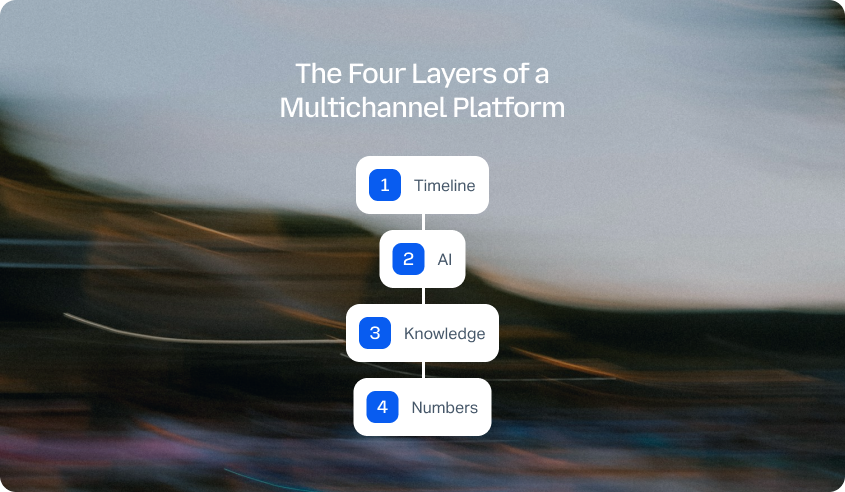
A unified inbox is the easy quarter of the job, and it's table stakes now. Every platform in this comparison can put email, chat, and social in one queue. That isn't what fragmentation means anymore.
Four things actually have to be unified, and most platforms manage one of them.
A platform that unifies layer one and leaves two, three, and four exactly where they were is a shared inbox with a routing engine. That's a useful product, and it isn't what the reader was sold when they added channels.
Each layer has its own cost when it stays fragmented. Layer 3 is the least obvious and the most expensive. When knowledge lives in three places, a policy change has to be made three times, and one of them gets missed, which is how a bot ends up quoting a returns window that changed last quarter. A shared self-service knowledge base should give agents, customers, AI, and self-service portals access to the same trusted information, with strong search functionality helping people find answers faster.
The same principle applies to the AI layer. Intelligent routing can direct customer inquiries based on intent and priority, while the strongest platforms keep that context available whether a customer contacts support during business hours or switches to another channel later.
“By month three, most teams have stopped asking whether their channels are connected. They already know the answer is no. The inbox looks unified, but the AI still only knows what happened on the channel it's sitting in, the knowledge base still has three versions of the same policy, and someone is still rebuilding last month's report in a spreadsheet. Consolidating the view was the easy part. Nobody warns you the hard part is still ahead.” — Radu Dumitrescu, Head of Presale & Digital Transformation at BlueTweak
AI on Voice: The Test Most Multichannel Platforms Fail
There's a fast way to check all four layers at once: ask any vendor whether their AI works on a phone call. Not whether they support voice as a channel, almost all of them do. Whether the AI does.
The answer is usually no, and the reason is structural rather than a gap someone forgot to close. Most support platforms grew out of ticketing, added chat, and sourced voice from a third party later. The AI layer was built on text, and voice arrived as an integration bolted on afterward. The automation stops at that boundary.
The consequence is the part nobody writes about. Voice is typically the highest cost per contact in the operation, and the channel where automation would pay back fastest. It's also the one the AI never reaches. Teams end up automating the cheap channel and staffing the expensive one, which is close to the opposite of what they were sold.
Three questions worth asking any vendor on this list:
- Does the AI resolve voice conversations end to end, or only transcribe them?
- Does it assist the agent live, during the call itself?
- How many languages does conversational voice cover, asked separately from the translation figure? Vendors tend to quote the bigger number.
BlueTweak's conversational AI covers 30+ languages, with real-time transcription and translation available separately across 100+ languages, agents replying in languages they don't speak. Speech recognition follows live calls to surface relevant information to the agent as the conversation happens, rather than after the fact.
See how voice support works when it's part of the same interaction model as every other channel. Book a demo and explore how a connected support operation can improve customer retention across the various channels your customers actually use.
What to Look for in a Multichannel Customer Service Solution
Each of these is a question worth putting to a vendor directly, not a feature to take their word for.
Channel coverage that names the surfaces. Ask which social and messaging surfaces are native rather than integrated through a third party. "Social" isn't an answer. A bad answer sounds like "yes, we do social." A good one names WhatsApp, Instagram, or whichever surfaces are actually built in.
Cross-channel continuity over time. Ask whether a call from three months ago surfaces when the same customer emails today. Bad: the agent starts from a blank thread. Good: the earlier case is visible before the agent types a word.
AI scope by channel. Covered above, and it's the criterion that separates this list more than any other.
One knowledge base, or three. Ask whether agent macros, bot answers, and the public help center draw from the same content, and what happens when a policy changes.
Reporting from one model. Ask whether cross-channel metrics are measured directly or calculated afterward from per-channel exports.
Which channels are in the price. Voice and social are the two most commonly gated. Entry tiers in this category run roughly $7 to $25 per agent per month, and almost none include the full channel set.
Multi-brand separation. Ask whether running two brands means two accounts. For franchise groups, retail groups, agencies, and BPOs, this decides the shortlist on its own.
Language coverage, as two numbers. Transcription and translation is one figure, conversational voice is another. A vendor quoting a single number is quoting the bigger one.
Agent experience. Ask how many tabs an agent has open on a normal day. It's a blunt question, and it's the most honest measure of unification there is.
How We Evaluated These Multichannel Customer Service Solutions
BlueTweak publishes this guide, and BlueTweak appears in the list below. We're not neutral, and we'd rather say so plainly in the first line than bury it in a footnote, especially since at least one other ranking of multichannel platforms currently in search results discloses paid placements within the page itself. No vendor paid for inclusion here, ours or anyone else's.
Rankings are based on vendor documentation, public pricing pages, and G2 and Capterra review summaries, reviewed in Q3 2026. Channel support, AI scope, and tier structures change frequently, tier structures especially, so treat this as a starting shortlist rather than a final answer. Verify current capability with a demo before committing to anything on it. Where pricing isn't published, we've written "Not published, verify with vendor" rather than estimating.
The BlueTweak Four-Layer Unification Test
To keep the comparison consistent, every product on this list is scored against the same framework: how much of the operation it actually unifies, not just how many channels it covers.
The timeline carries the lowest weight on purpose. A connected customer history used to be the differentiator in this category. In 2026, it's close to table stakes, most platforms here already get it right, so it's necessary but no longer decisive.
The AI layer carries three times that weight, because that's where the real gap sits. A platform can unify a customer's history perfectly and still run automation that only works on the channels it was built for first, usually text, rarely voice. That's what actually separates a unified platform from one that unified the easy parts.
Best Multichannel Customer Service Software at a Glance
If you're comparing 12 platforms, you shouldn't have to dig through every product page to work out which ones are worth a closer look. This quick comparison focuses on four practical buying criteria, including whether voice is genuinely native, how broadly AI is applied, whether the platform has a knowledge base, and who it's best suited to.
Pricing & feature disclaimer
Pricing, features, AI capabilities, integrations, and trial availability were verified from publicly available vendor information at the time of publication. Software platforms update their products frequently, so details may change after publication. We recommend confirming the latest pricing and feature availability with each vendor before making a purchasing decision.
This is the quick view, but the most important differences aren't always visible in a feature matrix. A platform can tick the boxes for voice, AI, and a knowledge base while still keeping those capabilities disconnected from the rest of the customer journey.
That's why the sections below apply the four-layer test to every solution, looking at the timeline, AI, knowledge, and reporting rather than simply counting features.
Want to see what a genuinely connected support operation looks like? Try BlueTweak free for 14 days, with no credit card required, and explore how email, voice, chat, and social can work from a single platform.
The 12 Best Multichannel Customer Service Solutions in 2026
With the four-layer framework in place, we can now apply the same test to the platforms themselves. The 12 solutions below are grouped according to how much they actually unify, rather than simply how many communication channels they support.
That distinction matters because a long channel list doesn't necessarily mean a connected customer journey. Some platforms bring the timeline, AI, knowledge, and reporting together, while others are particularly strong on one channel, one customer segment, or one part of the support operation.
Category 1: Unified Across All Four Layers
These platforms go beyond consolidating customer conversations. Their timeline, AI, knowledge, and reporting work from a shared foundation, with the strongest solutions extending AI into voice as well as digital channels.
1. BlueTweak: Best for Unified AI, Knowledge, and Reporting

BlueTweak brings email, voice, chat, WhatsApp, and Facebook Messenger into a single interaction timeline, with one AI layer, one Smart Knowledge Base, and one reporting model behind those interactions. The result is a single platform for managing customer interactions rather than separate tools for each communication channel.
- Timeline: BlueTweak connects customer contacts across channels in one interaction timeline, so an agent can see the history behind a customer inquiry even when that customer switches from one support channel to another. That continuity also persists over time, meaning a call in January can connect to an email in March with the earlier interaction still visible.
- AI in Voice: BlueTweak's AI applies across channels rather than operating as a separate chatbot or automation tool for each one. This includes conversational voice across 30+ languages, as well as real-time transcription and translation
The key distinction is voice. BlueTweak's conversational AI extends beyond text-based customer support, while real-time assistance can surface relevant information during live calls. That makes voice a useful test of whether the platform has actually unified its AI layer or simply added AI to its digital channels. - Knowledge: BlueTweak's Smart Knowledge Base acts as one verified source for agents, suggested replies, chat, and voice. Suggested replies are grounded in that approved content rather than generated freely, helping teams maintain consistent answers when policies, products, or processes change.
- Reporting: BlueTweak's reporting uses a single interaction model, allowing customer service operations to measure performance across channels rather than stitching together separate channel reports. Teams can track metrics such as response times, resolution, workload, SLAs, agent performance, and customer satisfaction across the wider operation.
Native voice, not resold: BlueTweak's voice capability is built around its proprietary softphone rather than a separate third-party voice product. That matters because the voice channel is part of the same interaction model as the rest of the platform, rather than sitting alongside it as a separate system.
Multi-brand support: BlueTweak can also support multiple brands or departments within a single instance, with reporting separated by brand. That's particularly useful for organizations running several customer-facing operations from one support function, without requiring a separate platform for every brand or department.
Limitation: BlueTweak is a smaller vendor than Zendesk, Salesforce, or Freshworks, with a smaller integration marketplace and fewer public case studies. If your evaluation is gated on app ecosystem breadth or a specific native connector, check the integration list first, and note that custom integrations are built quickly but are not the same as a native connector on day one. On security specifically, BlueTweak currently supports role-based access control, with SSO and MFA on the roadmap rather than shipped today. Teams with SSO or MFA as a hard requirement should confirm current status directly before committing.
Pricing: BlueTweak is priced at €65 per agent per month, with ticketing, omnichannel support, AI, workforce management, quality assurance, analytics, and APIs included in the subscription.
Want to see what the numbers could look like for your operation? Use the BlueTweak ROI Calculator to estimate the potential impact based on your own support operation.
“Most teams don't have a channel problem, they have a fragmentation problem. They've already invested in email, chat, voice, and social, but the real value comes when those interactions, the AI supporting them, the knowledge behind every answer, and the data used to measure performance all work from the same foundation. That's where we believe support teams can move from simply managing more channels to actually delivering a more connected customer experience.” — Radu Dumitrescu, Head of Presale and Digital Transformation, BlueTweak
BlueTweak in Action
Conectys, a global BPO, used BlueTweak to improve how its teams accessed customer data and managed reporting across its support operation. The implementation reduced data retrieval times by 30%, increased reporting efficiency by 40%, improved customer satisfaction scores by 35%, and reduced resolution times by 25%, demonstrating how connecting the underlying support operation can deliver benefits beyond simply consolidating communication channels.
Verdict: BlueTweak is one of the few platforms in this comparison that properly unifies the timeline, AI, knowledge, and reporting layers, including voice.
Want to see what your channels look like in one timeline, with one AI behind them? Book a BlueTweak demo or start a free 14-day trial with no credit card required.
2. Zendesk: Best for Broad Ecosystem and Mature Tooling

Zendesk is the category's default reference point, built around ticketing and expanded over the years into a full customer service suite covering email, chat, voice, and social messaging, backed by the largest integration marketplace on this list and its own AI layer.
- Timeline: Zendesk's Suite plans bring channels into a shared agent workspace with a unified customer view, and its ticketing and routing are mature enough that most teams have no complaints here. This is Zendesk's most consistently strong layer across tiers.
- AI in Voice: Zendesk AI Agents ship with every Suite plan for basic deflection, with a more capable Advanced tier priced separately on a per resolution basis. Voice specific AI capability, including generative AI on calls, sits on Zendesk's higher Enterprise tier rather than the entry Suite plans, so teams should confirm exactly which AI features apply to voice before assuming coverage matches what's advertised for chat and email.
- Knowledge: Zendesk's knowledge base powers both self service and AI Agents, with content reused across the help center, chat, and automated resolutions from a shared source. Zendesk's AI Agent defaults to the help center as its knowledge source, but can also be connected to Confluence, external websites, or other help centers, so whether it stays a single source of truth depends on how a team configures it.
- Reporting: Reporting improves meaningfully at higher tiers, with cross channel dashboards and more advanced analytics reserved for Professional and above. Teams comparing entry level Suite pricing against a fuller reporting picture often underestimate how much of that capability sits above the tier they're evaluating.
Limitation: The capability that makes Zendesk worth buying, meaning AI Agents with voice coverage, agent side Copilot, and advanced reporting, sits several tiers and several add ons above entry pricing. Copilot adds a separate per agent fee on top of the Suite plan, and AI Agent usage bills per resolution once the included allowance runs out.
Pricing: Zendesk Suite, the omnichannel offering, starts at roughly $55 per agent per month for Team, rising to $115 for Professional, with Enterprise priced on request, all based on annual billing. Voice and workforce tooling are separate add on bundles, and AI Agent usage bills per resolution on top. Verify current packaging directly with Zendesk, since tiers and add-on pricing shift frequently.
Verdict: Zendesk unifies the timeline and knowledge layers well, but the AI and reporting depth that make the multichannel promise real live in tiers most buyers don't budget for at signup.
3. Salesforce Service Cloud: Best for Operations Already Standardized on Salesforce

Salesforce Service Cloud extends Salesforce's CRM into customer service, giving teams already running Salesforce a service desk built on the same customer data, case history, and platform tooling as their sales and marketing operations.
- Timeline: Because Service Cloud shares a data model with the rest of Salesforce, the customer timeline benefits from context most standalone help desks can't match, including purchase history, prior sales interactions, and account data alongside support cases. This is Salesforce Service Cloud's clearest strength.
- AI in Voice: Salesforce's AI layer, Agentforce, doesn't unlock until the Enterprise edition, and it's billed separately from the seat price, either per conversation or through a consumption based Flex Credits model. Voice specific Agentforce actions draw credits at a higher rate than standard actions, and voice support itself runs through a separate Service Cloud Voice add on. Teams should model AI and voice costs on top of the edition price rather than assuming either is included.
- Knowledge: Salesforce Knowledge is available from the Enterprise edition up and can ground both agent facing answers and Agentforce responses in the same content, though teams on the cheaper Starter Suite or Pro Suite editions don't get access to it.
- Reporting: Reporting benefits from the same shared data model as the timeline, with dashboards that can pull in the wider customer record rather than just support metrics. This is genuinely strong for teams that already have Salesforce reporting practices in place.
Limitation: The multichannel benefit is largely conditional on already owning or committing to the wider Salesforce platform. Implementation is heavier and slower than most other products on this list, and Salesforce's AI economics mean a mid-sized team can end up paying several times its base license cost in Agentforce usage once AI is switched on at any real scale.
Pricing: Service Cloud editions run from roughly $25 per user per month (Starter Suite) up to around $175 for Enterprise and $350 for Unlimited, with a bundled Agentforce edition priced separately again at roughly $550. Verify Enterprise and Unlimited pricing directly with Salesforce.
Verdict: Salesforce Service Cloud offers real timeline and reporting depth on the back of the wider CRM, but its AI and voice costs scale sharply, and the platform only makes sense once you're already committed to Salesforce as your system of record.
Category 2: Unified Timeline and Knowledge, AI Strongest on One Channel
These platforms do a good job consolidating the agent view and maintaining customer or knowledge context, but their AI is more strongly associated with a particular channel or interaction type. The important distinction is where each platform's strengths actually apply, rather than treating all AI capabilities as equivalent.
4. Intercom: Best for Product-Led, In-App Customer Support

Intercom combines customer messaging, help desk functionality, AI support, and a knowledge base around an in-app customer experience. It's particularly well suited to SaaS companies where customers can get support directly inside the product.
- Timeline: Intercom connects customer conversations and user information in a shared workspace, giving agents context around previous interactions. Its customer record is strongest when support is centered on conversations taking place through Intercom's own messenger.
- AI in Voice: Intercom's Fin AI Agent is a major strength, particularly for automated customer support and self-service. It can use a company's knowledge to answer questions and hand conversations to human agents when needed. The limitation is that Intercom's strongest AI experience is closely tied to its messaging and digital support environment rather than providing the same depth of AI support across every channel.
- Knowledge: Intercom provides a knowledge base that can power both customer self-service and AI-generated answers. This gives teams a stronger shared knowledge layer than platforms where chatbot content, help center articles, and agent resources are maintained separately.
- Reporting: Intercom provides reporting across conversations, support performance, and AI interactions. However, teams with significant support volume outside Intercom's core messaging environment should look closely at how much of that activity is represented in the same reporting model.
Limitation: Intercom's product-led approach isn't ideal for every support operation. If a large proportion of your customers reach support by phone or email, its in-app messenger and AI strengths become less central to the customer journey.
Pricing: Intercom's entry plans (starting at $29 per seat/month) provide the core customer service platform, while AI Agent usage is priced separately (Fin is priced at $0.99 per outcome). Teams should factor AI resolution costs into the total cost rather than evaluating the subscription price alone.
Verdict: Intercom is a strong choice for digital-first support, but its AI advantage is less compelling when voice and other channels dominate the customer journey.
5. Freshdesk: Best for Budget-Conscious Teams Wanting Fast Setup
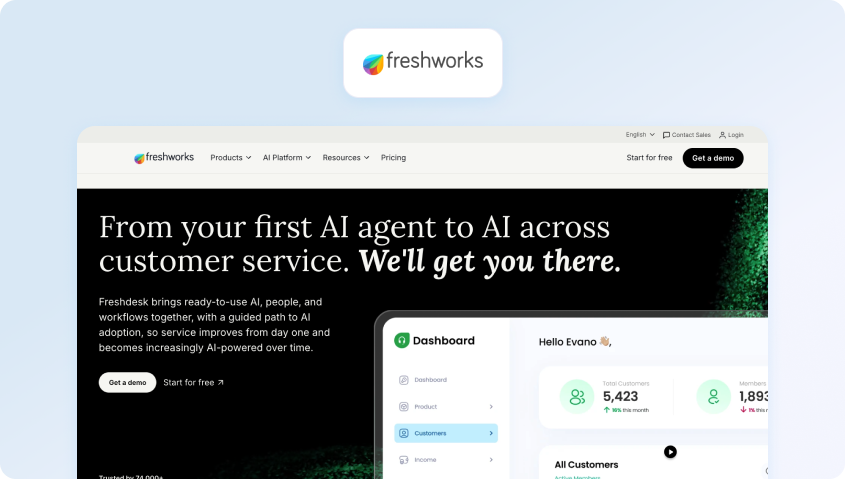
Freshdesk is a widely used customer support platform offering ticketing, automation, self-service, AI, and support across multiple communication channels. It's particularly attractive to teams that want to get a support operation running quickly without starting with the cost or implementation burden of an enterprise platform.
- Timeline: Freshdesk gives agents a centralized view of tickets and customer conversations, helping support teams manage interactions from multiple channels. However, voice is delivered through Freshcaller, so teams need to examine how their overall customer history is connected when interactions move between products.
- AI in Voice: Freshdesk's Freddy AI provides features including automated responses, ticket summaries, suggested replies, and AI-powered customer service. Its AI is increasingly integrated across the Freshworks ecosystem, but channel coverage and AI functionality vary by plan and product.
- Knowledge: Freshdesk includes a knowledge base for customer self-service and agent support, giving teams a central place to manage help content. This is one of the platform's stronger layers, particularly for teams that want to reduce repetitive support requests.
- Reporting: Freshdesk provides reporting and analytics for support performance, including metrics around tickets, agents, SLAs, and customer satisfaction. The potential fragmentation comes from the separate products used for different channels, particularly voice.
Limitation: Freshdesk's broad channel offering can involve separate Freshworks products, with voice handled through Freshcaller. That can make the underlying operation less unified than a platform where voice, digital channels, AI, and reporting all live in the same system.
Pricing: Freshdesk’s paid plans start at $15 to $19 per agent per month. Voice through Freshcaller is separately packaged, so teams should check the current plan and channel requirements rather than assuming the entry price covers every channel.
Verdict: Freshdesk offers a compelling low-cost starting point, but its channel architecture can leave some of the underlying operation fragmented.
6. Kustomer: Best for high-volume ecommerce customer timelines

Kustomer is a CRM-style customer service platform built around a persistent customer timeline. It's particularly suited to ecommerce and other high-volume operations where agents need a detailed view of customer history, orders, and previous interactions.
- Timeline: This is Kustomer's strongest layer. Kustomer's customer timeline brings conversations and customer information together, giving agents context across interactions rather than treating every support request as an isolated ticket.
- AI in Voice: Kustomer IQ provides AI-powered customer intent detection, self-service, and automation. Its strength is closely tied to understanding customer intent and using that information to support the service workflow, although teams should assess exactly which channels and AI capabilities are included in their chosen package.
- Knowledge: Kustomer supports knowledge-driven self-service and AI, helping customers find answers without always requiring a human agent. The knowledge layer is strongest when used alongside Kustomer's customer and intent data.
- Reporting: Kustomer provides reporting and analytics for support performance, customer service activity, and operational metrics. As with any platform in this category, teams should check whether the reporting they need is available across every channel and at their selected pricing tier.
Limitation: Kustomer doesn't offer a free trial, and costs can increase as support operations scale beyond the base package. That makes it particularly important to model expected customer volume and channel requirements before choosing it.
Pricing: Kustomer uses custom pricing models and as such, capabilities can be tailored to individual needs and requirements. Teams should confirm current channel, AI, and automation allowances before comparing the headline price with competitors.
Verdict: Kustomer's persistent customer timeline is a genuine strength, but its value is strongest for operations that can justify its cost at scale.
7. HubSpot Service Hub: Best for teams already running HubSpot
HubSpot Service Hub adds customer service capabilities to the wider HubSpot CRM platform, making it particularly attractive to companies that already use HubSpot for marketing, sales, and customer data. Its biggest advantage is continuity between those functions rather than customer support in isolation.
- Timeline: HubSpot's CRM provides a strong shared customer record, connecting service interactions with the wider history of a customer or prospect. This can give agents valuable context beyond the immediate support request.
- AI in Voice: HubSpot's AI capabilities support customer service tasks including conversation assistance, content generation, summarization, and automation. However, teams should distinguish between AI available across the HubSpot platform and capabilities specifically designed for customer-facing support.
- Knowledge: Service Hub includes a knowledge base that can support customer self-service, while HubSpot's wider content ecosystem can provide additional context. This gives teams a strong foundation for keeping customer-facing information connected to the broader CRM.
- Reporting: HubSpot provides service reporting around tickets, SLAs, customer feedback, team performance, and other support metrics. The broader CRM context is an advantage, although some advanced reporting and service functionality sits behind higher tiers.
Limitation: HubSpot's pricing can jump significantly between tiers, and teams requiring channels such as SMS may need third-party integrations. That means the attractive entry point doesn't necessarily represent the cost of the full multichannel customer service operation.
Pricing: HubSpot offers Service Hub across multiple tiers (including a free tier), with more advanced automation, reporting, and customer service capabilities reserved for higher plans (paid plans start at $7 per month/seat). Teams should also account for the cost of additional seats, usage, and third-party channel integrations when calculating the real total.
Verdict: HubSpot Service Hub is particularly compelling when the rest of your customer data already lives in HubSpot, but the economics become less attractive as advanced service requirements grow.
Category 3: Deep on a Channel or a Segment
Not every strong customer service platform needs to be equally broad. These solutions are particularly compelling when their strongest channel or customer segment matches your operation, even if they don't provide the same level of cross-channel unification.
They're also where shared inbox software naturally enters the comparison. For some teams, a genuinely collaborative inbox is more valuable than paying for a broader platform with capabilities they don't need.
8. Gorgias: Best for Shopify-First E-Commerce Customer Support
Gorgias is a helpdesk built around e-commerce, with deep Shopify integration that surfaces order context inside every ticket and automation designed around e-commerce-specific requests like order status, returns, and subscription changes.
- Timeline: Gorgias unifies email, chat, and social conversations in one inbox, with order data pulled in from Shopify so agents aren't switching tools to check a purchase.
- AI in Voice: Gorgias AI Agent handles automated resolutions as a separate add-on, billed per resolution on top of the base plan.
- Knowledge: A knowledge base is available for self-service, though it's a secondary layer compared to the ecommerce-specific automation that's the product's real strength.
- Reporting: Gorgias includes Revenue Statistics from the Pro plan up, tying support activity directly to sales impact, which is a genuinely useful angle for ecommerce specifically. Below Pro, reporting is more basic and doesn't carry that revenue lens.
Limitation: Voice and SMS are priced as usage-based add-ons whose exact rates aren't published on Gorgias's pricing page, and AI Agent resolutions bill separately once you exceed your plan's allowance. Brands running meaningful voice or SMS volume should get exact figures in writing before committing, since third-party estimates put both well above the sticker price at scale.
Pricing: Plans run from around $40 per month (Starter, 50 tickets) through Basic (roughly $77 per month for 300 tickets), Pro (around $471 per month for 2,000 tickets), and Advanced (around $1,227 per month for 5,000 tickets), with custom Enterprise pricing above that. Voice, SMS, and AI Agent usage are all billed on top.
Verdict: Gorgias is the strongest e-commerce-specific option on this list, but its per-ticket pricing model and gated voice and SMS mean the real cost climbs fast for brands with genuine omnichannel volume.
9. Front: Best for collaborative shared inbox workflows
Front is shared inbox software built around email collaboration, meaning assignment, internal comments, and shared drafts inside a familiar inbox layout, rather than a broader multichannel platform trying to unify voice, AI, and reporting across channels.
- Timeline: Front connects conversations within its shared inboxes well, but it doesn't build the kind of persistent, cross-channel customer base history that a CRM-style timeline does. The strength is team coordination on a thread, not a unified customer record over time.
- AI in Voice: Autopilot (automated resolution) and Copilot (suggested replies) are available as paid add-ons on the Starter and Professional plans, and included by default on Enterprise. Autopilot bills separately per resolution.
- Knowledge: A basic internal knowledge base is available from the Growth tier up, mainly to support agents rather than power a broader AI layer.
- Reporting: Front provides analytics on response times, volume, and team performance, with more advanced reporting reserved for higher tiers. Since Front's model is per-inbox rather than a unified interaction record, reporting reflects team activity well but doesn't build toward the kind of cross-channel metric BlueTweak and the category leaders offer.
Limitation: Front's model is rooted in email and messaging, and native telephony isn't part of the product, so voice and AI reach across channels aren't what you're buying here.
Pricing: Starter runs around $25 per seat per month and is limited to a single channel type, Professional is around $65, and Enterprise is around $105, all billed annually.
Verdict: Front is shared inbox software, not a multichannel platform, so voice and AI across channels were never the product. If a genuinely good collaborative email experience is what you actually need, it's one of the best in the category.
10. Help Scout: Best for Small Teams Prioritizing Simplicity

Help Scout keeps things clean and human, a support-focused shared inbox paired with a genuinely solid knowledge base, and it stays deliberately simpler than its broader helpdesk peers.
- Timeline: Conversations from email, live chat, and social channels like Messenger and Instagram sit in one shared inbox, with WhatsApp added at the Plus tier. There's no voice channel, so the timeline stops at digital channels.
- AI in Voice: AI Answers resolves customer questions from the knowledge base, billed at roughly $0.75 per resolution after a trial period. AI Drafts and Summarize are reserved for the Plus tier and above.
- Knowledge: Docs, Help Scout's knowledge base, is one of the platform's genuine strengths, powering both self-service and agent-facing answers from the same content. This is shared inbox software done well, with the knowledge layer doing real work rather than sitting on the side.
- Reporting: Basic reporting is available on the Standard tier, with more detailed metrics and customization added at Plus and Pro. It's serviceable for a small team's needs, but not built for measuring performance across a channel mix broader than email, chat, and social.
Limitation: No native voice channel at all, and automation is limited on the entry Standard tier. WhatsApp and more advanced routing require the Plus plan.
Pricing: A free plan covers up to 5 users, the Standard plan runs at $25 per user per month, Plus around $45, and Pro around $75, all billed annually. AI Answers are billed separately at $0.75 per resolution.
Verdict: Help Scout is shared inbox software done right for small teams, but the lack of a voice channel and the automation ceiling on lower tiers mean it stops scaling right where this comparison's four-layer test starts to matter.
11. LiveAgent: Best for Broad Channels at Low Cost

LiveAgent packs ticketing, live chat, native voice, and social channels into one plan at one of the most aggressive price points in this comparison.
- Timeline: LiveAgent brings email, chat, calls, and social messages into a single unified inbox, and reviewers consistently praise its departmental routing and workload distribution.
- AI in Voice: An AI chatbot and AI answer assistant are included on every plan tier, though the depth is basic compared to purpose-built AI layers elsewhere on this list.
- Knowledge: A built-in knowledge base is available across plans.
- Reporting: Basic reporting is available across every plan, but advanced analytics and call monitoring features, like supervisor dashboards, are gated to higher tiers and need additional configuration to set up.
Limitation: Multiple recent reviews cite user interface complexity and an aging, occasionally overwhelming feature set, along with a mobile app that lags the category. Additional social channels are priced on top of the base plan, which narrows the price advantage faster than the entry price suggests.
Pricing: Promotional pricing plans start at $10 per agent per month, with the full call center (voice, IVR, SLA rules) available from the Medium plan ($19 per agent per month), Large running at $33 per agent per month, and Enterprise at $46 per agent per month. Prices normally range from $15 (or $19 monthly) for Small, to $69 (or $85) for Enterprise.
Verdict: LiveAgent is one of the cheapest ways to get broad channel coverage including voice, but the interface and mobile experience lag the category leaders, and add-ons close the price gap faster than the sticker suggests.
Category 4: Genuinely Multichannel, and Priced Accordingly
These platforms offer a broad range of communication channels, but those channels can operate more independently than they do in the leading platforms above. That's not automatically a problem: for some teams, broad coverage at a competitive price is exactly the trade-off they're looking for.
12. Zoho Desk: Best for Teams Already Using Zoho

Zoho Desk is part of Zoho's wider software suite, connecting to Zoho CRM, Zoho SalesIQ, and Zoho Analytics for teams that already run their business on Zoho, and it undercuts most of this list on price at every comparable tier.
- Timeline: Conversations across email, chat, social, and phone are consolidated into one workspace, and CRM context from the wider Zoho suite adds depth for teams already inside that ecosystem. Cross-channel unification here is more modest than the category leaders above.
- AI in Voice: Zia, Zoho's AI assistant, provides sentiment detection, ticket categorization, and automated replies, but it's reserved for the Enterprise tier rather than included from entry pricing.
- Knowledge: A multilingual knowledge base is available, though reviewers consistently note that Zoho Desk's reporting and analytics lack the depth and flexibility of rivals on this list.
- Reporting: Zoho Desk includes real-time dashboards and customizable reporting, and ties into Zoho Analytics for teams already in that ecosystem. That said, this is one of the more consistently flagged weak points in reviews, reporting and analytics are repeatedly described as lacking the depth and flexibility of category leaders.
Limitation: Reporting and analytics lack depth compared to competitors, the interface has a steep learning curve, and several advanced features, including Answer Bot and sentiment AI, are gated to the $40 per agent Enterprise tier. Telephony and multi-department support don't arrive until the Professional tier either.
Pricing: A free plan covers up to 3 agents, then Express runs around $7 per agent per month, Standard around $14, Professional around $23, and Enterprise around $40, all billed annually.
Verdict: Zoho Desk offers broad channel coverage at the lowest price on this list, but cross-channel context and unified reporting are weaker than the leaders, and the value case depends heavily on already running the wider Zoho suite.
How Much Should Multichannel Customer Service Software Cost?
Published entry prices for customer service software typically start between $7 and $25 per agent per month, but the cost of a genuinely multichannel setup can be considerably higher once you include voice, social channels, AI, and other advanced capabilities. Almost none of the entry tiers in that range include the full channel set.
The problem is that entry tiers often cover only a subset of the channels you need. Voice and social support are among the channels most commonly gated behind higher plans or separate products, meaning the platform you thought would consolidate your support channels can still leave important parts of the operation fragmented.
AI is another common paywall. Some platforms include basic automation in their entry plans but reserve more advanced AI, AI agents, conversation intelligence, or higher usage limits for more expensive tiers or separate add-ons. The automation layer is important though as it is one of the things that can make multichannel customer service more efficient in the first place.
For a realistic comparison, don't multiply the entry price by your number of agents and stop there. Instead, model the tier that includes your actual channel mix and the AI capabilities you need, multiply that by your seats, then add any separate costs for voice, social, AI usage, additional contacts, or other required features.
For example, if you need email, chat, social, and phone support, the cheapest plan that supports email and chat isn't your real cost. Your real cost is the plan that includes all four channels, plus the AI required to automate or assist those interactions.
That makes the multi-channel help desk price less about the advertised per-agent figure and more about what's actually included in the seat price.
For many teams, the biggest cost isn't the initial setup. It's paying separately for voice, social, AI, and the channel-specific training needed when agents have to learn multiple interfaces.
Why Teams Choose BlueTweak

More channels don't automatically mean better customer service. The teams that see the biggest operational gains are the ones that connect those channels to the context, knowledge, AI, and reporting that sit behind every interaction.
Faster Resolutions
Agents have the customer's history and interaction context in front of them when they open a conversation, reducing the need to search across systems or ask customers to repeat information.
Customers Stop Repeating Themselves
A connected interaction timeline means a conversation doesn't become a new thread every time a customer moves from email to chat or voice.
Agents Stop Switching Tabs
Email, voice, chat, WhatsApp, and Facebook Messenger can be managed from a single workspace, keeping agents focused on the customer interaction rather than navigating between channel-specific tools.
Numbers You Can Act On
Reporting is based on a single interaction model rather than disconnected per-channel exports, giving customer service operations a clearer view of trends, performance, and where customers are encountering friction.
See every channel in one timeline, with one AI behind them. Book a BlueTweak demo or start a 14-day free trial , no credit card required.
Which Multichannel Customer Service Solution Is Right for You?

There's no single best platform for every support operation. The right choice depends on the channels your customers actually use, the systems your team already has in place, and how much of the underlying customer service operation you need to unify.
- Need AI, knowledge, timeline, and reporting unified across channels, including voice? Choose BlueTweak.
- Need the broadest ecosystem and mature enterprise tooling? Choose Zendesk.
- Already standardized on Salesforce? Choose Salesforce Service Cloud.
- Already running HubSpot? Choose HubSpot Service Hub.
- Support happens primarily inside your product? Choose Intercom.
- Running a Shopify-first ecommerce operation? Choose Gorgias.
- Want genuinely strong shared inbox software? Choose Front.
- Prioritize simplicity for a small support team? Choose Help Scout.
- Want broad channel coverage at the lowest cost? Choose LiveAgent or Zoho Desk.
But there's a bigger lesson in the comparison.
If you've already consolidated your communication channels and the customer experience still feels fragmented, the channels probably aren't the problem. You've unified one layer, but the AI, knowledge, and numbers behind those interactions may still be operating independently.
That's why the most revealing question isn't how many channels a support platform supports. It's whether its AI works when a customer picks up the phone. A strong AI voice experience should feel like part of the same customer conversation, with low response latency that keeps interactions flowing naturally, natural conversation quality that makes automated support feel usable, and speech recognition that can handle various accents and background noise without losing context.
A customer shouldn't have to explain the same problem again because they changed channels. An agent shouldn't have to switch between five systems to understand what happened. And a support leader shouldn't have to stitch together separate reports to understand the customer journey.
You were told to add channels, so you added channels. If the promised improvement didn't arrive, that isn't necessarily a failure of execution. It's what happens when one layer of the operation is unified and three aren't. The platforms worth considering are the ones that connect voice, chat, email, and messaging with the same AI, knowledge, and reporting, using modern speech recognition and natural-sounding speech synthesis to make conversations feel consistent across every channel.
Want to see what that looks like in practice? Book a BlueTweak demo and see how every channel can work from one timeline, with one AI behind them.
12 Best Conversation Intelligence Platforms to Consider in 2026
If you are responsible for support quality, there is a good chance you already know you have a visibility problem. Your team handles hundreds, thousands, or even tens of thousands of customer interactions across voice, email, chat, and messaging. Yet when someone asks why CSAT moved, why repeat contacts are increasing, or where agents are struggling, the answer often comes from reviewing a handful of conversations by hand.
That isn’t really conversation intelligence; it’s conversation sampling. The problem becomes more serious as customer expectations rise. PwC's 2025 Customer Experience Survey found that 70% of executives believe customer expectations are evolving faster than their organizations can adapt. The same research found that 29% of consumers had stopped using or buying from a brand because of poor customer experience.
You therefore need to know more than whether an individual interaction went well. You need to see patterns across the customer conversations your team is actually handling: which topics are driving contacts, where sentiment is deteriorating, whether agents are following the right processes, and what is changing from one week to the next. That is where conversation intelligence software comes in.
For support teams, BlueTweak takes a different approach from the traditional analytics layer. Conversation intelligence is part of the same platform handling voice, email, chat, WhatsApp, and Facebook Messenger, with the interaction history and reporting held in one system. That means the analysis is connected to the conversation itself rather than requiring a separate analytics system to ingest it.
But BlueTweak is not the right shape of product for everyone. If you are committed to your existing CCaaS or help desk and simply want to add conversation analytics, a specialist platform may make more sense. The important thing is understanding which type of conversation intelligence platform you are actually buying.
Why Support Teams Need Conversation Intelligence in 2026
Customer support generates huge amounts of information about what customers want, what frustrates them, and where the experience breaks down. The problem is that most teams cannot review enough interactions manually to turn that information into a reliable operational picture.
A QA lead might review a handful of calls or tickets each week, identify a few coaching opportunities, and use those findings to make decisions about the wider operation. But that sample can easily miss emerging topics, changing sentiment, inconsistent handling, or recurring issues buried across thousands of customer interactions.
This is why conversation intelligence goes beyond call recording or meeting notes. Its value lies in turning conversation data into actionable insights across customer experience, quality assurance, coaching, and operational efficiency.
For support leaders, AI adds another layer to the challenge. It can help teams handle more interactions, but you still need visibility into what is happening inside those interactions.
The difference is coverage. Traditional QA tells you what happened in the interactions someone selected for review. Conversation intelligence can show you what is happening across the wider operation.
| Traditional QA approach | Conversation intelligence approach |
|---|---|
| Review a small sample of interactions | Analyze interactions at scale |
| Find issues you already know to look for | Surface recurring topics, trends, and patterns |
| Rely on individual reviews to identify coaching needs | Use conversation insights to target coaching where it matters |
| Make assumptions about the wider operation | Make decisions using a broader view of customer interactions |
That broader view is what makes conversation intelligence useful. But before you choose a platform, you need to understand what kind of conversation intelligence you are actually buying.
Not every product marketed as conversation intelligence is designed for support.
What Is Conversation Intelligence Software?
Conversation intelligence software captures and transcribes customer conversations, then uses natural language analysis to identify patterns and surface insights that would be difficult to find through manual review. Depending on the platform, this can include sentiment, topics, intent, quality scores, coaching signals, and conversation trends across voice and digital channels.
Modern conversation intelligence platforms typically bring together several capabilities:
- Conversation capture: Records or ingests customer interactions across supported channels.
- Diarized transcription: Converts conversations into text while distinguishing between speakers.
- Topic and intent analysis: Identifies what customers are contacting you about, including topics you may not have explicitly configured.
- Sentiment analysis: Detects sentiment at the interaction level and helps identify broader changes in customer sentiment over time.
- Automated quality evaluation: Applies defined criteria to conversations so teams can evaluate more interactions without relying entirely on manual QA.
- Actionable insights: Turns conversation data into coaching opportunities, quality signals, trends, and other information that can feed operational workflows.
The important distinction is between conversation intelligence software and tools that simply record or transcribe interactions. A transcript gives you a searchable record. Conversation intelligence analyzes that record to help you understand what happened and identify patterns across customer interactions.
Coverage matters, too. A system that analyzes every interaction gives you a fundamentally different view from one that analyzes only the calls or tickets selected for manual review. The more conversations a platform can analyze across your operation, the more useful its conversation insights become.
This guide focuses specifically on software that analyzes conversations that have already happened. It does not cover conversational AI builders such as Dialogflow, Rasa, or Kore.ai, which are designed to build AI-powered customer interactions, or "conversational intelligence" as a human communication and coaching methodology.
That distinction becomes important because the same terminology now covers several very different types of software.
How Conversation Intelligence Got Here, and Why Some Tools Are Still Stuck
Conversation intelligence did not start with AI. The category has evolved through several stages, and some products marketed as modern conversation intelligence software still rely heavily on techniques from earlier generations.
Call recording came first. It gave contact centers a record of customer interactions that managers could retrieve when they needed to investigate a complaint, review an agent's performance, or check what was said. But recording alone does not tell you what is happening across thousands of conversations.
Speech analytics added transcription and search. Historically, these systems relied heavily on keyword spotting and phonetic indexing to find specific terms or phrases in voice recordings. That made it faster to locate known issues, but created an obvious limitation: you could only reliably find what you had already thought to search for.
Conversation intelligence added natural language processing and natural language understanding to the transcript, making it possible to identify sentiment, intent, topics, and other signals rather than simply storing a written record of the conversation. Instead of simply asking whether a particular word appeared, teams could analyze sentiment, identify topics and behaviors, and connect conversation patterns to outcomes such as quality scores or sales performance.
Then came the LLM era. Modern conversation intelligence products can use configurable analysis pipelines, generated summaries, evidence-linked scoring, and analysis across digital channels as well as voice. The result is less about searching recordings and more about turning large volumes of conversation data into operational insight.
But not every product has made that leap.
A useful test is simple: ask whether the platform can surface a topic you never configured it to look for. If it can only identify predefined words, phrases, or rules, you are looking at a form of speech analytics rather than the broader capabilities associated with modern conversation intelligence.
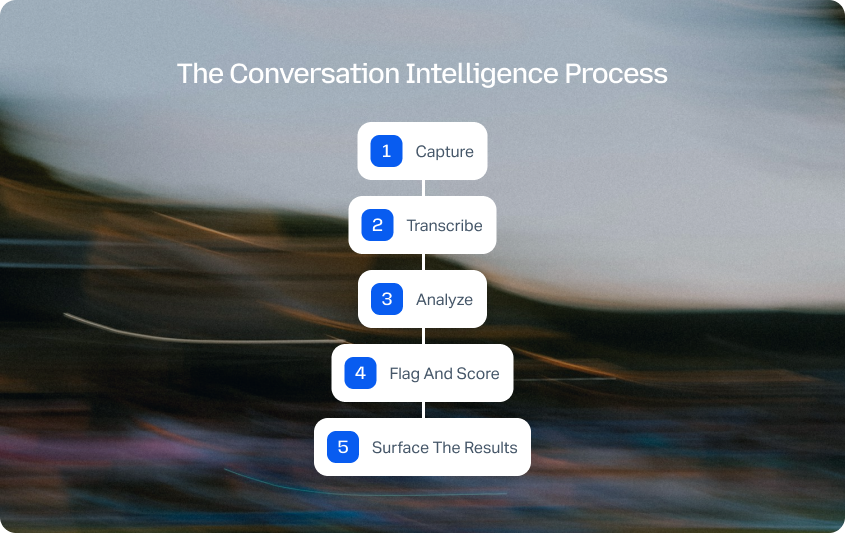
At a high level, the process looks like this:
- Capture the customer interaction.
- Transcribe it with speaker separation.
- Analyze the conversation for sentiment, topics, intent, and behavior.
- Flag and score relevant interactions against defined criteria.
- Surface the results in a workflow where managers and agents can act on them.
The technology has changed considerably. The operational question has not: can the system turn the conversations your team is already having into information you can actually use?
Best Conversation Intelligence Software at a Glance
Disclosure: BlueTweak publishes this guide and is included in the list. No vendor paid for inclusion. We reviewed vendor documentation, published pricing where available, and independent review sources. Not every platform was trialed live, and pricing and product capabilities can change, so verify current details with the vendor before making a purchase decision.
There is no single best conversation intelligence software for every organization. The right choice depends on where your conversations happen, how much of that interaction volume you need to analyze, and whether you want conversation intelligence as a separate analytics layer or as part of the platform already handling customer interactions.
The table below gives you the shortlist at a glance. We have deliberately included both support and sales products because they frequently appear together in searches for the best conversation intelligence platforms, but they solve different problems.
| Tool | Built for | Layer or platform | Best for |
|---|---|---|---|
| BlueTweak | Support, omnichannel | Platform | Teams that want conversation intelligence native to the system handling their customer conversations |
| Dialpad | Support and sales voice | Platform | Teams wanting real-time voice intelligence built into their phone system |
| Zendesk QA | Support QA | Layer, Zendesk-first | Zendesk teams adding automated QA without leaving their existing suite |
| Observe.AI | Contact centers | Layer | Automating quality assurance across voice and digital interactions at scale |
| Level AI | Contact centers | Layer | Combining conversation analytics and automated QA in one specialist platform |
| CallMiner | Regulated contact centers | Layer | Compliance analytics, root cause analysis, and large-scale conversation analysis |
| Cresta | High-conversion inbound teams | Layer | Real-time agent guidance and conversation intelligence tied to operational outcomes |
| Balto | Live-call support | Layer | In-the-moment guidance, prompting, and compliance checks during customer calls |
| Verint | Enterprise workforce engagement | Layer | Adding conversation analytics to existing contact center infrastructure |
| NICE Enlighten | Enterprise CCaaS | Layer, NICE-native | Organizations already standardized on NICE CXone |
| Gong | Sales and revenue teams | Layer | Deep sales call analytics, coaching, and revenue intelligence |
| Avoma | Sales and revenue teams | Layer | Meeting intelligence, coaching, and customizable scorecards for revenue teams |
Layer vs. platform: A layer analyzes conversations imported from another system, while a platform already handles the customer interaction itself. That distinction matters because it affects integrations, data flow, workflow, and where conversation insights ultimately appear.
The BlueTweak Conversation Intelligence Scoring Rubric
To make the comparison more useful than a feature-counting exercise, we evaluated each platform against eight criteria:
| Criterion | Weight | What we looked for |
|---|---|---|
| Analysis coverage | 25% | Automated analysis across interactions rather than only a sampled QA queue |
| Channel scope beyond voice | 15% | Voice, email, chat, and messaging analyzed within the same interaction model |
| Real-time assist | 15% | Live speech recognition and guidance surfaced to agents during conversations |
| Where the insight lands | 15% | Insights appear in the same system and reporting model as the interaction, rather than requiring a second console |
| Time to value | 10% | Useful output within days or weeks without requiring a manual taxonomy build first |
| Language coverage | 10% | Transcription and analysis beyond English, with a clearly stated language count |
| Pricing transparency | 5% | Published pricing and clear explanation of whether analysis is metered separately |
| Security and compliance | 5% | Capabilities such as PII redaction, SOC 2 Type II, role-based access controls, and audit logs |
Pricing & Feature Disclaimer
Pricing, features, AI capabilities, integrations, and trial availability were verified from publicly available vendor information at the time of publication. Software platforms update their products frequently, so details may change after publication. We recommend confirming the latest pricing and feature availability with each vendor before making a purchasing decision.
The weighting reflects the priorities of a support operation rather than a sales organization. Coverage receives the highest score because conversation intelligence is only as useful as the conversations it can actually analyze. A platform with sophisticated AI that sees only a fraction of your customer interactions may tell you less about the operation than a simpler system with much broader coverage.
The same principle applies throughout the comparison. A real-time coaching feature may be valuable for a contact center focused on live calls, while multilingual analysis or omnichannel coverage may matter more to a support operation handling customers across markets and channels.
The result is a comparison designed to answer a practical question: which conversation intelligence solution is best suited to the way your support operation actually works?
The 12 Best Conversation Intelligence Platforms in 2026
The best conversation intelligence platforms are not interchangeable. Some are complete customer support platforms with conversation intelligence built in, while others are specialist analytics layers that sit alongside an existing contact center or help desk.
That distinction matters. A support leader looking to understand thousands of customer interactions has different requirements from a sales leader analyzing a handful of sales calls each week.
To make the differences clearer, we have grouped these conversation intelligence software tools into four categories: support platforms with conversation intelligence built in, specialist contact center conversation intelligence and auto-QA tools, enterprise workforce engagement suites, and sales and revenue conversation intelligence platforms.
Category 1: Support Platforms With Conversation Intelligence Built In
These platforms combine conversation intelligence with the systems used to manage customer interactions. Instead of adding a separate analytics layer to your existing stack, conversation data, transcripts, quality assurance, and operational reporting are part of the wider support environment.
That can reduce integration work and give support leaders a more connected view of customer interactions, particularly when conversations span multiple channels.
1. BlueTweak: Best for Support Teams That Don't Want a Second System
BlueTweak is a customer support platform with conversation intelligence built into the wider CX operation, rather than a standalone analytics layer. It handles customer interactions across voice, chat, email, and social messaging, then connects transcripts, summaries, quality assurance, analytics, and customer context to the same interaction record.
That connected approach also means conversation insights can feed into other support workflows, rather than sitting in a separate analytics dashboard. For example, Proposed Reply can use the context already available from the customer interaction to help agents draft relevant responses, giving teams a practical way to turn conversation intelligence into action.
Key conversation intelligence features
- Conversation coverage: BlueTweak automatically transcribes calls and chats across 100+ languages, with speaker-labeled transcripts linked directly to the interaction timeline and customer profile.
- Analysis and QA: Transcripts feed into AI summaries and structured quality evaluations, allowing QA teams to work from the actual conversation rather than reconstructed notes. BlueTweak's QA platform also connects quality findings with metrics such as AHT, FCR, and CSAT.
- Where insights land: BlueTweak builds analytics and reporting on the same interaction data used to manage support, with real-time dashboards covering email, chat, voice, and social interactions.
- Omnichannel advantage: BlueTweak treats conversations across voice, chat, email, and social messaging as part of one interaction model, rather than requiring separate analysis for each channel.
Pricing: BlueTweak publicly lists pricing from €65 per agent per month, including email, chat, voice, social messaging, analytics, QA, WFM, and other core capabilities. AI features and usage terms can be checked against the current pricing page before purchase
“Support leaders don't need another dashboard telling them what happened in a handful of conversations, they need a reliable view of what is happening across the customer interactions they are responsible for. When conversation intelligence sits inside the platform handling those interactions, insights can connect directly to quality, customer experience, and operational decisions, rather than becoming another report someone has to interpret and act on.” — Radu Dumitrescu, Head of Automation & Digital Transformation, BlueTweak
Where BlueTweak fits best: Support teams that want conversation intelligence to arrive with their customer support platform rather than adding another analytics console, particularly where multiple channels, languages, brands, or operational teams make fragmented systems harder to manage.
Where it falls short: BlueTweak is best suited to teams evaluating their wider support platform rather than organizations that only want to bolt conversation analytics onto an existing CCaaS deployment. If your current infrastructure is fixed and working well, a specialist conversation intelligence layer may require less platform change.
BlueTweak in action: Global outsourcing provider Conectys needed to consolidate data from different systems, improve reporting, give clients better access to information, and improve the efficiency and quality of its support operation. Conectys implemented BlueTweak to centralize those workflows and provide a more connected operational view.
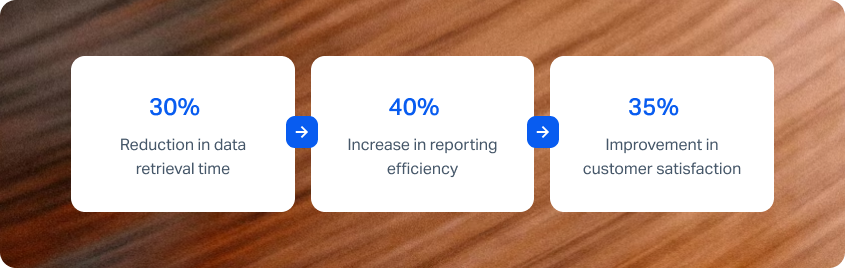
The implementation also delivered a 25% reduction in resolution times, demonstrating how better visibility and connected support workflows can translate into measurable operational improvements.
Customer: Conectys, global BPO and outsourcing provider
Challenge: Consolidating data, improving reporting, increasing operational efficiency, and maintaining customer and agent satisfaction across complex support operations.
Results: Faster data retrieval, more efficient reporting, higher customer satisfaction, and shorter resolution times.
Verdict: Best for support teams that want conversation intelligence native to the platform handling their customer conversations. BlueTweak's main differentiator is not simply automated analysis. It is the connection between the conversation, transcript, QA process, customer data, and operational reporting in one system.
Want to see what’s actually inside your own conversations? Book a personalized BlueTweak demo or start a 14-day free trial , no credit card required.
2. Dialpad: Best for Voice-Centric Teams Wanting Real-Time Intelligence

Dialpad takes a platform approach to conversation intelligence, with AI capabilities built into its communications and contact center products. Its support offering combines voice infrastructure with AI-powered transcription, sentiment analysis, contact center analytics, and other tools, making it particularly relevant for organizations where voice remains a major part of the support operation.
Key conversation intelligence features
- Real-time transcription: AI-powered transcription and conversation analysis are built into Dialpad's communications environment.
- Sentiment analysis: Dialpad can analyze customer sentiment and conversation trends.
- Contact center analytics: Support teams can use AI-powered analytics alongside their contact center workflows.
- AI assistance: Dialpad also offers AI agents and other automation capabilities across voice and digital channels.
- Platform approach: Conversation intelligence sits within the wider communications and contact center platform rather than operating as a separate analytics layer.
Pricing: Dialpad publishes pricing for its support and communications products, with current pricing varying by plan, billing arrangement, and region. Plans start at $80 per user per month for the Essentials Plan.
Best fit: Support organizations that want voice infrastructure, AI assistance, transcription, and analytics within the same communications platform.
Where it falls short: Dialpad's conversation intelligence has strong voice roots. Teams where email, chat, and messaging represent a significant share of customer interactions should verify that its current channel coverage matches their requirements.
Verdict: A strong option for voice-centric support teams that want real-time conversation intelligence built into their communications platform.
3. Zendesk Quality Assurance: Best for Zendesk teams Adding Automated QA Without Leaving the Suite
Zendesk Quality Assurance is designed to automate interaction reviews within the Zendesk environment. Zendesk says its QA product can use AI to automate review of 100% of tickets, giving teams broader quality coverage than traditional manual sampling.
Key conversation intelligence features
- Automated QA: AI can evaluate interactions against defined quality criteria.
- Interaction coverage: Automated evaluation can extend quality monitoring across a much larger proportion of interactions than manual review alone.
- Quality dashboards: Teams can monitor scores and pass rates to identify quality issues and coaching opportunities.
- Zendesk integration: QA operates within the wider Zendesk customer service environment.
Pricing: Zendesk QA pricing is not presented as a simple standalone conversation intelligence subscription; is an optional add-on layer that must be purchased on top of your core plan. Add-on pricing for QA starts at $35 per agent per month.
Best fit: Existing Zendesk customers whose primary requirement is automated quality assurance without introducing a separate specialist platform.
Where it falls short: Zendesk QA is primarily a quality assurance capability within the Zendesk ecosystem rather than a standalone conversation intelligence platform. Teams looking for deeper cross-channel conversation analytics should compare the wider capabilities carefully.
Verdict: A logical choice for Zendesk-first teams that want to automate QA without adding another support platform.
Category 2: Specialist Contact Center Conversation Intelligence and Auto-QA
Specialist platforms take a different approach. They are designed to sit on top of existing contact center infrastructure and add conversation analytics, automated quality assurance, coaching, compliance monitoring, or real-time assistance.
This can be attractive when your CCaaS is already established and replacing it is not on the table. The trade-off is that conversation intelligence becomes another layer in the technology stack.
4. Observe.AI: Best for Automating Quality Assurance Across Voice and Digital at Scale

Observe.AI is a specialist contact center intelligence platform focused on conversation intelligence, automated quality assurance, agent coaching, and compliance. Its platform can analyze customer interactions across channels and automatically score conversations against quality and compliance criteria. Observe.AI says its systems can analyze 100% of interactions, with capabilities including intent detection, sentiment analysis, automated QA, and PII redaction.
Key conversation intelligence features
- Automated QA: Observe.AI can apply configurable quality criteria across interactions rather than relying on a small manually selected sample.
- Conversation analysis: Observe.AI analyzes intent, sentiment, behaviors, and compliance signals, giving QA teams more context than keyword search alone.
- Compliance: Automatic PII redaction and compliance monitoring are particularly relevant to regulated contact centers.
- Deployment: Observe.AI is a specialist layer, so it works alongside existing contact center infrastructure rather than replacing it.
Pricing: Observe.AI does not publicly publish this information. Pricing should be confirmed directly with the vendor and evaluated against interaction volume, users, integrations, and implementation requirements.
Best fit: Contact centers that want automated QA and conversation intelligence while retaining their existing CCaaS infrastructure.
Where it falls short: As a specialist layer, Observe.AI introduces another system alongside the platform already handling customer interactions. Teams should also evaluate implementation requirements and the effort involved in configuring custom scorecards.
Verdict: A strong specialist option for contact centers looking to expand QA coverage without replacing their existing infrastructure.
5. Level AI: Best for Consolidating QA and Conversation Analytics
Level AI is an AI-native contact center intelligence platform that combines automated QA, conversation intelligence, agent coaching, Voice of the Customer insights, and agent assist. Its Auto-QA capability is designed to score 100% of interactions against custom criteria, while its conversation analysis identifies intent, sentiment, and customer concerns.
Key conversation intelligence features
- Automated quality: Level AI's QA-GPT scores conversations against custom scorecards and provides evidence and reasoning for its evaluations.
- Conversation intelligence: Semantic analysis is designed to understand the context of conversations rather than simply match predefined keywords.
- Voice of the Customer: Level AI can surface recurring customer issues and themes from interaction data, helping teams identify problems beyond individual QA reviews.
- Real-time assist: Level AI also offers live agent guidance, although its core differentiation remains broader contact center intelligence and QA.
- Compliance: Level AI states that it holds GDPR, HIPAA, SOC 2, and PCI certifications.
Pricing: This information is not publicly published. Request current pricing from Level AI and confirm whether costs vary according to users, interaction volume, modules, or implementation requirements.
Best fit: Contact centers that want QA, conversation analytics, coaching, and Voice of the Customer capabilities in one specialist platform.
Where it falls short: Level AI's broad feature set may be more than teams need if their requirement is limited to post-interaction QA or transcription. Pricing also requires a vendor conversation, making early cost comparison more difficult.
Verdict: A good fit for contact centers looking for a broad specialist conversation intelligence and QA platform.
6. CallMiner: Best for Regulated Contact Centers Needing Deep Compliance Analytics

CallMiner is one of the more established names in conversation and speech analytics, with a particular strength in compliance monitoring, customer journey analysis, and large-scale interaction analytics. Its platform can process voice and digital interactions and uses AI to surface topics, sentiment, behaviors, and other signals from customer conversations.
Key conversation intelligence features
- Analytics depth: CallMiner combines conversation analytics with emotion detection, sentiment, topics, and customer journey analysis.
- Compliance: Its long-standing focus on regulated contact centers makes it particularly relevant where monitoring adherence and risk is a major priority.
- Omnichannel analysis: CallMiner supports analysis of calls and digital interactions, allowing teams to look beyond voice alone.
- Deployment: CallMiner is a specialist analytics layer designed to work with existing contact center infrastructure.
Pricing: CallMiner pricing can depend on factors such as users, interaction volume, analytics modules, and integration requirements. Request a current quote from the vendor.
Best fit: Regulated or enterprise contact centers that need mature conversation analytics, compliance monitoring, and detailed root cause analysis.
Where it falls short: CallMiner's depth can mean a more involved implementation. Teams prioritizing rapid deployment and minimal configuration should compare its time-to-value against newer AI-native alternatives.
Verdict: A strong choice for organizations that need deep conversation analytics and compliance capabilities and can support a more involved implementation.
7. Cresta: Best for Real-Time Agent Guidance Tied to Customer Outcomes
Cresta combines conversation intelligence with real-time agent assist and AI-powered automation. Its Conversation Intelligence product analyzes interactions for sentiment, friction, process gaps, and quality, while its Agent Assist capability listens to live conversations and surfaces guidance during the interaction.
Key conversation intelligence features
- Real-time intelligence: Cresta's Agent Assist interprets live conversations and surfaces answers, hints, and guided workflows while the agent is still speaking to the customer.
- Conversation analysis: Cresta uses conversation intelligence to identify recurring issues, score interactions, and surface coaching opportunities.
- Shared intelligence layer: Conversation Intelligence, Agent Assist, and AI Agent capabilities operate on a shared platform, allowing insights from conversations to feed other CX workflows.
- Deployment: Cresta is designed to deploy alongside existing contact center technology rather than requiring a full CCaaS replacement.
Pricing: This is another vendor without published pricing details; verify with Cresta for accurate pricing specifics. Cresta describes its pricing as dependent on modules, interaction volumes, channels, and implementation scope.
Best fit: High-complexity contact centers where real-time agent guidance is as important as post-interaction conversation analysis.
Where it falls short: Cresta's wider AI and automation capabilities can make it a more substantial purchase than teams need if their primary requirement is simply automated QA or post-call analysis.
Verdict: A strong choice for high-conversion or high-complexity contact centers where real-time agent guidance is as important as post-call conversation analysis.
8. Balto: Best for In-The-Moment Prompting and Compliance Checks

Balto is built around real-time guidance. Rather than focusing primarily on what happened after a call, Balto surfaces prompts, scripts, recommendations, and compliance guidance while the conversation is still taking place. Its broader platform also includes automated QA, coaching, and conversation insights.
Key conversation intelligence features
- Real-time guidance: Balto listens to live conversations and provides agents with prompts and guidance at the moment they need them.
- Compliance: Real-time prompts and checklists can help agents follow required processes and statements during calls.
- Automated QA: Balto offers automated quality evaluation alongside its live guidance capabilities.
- Integrations: Balto says it works with 50+ CCaaS and softphone systems, meaning it is designed to sit alongside existing telephony infrastructure rather than replace it.
Pricing: Balto uses modular pricing across products including Guidance, QA, Coaching, Notes, Insights, and Omnichannel. Current pricing needs to be confirmed directly with the vendor as no pricing details are published on their website.
Best fit: Contact centers where improving agent performance during live calls is the primary objective.
Where it falls short: Balto's strongest differentiation is real-time guidance. Teams primarily looking for deep post-interaction analytics, broad conversation trends, and extensive customer conversation analysis should compare it with more analytics-led platforms.
Verdict: Best suited to contact centers where real-time agent guidance is the priority.
Category 3: Enterprise Workforce Engagement Suites
The next group approaches conversation intelligence as part of a much larger enterprise contact center ecosystem. These platforms combine analytics with capabilities such as quality management, workforce management, performance management, and CCaaS.
They can be particularly compelling for organizations that already have a significant investment in the underlying platform. For teams starting from scratch, however, the broader suite may be more than they need.
9. Verint: Best for Enterprise Teams Layering Analytics onto Existing Contact Center Infrastructure

Verint provides conversation and interaction analytics as part of its wider customer experience and workforce engagement portfolio. Its current analytics offering covers voice and digital interactions, with AI-powered topic detection, sentiment analysis, intent classification, automated quality management, and GenAI-powered insights.
Key conversation intelligence features
- Omnichannel analysis: Verint's current platform analyzes voice, chat, email, and other digital interactions, rather than restricting conversation intelligence to calls.
- Automated QA: Verint says its AI-powered quality management can evaluate up to 100% of interactions across voice and digital channels.
- Conversation insights: Topic detection, sentiment, intent, compliance scoring, and automated summaries can feed quality, coaching, and CX workflows.
- Enterprise integration: Verint is designed to work with existing contact center infrastructure, making it relevant to organizations that cannot or do not want to replace their CCaaS.
Pricing: Not publicly published. Request a current quote from Verint based on the products, users, interaction volume, and implementation requirements involved.
Best fit: Enterprise contact centers that want conversation intelligence connected to a broader workforce engagement strategy.
Where it falls short: Verint's enterprise breadth can make implementation and evaluation more complex than a focused conversation intelligence purchase. Organizations looking only for automated QA or conversation analytics may not need the wider suite.
Verdict: A strong enterprise option for teams that want conversation intelligence alongside a broader workforce engagement platform.
10. NICE Enlighten: Best for Teams Already Standardized on NICE CXone
NICE Enlighten brings AI-powered intelligence into the NICE ecosystem, where conversation analytics sits alongside CCaaS, workforce management, quality management, and other contact center capabilities. For organizations already standardized on NICE CXone, that native ecosystem is the main attraction.
Key conversation intelligence features
- CCaaS-native analytics: NICE combines interaction analytics with the broader CXone platform, reducing the integration work required when the underlying conversations already run through NICE.
- Interaction coverage: NICE's current CXone packaging includes interaction analytics, automated summaries, and AI copilot capabilities across its workforce empowerment offering.
- Wider workforce stack: NICE combines conversation intelligence with quality management, workforce management, performance management, and other contact center capabilities.
Pricing: NICE Enlighten AI pricing is integrated into the CXone ecosystem. It is available through the CXone Mpower Ultimate suite at $249 per agent per month, which bundles the full Enlighten AI toolkit, including Actions, Autopilot, Copilot, and XM, alongside core omnichannel capabilities. Other CXone packages may also include relevant Enlighten capabilities, so contact NICE for a personalized quote based on your requirements.
Best fit: Organizations already standardized on NICE CXone that want to extend their existing investment into conversation intelligence and AI-powered workforce management.
Where it falls short: NICE's strongest advantage is its ecosystem. Teams that are not already invested in NICE should compare the cost and complexity of adopting the wider platform against specialist conversation intelligence tools.
Verdict: The natural choice for organizations already committed to NICE CXone and looking to extend that investment into conversation intelligence and AI-powered workforce management.
Category 4: Sales and Revenue Conversation Intelligence
Finally, we come to the products that dominate many searches for best conversation intelligence software but are not primarily designed for customer support.
Gong and Avoma are highly capable conversation intelligence tools, but their core use cases revolve around sales calls, revenue teams, meetings, coaching, and CRM data. They belong in this guide because support buyers are likely to encounter them during research, but they should not be evaluated as though they solve the same problem as a support-focused platform.
11. Gong: Best for Teams Wanting Deep Deal and Sales Conversation Analytics
Gong is one of the best-known sales conversation intelligence platforms, built around revenue teams rather than high-volume customer support. Gong records and analyzes sales conversations, connects insights with CRM data, and provides tools for sales coaching, deal execution, and revenue intelligence.
Key conversation intelligence features
- Sales conversation analysis: Gong analyzes sales calls and meetings for topics, objections, competitor mentions, and other signals relevant to the sales process.
- Coaching: Sales managers can use conversation data to identify coaching opportunities, compare rep behavior, and examine patterns associated with successful deals.
- CRM integration: Gong connects conversation data with CRM and revenue workflows, making it particularly useful for sales leaders who want conversation insights connected to pipeline activity.
- Revenue intelligence: Gong extends beyond individual call analysis into deal and pipeline intelligence for revenue teams.
Pricing: Gong does not publish a simple public price list. Its pricing model includes user licensing and a platform fee, with final pricing dependent on the organization's requirements.
Best fit: Sales and revenue teams that want deep conversation analysis connected to pipeline, CRM, coaching, and sales performance.
Where it falls short for support: Gong is designed around sales conversations rather than high-volume inbound customer interactions. A support team analyzing thousands of calls, chats, emails, and messages will have very different requirements from a sales team reviewing scheduled meetings.
Verdict: One of the strongest conversation intelligence platforms for sales teams, but not a natural choice for support organizations looking for broad customer interaction analysis.
12. Avoma: Best for Smaller Revenue Teams Wanting Coaching at a Published Price

Avoma combines AI meeting assistance with conversation intelligence and revenue intelligence, giving sales and customer-facing teams tools for transcription, summaries, topic analysis, call scoring, coaching, and CRM workflows. Its published pricing makes it easier to evaluate than many enterprise sales intelligence platforms.
Key conversation intelligence features
- Conversation intelligence: Avoma offers sentiment analysis, topic identification, custom keyword and semantic trackers, call scoring, and conversation intelligence dashboards.
- Coaching: Custom scorecards and conversation analysis can help sales managers identify coaching opportunities and track performance.
- Meeting coverage: Avoma is built around meetings and calls, with integrations for platforms including Zoom, Microsoft Teams, Google Meet, Webex, and dialers.
- Meeting lifecycle: Avoma supports the meeting lifecycle from scheduling and preparation through recording, transcription, notes, and post-meeting analysis, rather than focusing solely on conversation analysis.
- Free users: Viewers and collaborators do not require paid recorder seats, which can make Avoma comparatively accessible for distributed revenue teams.
Pricing: Avoma's Startup plan starts at $19 per recorder seat per month when billed annually, with viewers free. Avoma also offers higher-tier plans and conversation intelligence capabilities, so teams should compare the current plan structure against their specific requirements.
Best fit: Smaller sales and revenue teams looking for meeting intelligence, coaching, and conversation analytics without an enterprise-only buying process.
Where it falls short for support: Avoma is fundamentally a meeting and revenue intelligence platform. Its strengths are sales meetings, coaching, CRM workflows, and revenue conversations rather than high-volume inbound support across a CCaaS or help desk.
Verdict: A compelling option for sales and revenue teams, but not a natural fit for support operations that need broad customer conversation coverage.
Sales Conversation Intelligence vs. Support Conversation Intelligence: Which Do You Actually Need?
The term conversation intelligence is used for both sales and customer support software, but the two categories solve different problems.
Sales conversation intelligence is usually designed around scheduled sales calls and meetings. It helps revenue teams understand why deals are won or lost, coach sales reps, identify objection-handling patterns, and connect conversation insights with CRM data.
Support conversation intelligence has a different job. It needs to make sense of high-volume inbound customer interactions, often across voice, email, chat, and messaging, and help support leaders understand why customers are contacting them and whether those interactions were handled well.
| Sales conversation intelligence | Support conversation intelligence | |
|---|---|---|
| Question it answers | Why did we lose that deal? | Why are customers contacting us, and did we handle it well? |
| Who buys it | VP Sales, RevOps, Sales Enablement | Head of CX, Support Operations, QA Lead |
| Conversation type | Outbound and scheduled calls, usually virtual meetings | High-volume inbound across voice, email, chat, and messaging |
| Headline metrics | Talk-to-listen ratio, objection frequency, deal risk, win rate | CSAT, FCR, AHT, containment, sentiment, QA score |
| Integrations that matter | CRM, calendar, conferencing | CCaaS or help desk, WFM, knowledge base |
| Typical pricing unit | Per rep, per month | Per seat plus metered analysis, or included in the platform |
| Representative platforms | Gong, Avoma, Clari, Jiminny, Fireflies | BlueTweak, Observe.AI, Level AI, CallMiner, Cresta, Balto |
If you run inbound support, the sales-focused platforms dominating many best conversation intelligence platforms lists are not shortlist candidates simply because they have strong ratings or impressive AI features. They are built around a different conversation, a different workflow, and a different buyer.
There is one important exception. Some organizations genuinely need both sales and support conversation intelligence. In that case, you are not choosing one universal tool. You are potentially buying two systems designed around two very different operational problems.
For support leaders, the distinction also raises a more fundamental question: where does the conversation intelligence actually live?
Some platforms are specialist analytics layers. They ingest conversations from your existing CCaaS or help desk, analyze them in a separate system, and return the insights through their own interface.
Others make conversation intelligence part of the platform that already handles the customer interaction.
That difference affects more than the technology. It determines where your data lives, where managers see the resulting insights, how much integration is required, and how many systems your team has to maintain.
For a support operation, that is often the more important buying decision than the number of features on the product page.
Where Support Conversation Intelligence Programs Break
Choosing a conversation intelligence tool is not simply a matter of finding the platform with the longest feature list. Support teams need to know whether the system can actually give them a reliable view of customer interactions and turn that visibility into action.
Four problems tend to undermine that goal:
1. Sampling Bias
Manual QA is useful, but it is still a sample. If managers review a small percentage of conversations, they can identify individual problems without knowing whether those problems are isolated incidents or symptoms of a wider trend.
A stronger conversation intelligence platform should help teams analyze a much broader set of interactions, making it easier to spot recurring topics, changes in sentiment, and patterns in agent behavior.
2. Disconnected Insights
Conversation analysis is less useful when it lives separately from the systems used to manage customer support.
If a QA lead has to move between a CCaaS platform, help desk, conversation intelligence tool, analytics dashboard, and workforce management system to understand what happened, valuable context can get lost between systems.
For support teams, the better question is not simply whether a tool produces conversation insights, but whether those insights connect to the workflows and customer data already used to manage the operation.
3. Voice-Only Coverage
Many conversation intelligence products were built around recorded sales calls or contact center voice interactions. That can leave important parts of the customer journey outside the analysis.
Modern support operations span multiple communication channels. Customers may start with chat, move to email, then call when the issue remains unresolved. If conversation intelligence only analyzes voice, support leaders may be looking at one part of the customer interaction while missing the rest.
4. Slow Configuration
Conversation intelligence is only useful if teams can adapt it as their operation changes.
New products launch. Policies change. Contact reasons evolve. Customers start asking different questions. A platform that requires extensive manual configuration every time you want to investigate a new topic can quickly become a bottleneck.
Modern conversation intelligence software should make it possible to identify emerging themes and investigate customer conversations without requiring teams to build a new rule for every possible phrase or scenario.
The common thread is coverage. A platform can have excellent transcription, impressive AI features, or sophisticated dashboards and still leave support leaders with an incomplete picture of what customers and agents are actually saying.
That gives us a more useful way to evaluate the best conversation intelligence platforms: not by how many features they advertise, but by how effectively they help support teams see, understand, and act on their customer conversations.
What to Look For in a Conversation Intelligence Platform

The right conversation intelligence platform should do more than transcribe customer interactions and produce attractive dashboards. For support teams, the real test is whether it can give you a reliable view of customer conversations, turn that data into useful insights, and fit into the way your operation already works.
We evaluated the platforms in this guide against five criteria: coverage, analysis depth, operational integration, time-to-value, and transparency.
Coverage
Coverage should be the first question to ask. A platform that can analyze a broad range of customer interactions gives support leaders a very different picture from one that only analyzes selected calls.
Look beyond voice to the multiple communication channels your customers actually use, including email, chat, messaging, and social interactions. Language and interaction-type coverage matter too, particularly for teams operating across markets.
The key question is: How much of our customer conversation data will this platform actually see?
Analysis Depth
Transcription is the foundation of conversation intelligence, not the finished product.
The best conversation intelligence software can go further by identifying sentiment, intent, key topics, behaviors, and recurring conversation trends. For support teams, capabilities such as automated quality assurance, call scoring, and behavioral analysis can turn that information into actionable coaching insights.
Look for platforms that can analyze real conversations at scale, rather than simply making call recordings searchable.
Operational Integration
Insights are only useful if people can act on them.
Check how easily the conversation intelligence software integrates with the systems your support operation already relies on, including your CCaaS, help desk, CRM, workforce management, and quality assurance tools.
This is also where the difference between a specialist analytics layer and an integrated platform becomes important. When conversation intelligence is built into the platform already handling your customer interactions, teams may have less context switching, data movement, and workflow fragmentation to manage.
Time-to-Value
Conversation intelligence should help teams find answers faster, not create another lengthy implementation project.
Consider how much configuration is required before you can identify useful topics, analyze conversations, establish QA criteria, or surface coaching opportunities. It's also worth checking whether managers can adapt analysis as customer conversations change without relying on technical teams to rebuild rules or workflows.
Transparency
Finally, look beyond the headline feature list and published starting price. When you compare the prices of conversation intelligence tools, check whether transcription, AI analysis, quality assurance, integrations, storage, and additional channels are included or charged separately.
The same principle applies to capabilities. Vendors should make it clear what their AI can analyze, which channels and languages are supported, and where human configuration is still required. If important information is only available after speaking to sales, that is relevant context when comparing your options.
Ultimately, the right conversation intelligence software is not necessarily the platform with the longest feature list. It is the one that provides enough coverage, analysis depth, integration, speed, and transparency to give support leaders confidence in the decisions they make from their conversation data.
How to Compare Conversation Intelligence Pricing
Comparing the prices of conversation intelligence tools is not as straightforward as comparing monthly subscription fees. Vendors use different pricing models, and the cost of analyzing customer conversations can vary significantly depending on interaction volume, channels, users, and the level of AI analysis required.
The three most common approaches are per-seat pricing, usage-based pricing, and hybrid pricing.
| Pricing model | How it works | What to watch |
|---|---|---|
| Per seat | You pay a fixed amount for each user, agent, or manager using the platform | Costs can increase as more people need access to conversation insights |
| Per interaction or minute | You pay according to the number or duration of conversations analyzed | High-volume support operations can see costs rise quickly as interaction volumes increase |
| Hybrid | A platform or seat fee is combined with usage-based charges for analysis, AI features, or other capabilities | The headline subscription price may not reflect the total cost of analyzing your conversations |
Why Analysis Volume Matters
For sales teams, conversation volumes are relatively predictable. A sales rep might have a handful of recorded meetings each week, making per-user pricing relatively easy to understand.
Support is different. A contact center can generate thousands or even millions of customer interactions across voice, chat, email, and messaging. If conversation intelligence pricing is tied to minutes, interactions, or AI processing, the cost can therefore scale with the volume of conversations you want to analyze.
This creates an important distinction when you compare the prices of conversation intelligence tools:
What does the platform cost? is only the first question.
What will it cost to analyze the proportion of customer interactions we actually need visibility into? is the more useful one.
A platform that appears inexpensive at the seat level may become considerably more expensive when you add high interaction volumes, additional channels, AI analysis, or other usage-based capabilities.
Look Beyond the Subscription Price
The total cost of a conversation intelligence solution can also include:
- Implementation and onboarding: Complex integrations may require professional services or additional implementation fees.
- Integrations: Check whether CRM, CCaaS, help desk, or data warehouse integrations are included or charged separately.
- Storage: Large volumes of call recordings and transcripts can affect costs depending on the vendor's retention model.
- AI usage: Some platforms charge separately for AI analysis, transcription, summaries, or other processing.
- Additional users: Managers, QA teams, analysts, and other stakeholders may require paid access even if they do not handle customer interactions themselves.
- Channel expansion: Adding digital channels can change the amount of conversation data being processed and therefore the overall cost.
This is why published pricing should be treated as a starting point rather than a complete cost comparison. Some vendors publish clear plans, while others require a sales conversation before revealing pricing. Even where pricing is public, the final cost can depend on the combination of seats, interaction volume, channels, and additional modules.
Calculate the Cost of the Visibility you Actually Need

Before choosing a conversation intelligence platform, estimate:
- How many interactions do you handle each month?
- Which channels need to be analyzed?
- What percentage of those interactions do you want analyzed automatically?
- How many people need access to the resulting insights?
- Which capabilities are essential, such as transcription, sentiment analysis, automated QA, coaching, or real-time assistance?
- What integrations and implementation support will you need?
This gives you a more realistic basis for comparing conversation intelligence software than simply comparing the price per agent or user.
For support teams in particular, coverage should be part of the pricing calculation. Paying less for a tool that analyzes a small sample of your interactions may not deliver the visibility you need. A slightly higher platform cost may be more economical if it gives your team broader coverage and reduces the manual work required to find quality issues, recurring customer problems, and coaching opportunities.
The goal is not to find the cheapest conversation intelligence software. It is to find the platform that provides the right level of conversation coverage and actionable insight at a sustainable total cost.
Conversation Intelligence for Sales vs. Support: What's the Difference?
The phrase conversation intelligence covers two quite different use cases. Sales teams typically use it to understand sales conversations, coach reps, identify objections, track competitor mentions, and connect conversation data to pipeline and revenue outcomes. Support teams have a different problem: they need to understand what is happening across a much larger volume of customer interactions.
The sales use case is partly driven by a productivity problem. Salesforce's State of Sales research found that sales reps spend just 28% of their week selling, with the rest taken up by tasks such as administrative work and data entry. Conversation intelligence can reduce some of that burden by turning conversations into transcripts, call summaries, and structured CRM data, helping sales teams spend less time on manual data entry and more time selling.
| Sales conversation intelligence | Support conversation intelligence | |
|---|---|---|
| Primary conversations | Sales calls, demos, and meetings | Customer calls, chats, emails, and messaging |
| Typical users | Sales reps, managers, and revenue leaders | QA leads, CX leaders, support operations, and contact center managers |
| Key insights | Objections, competitor mentions, talk tracks, deal risk | Sentiment, intent, recurring issues, quality, compliance, and customer friction |
| Typical interaction volume | Lower-volume, scheduled conversations | High-volume, continuous customer interactions |
| Core outcomes | Sales performance, coaching, pipeline, and revenue | Customer experience, quality assurance, resolution rates, and operational efficiency |
| Critical integrations | CRM and sales engagement tools | Help desk, CCaaS, CRM, workforce management, and support systems |
This difference changes what you should look for when choosing a conversation intelligence platform. The sales application is highly specific. Salesforce research also found that 39% of respondents said conversation intelligence improved their understanding of competitors, while 40% said it helped them understand customer needs better. For sales teams, that can mean using conversation data to identify competitor mentions, objection handling patterns, and other signals that can inform coaching and sales strategy.
A sales team may get significant value from a tool that records sales calls, generates meeting notes, identifies objection handling patterns, and gives sales managers coaching insights. A support operation needs broader coverage. It may need to analyze thousands of interactions across multiple communication channels, identify emerging customer issues, monitor quality and compliance, and connect those findings to wider support metrics.
That is why a sales-focused product can be excellent conversation intelligence software and still be the wrong choice for a support operation.
If you are responsible for support quality, ask a more fundamental question than whether a platform has AI insights or call recording: can it give you a reliable view of the customer conversations your team is actually responsible for?
For many support teams, that means looking beyond sales calls and evaluating conversation intelligence based on interaction coverage, channel scope, QA capabilities, operational reporting, and how easily insights can feed into the workflows already used by your support team.
How to Choose the Right Conversation Intelligence Platform
The right conversation intelligence platform should help you see more of what is happening across your customer interactions, not simply automate the work of reviewing the same small sample.
Start with the operational problem you need to solve. If your biggest challenge is inconsistent quality, prioritize automated QA and call scoring. If you need to understand why customer satisfaction is changing, look for conversation analytics that can surface recurring topics, sentiment, and customer friction. If your agents need help during live interactions, real-time coaching and agent assist may matter more.
Then consider the practical requirements:
- Coverage: Can the platform analyze enough of your interactions to give you a representative operational picture?
- Channels: Does it cover the communication channels your customers actually use?
- Analysis: Can it identify topics, sentiment, intent, behaviors, and other signals that matter to your operation?
- Quality assurance: Can it automate reviews and identify coaching opportunities without relying entirely on manual sampling?
- Integration: Do insights connect with your existing support, CRM, CCaaS, and workforce workflows?
- Pricing: Can you understand the likely total cost at your actual interaction volume?
- Deployment: How much implementation and configuration will be required before your team sees useful results?
- Scalability: Will the platform continue to work as interaction volume, channels, brands, or markets expand?
Most importantly, do not choose based on the feature list alone. The best conversation intelligence software is the system that gives your team the visibility it needs to make better decisions about customer experience, quality, and operational performance.
Choose Conversation Intelligence That Shows You the Bigger Picture
Support teams already have more customer conversation data than they can realistically review manually. The challenge is turning that data into a reliable picture of what is happening across the operation.
The best conversation intelligence platforms can help close that gap by analyzing interactions at scale, surfacing patterns that manual QA can miss, and giving support leaders the evidence they need to act on quality issues, customer friction, and coaching opportunities.
But the platform itself matters. A sales-focused conversation intelligence tool may be excellent at analyzing sales calls while being poorly suited to a support operation handling thousands of customer interactions across multiple channels. Likewise, a specialist analytics layer can be powerful without necessarily giving your team the connected workflows you need to act on its insights.
For support leaders, the real question is therefore not simply “Which conversation intelligence tool has the most AI features?”
It is “Which platform can give me the clearest view of what is actually happening across my customer interactions?”
BlueTweak takes a platform-first approach, bringing conversation intelligence, transcription, quality assurance, analytics, and omnichannel customer support together rather than requiring teams to build another layer around their existing operation.
15 Best Omnichannel Contact Centre Software Solutions in 2026
Customers don't think in channels. They start a conversation over live chat, follow up by email, then call your support team expecting everything to continue seamlessly. Too often, they're forced to repeat themselves because the systems behind the scenes don't communicate.
That's exactly why organizations are replacing disconnected phone systems, help desks, and messaging tools with omnichannel contact centre software. Instead of juggling multiple vendors, modern platforms bring voice, email, chat, SMS, social media, AI automation, workforce management, and reporting together in one place.
Whether you're running inbound call centers, managing high volumes of outbound calls, or simply want a modern call center software platform that strengthens your contact center infrastructure over time, choosing the right provider matters. In this guide, we compare the best call center software and top contact center solutions for 2026, including BlueTweak, to help you find a call center software solution that lets your team provide quality customer service and personalized service at scale.
In this guide, we compare the best omnichannel contact centre software platforms for 2026, including BlueTweak, to help you choose the right solution for your team.
From Channels to a Continuous Customer Conversations
Choosing omnichannel contact centre software isn't about how many boxes a vendor can tick. It's about whether the platform treats every customer interaction as part of one continuous conversation or as a collection of disconnected messages stitched together behind the scenes. Many organizations still describe this category as multichannel contact centre software, but true unification requires more than parallel channels bolted onto the same dashboard; it requires shared context, intelligent routing, and AI that understands what customers are trying to achieve.
Today, the term omnichannel is used to describe everything from traditional phone systems with basic digital add-ons to genuinely unified customer engagement platforms. The difference lies in how well they connect voice, chat, email, SMS, social media, and web messaging into a single customer journey, supported by intelligent routing, shared context, and AI that understands what customers are trying to achieve.
The 15 platforms below cut through that marketing noise. We've evaluated each solution based on the capabilities that matter most to modern contact centres, including omnichannel coverage, AI, workforce management, knowledge management, security, and total cost of ownership, so you can identify the best fit for your organization.
Quick Comparison: Top 5 Contact Centre Software Platforms
Choosing the right contact centre software often means balancing functionality, scalability, and total cost of ownership. Some platforms specialise in enterprise-scale routing and workforce optimisation, while others focus on delivering unified customer support with built-in AI and faster deployment.
The table below compares five of the leading omnichannel contact centre platforms at a glance, highlighting who they're best suited for, their starting pricing, and whether they include key capabilities like AI, workforce management, and native voice. Use it as a quick way to narrow your shortlist before exploring the full vendor breakdowns further down the page.
| Platform | Best For | Starting Price | AI | WFM | Native Voice |
|---|---|---|---|---|---|
| BlueTweak | Mid-market unified customer support | €65/agent/month | ✓ | ✓ | ✓ |
| Genesys Cloud CX | Large enterprises with complex routing | $75/user/month | ✓ | ✓* | ✓ |
| NICE CXone | Enterprise workforce optimisation | $110/agent/month | ✓ | ✓ | ✓ |
| Talkdesk | Fast deployment and modern CX | $85/user/month | ✓ | ✓* | ✓ |
| Zendesk | Existing Zendesk support teams | $55/agent/month | ✓ | Add-on | Add-on |
*Available from Genesys Cloud CX 3 ($155/user/month) and Talkdesk CX Cloud Elite ($145/user/month); not included in the entry-level tiers shown here
While these platforms represent some of the most recognised names in the market, they're only part of the picture. Below, we've reviewed 15 leading contact centre software solutions in detail, covering their features, pricing, strengths, limitations, and the types of organizations they're best suited for, helping you find the right platform for your operational requirements, customer experience goals, and budget.
Comparison tables are a great starting point, but the best way to evaluate contact centre software is to see how it fits your own workflows.
Book a personalized demo to explore BlueTweak's omnichannel platform, AI-powered automation, workforce management, and quality assurance tools, or calculate your potential savings with our ROI Calculator.
The 15 Best Contact Centre Software Platforms in 2026
Every organization has different priorities when choosing contact centre software. Some need enterprise-grade routing and workforce optimisation, while others prioritise faster deployment, multilingual AI, or transparent pricing without expensive add-ons.
Below, we've reviewed 15 of the best contact centre software platforms available in 2026, comparing their features, pricing, strengths, limitations, and ideal use cases. Whether you're running a growing support operation, a multi-site contact centre, or a global BPO, these detailed reviews will help you identify the platform that best fits your customer experience goals and operational requirements.
Where pricing transparency is lacking, we note “Contact sales”, “Custom pricing” or “Varies by plan.”
1. BlueTweak: Best for Unified Omnichannel Customer Support

BlueTweak is a mid-market CCaaS help desk software that that combines native voice, omnichannel customer support, AI-powered automation, workforce management, and quality assurance without the complexity of managing multiple vendors or costly add-ons. Designed specifically for growing support teams and BPOs, it brings every customer interaction into a single workspace while using knowledge base-grounded AI to help agents deliver faster, more accurate responses.
Unlike many contact centre platforms that require separate products for voice, workforce management, quality assurance, or AI, BlueTweak includes these capabilities in one unified solution with transparent pricing. This makes it particularly well suited to organizations that want enterprise-grade functionality without enterprise-level complexity or implementation timelines.
Best for: Teams that want true omnichannel customer support, KB-grounded AI, and integrated WFM, without stitching together multiple vendors.
Key features:
- Native telephony infrastructure (call center, IVR, multilingual AI voicebot, call recording, transcription, translation)
- Chat powered by an AI customer service chatbot with real-time language translation
- Email with AI-powered reply suggestions, canned responses templates, and automatic summaries
- KB-grounded AI assistance using a centralized knowledge base with hierarchical organization
- Ticketing system with sentiment analysis, AI-driven classification, and customizable fields
- Built-in customer service workforce management (forecasting, scheduling, adherence monitoring) and quality assurance module
- Prebuilt and custom analytics dashboards tracking customer support metrics
- Enterprise security (audit trails, role management, MFA, data residency controls)
- Open APIs with a sandbox environment
"The best customer experiences don't happen because organizations add more communication channels. They happen when every conversation, regardless of whether it starts over voice, chat, email, or social media, feels like one continuous interaction. That's what a truly unified contact centre platform should deliver." — Radu Dumitrescu, Head of Presale & Digital Transformation at BlueTweak
Pricing:
- €65/agent/month (all features included)
- No feature gating; unlimited users and integrations
- AI usage priced separately per customer interaction (transparent, predictable)
Pros:
- Unified voice, digital channels, AI, workforce management, and quality assurance reduce vendor sprawl and simplify operations
- KB-grounded AI prevents agents from providing incorrect information by citing actual documentation
- Workforce management and quality assurance are included, avoiding the additional per-agent costs common with competing platforms
- Transparent pricing without surprise usage fees or feature unlocks
- Rapid deployment (weeks rather than quarters) with dedicated implementation support
- Comprehensive multilingual support (35+ languages) across voice and digital channels
- Multi-tenant architecture designed for BPO operations managing multiple clients
Cons:
- Newer entrant versus established brands like Genesys or NICE
- Optimized for mid-market (20-100 agents); massive enterprises may need customization
- AI usage scales with volume, requiring forecasting for budget accuracy
BlueTweak in Action:
Global BPO Conectys chose BlueTweak to unify its customer support operations and streamline reporting across multiple client programmes. Following implementation, the organization increased CSAT by 35%, reduced resolution times by 25%, accelerated data retrieval by 30%, and improved reporting efficiency by 40%. The results demonstrate the impact of consolidating omnichannel customer support, AI, workforce management, and reporting into a single, unified platform.
If you're looking for a contact centre platform that combines omnichannel customer support, AI, workforce management, and quality assurance in one solution, BlueTweak is well worth exploring. Book a personalized demo to see how BlueTweak supports modern customer service teams, or start your free 14-day trial to experience the platform for yourself.
2. Genesys Cloud CX: Best for Enterprise Contact Centres with Complex Routing
Genesys Cloud CX provides a cloud-native contact center platform with voice, digital channels, and AI capabilities. Long-standing presence in enterprise contact center software with extensive feature depth across customer engagement scenarios.
Best for: Genesys Cloud CX is best for large enterprises managing high interaction volumes, advanced routing requirements, and complex CRM integrations.
Key features:
- Voice channel with call routing, IVR, and call recording
- Digital channels (chat, email, SMS, social media messaging)
- Omnichannel routing and workflow orchestration
- AI virtual agents and predictive routing
- Agent Copilot for real-time assistance
- Speech and text analytics
- Knowledge base with AI grounding
- Workforce management (forecasting, scheduling, performance management)
- Quality management and compliance tools
- Journey management and analytics
Pricing:
- Genesys Cloud CX 1: $75 per user/month (billed annually), including voice, call routing, IVR, outbound campaigns, analytics, recording, knowledge, native bots, predictive engagement, predictive routing, and Agent Copilot.
- Genesys Cloud CX 2: $115 per user/month (billed annually), adding digital channels plus built-in quality assurance and compliance.
- Genesys Cloud CX 3: $155 per user/month (billed annually), including employee performance, resource management, AI-powered forecasting and scheduling, and speech and text analytics.
- Genesys Cloud CX 4: $240 per user/month (billed annually), including journey management, virtual agents, Supervisor Copilot, Virtual Supervisor, social listening, and 30 AI Experience tokens per named agent.
Pros:
- Mature platform with extensive feature depth
- Strong AI capabilities, including predictive routing
- Comprehensive workforce management in upper tiers
- Deep integration ecosystem
- Enterprise-grade security and compliance
Cons:
- Complex pricing with usage charges on top of seat fees
- Steep learning curve requiring specialized expertise
- Implementation timelines are measured in months
- Can be overkill for small to mid-sized operations
- Costs escalate quickly with full feature adoption
3. NICE CXone: Best for Workforce Optimisation at Enterprise Scale
NICE CXone offers a cloud contact center platform emphasizing workforce optimization, quality management, and analytics. Strong pedigree in enterprise call center software with a focus on operational efficiency and agent performance.
Best for: Large contact centres that prioritise workforce engagement, quality management, and operational analytics.
Key features:
- Omnichannel routing across voice and digital channels
- Workflow orchestration
- Workforce engagement management (WEM)
- Quality assurance automation
- Performance analytics
- Voice of Customer (VoC) tools
- AI-powered automation
- Speech and text analytics
- Agent desktop with unified interface
Pricing:
- Omnichannel Suite: $110 per agent/month
- Essential Suite: $135 per agent/month
- Core Suite: $169 per agent/month
- Complete Suite: $209 per agent/month
- Ultimate Suite: $249 per agent/month, plus $0.25 per session for certain AI-powered interactions
Pros:
- Industry-leading WEM and quality management
- Sophisticated analytics and reporting
- Strong compliance and recording capabilities
- Proven enterprise scalability
- Comprehensive VoC integration
Cons:
- Premium pricing across all tiers
- A complex feature set requires extensive training
- Implementation requires significant time investment
- The best features are only available in the expensive top-tier
- Can feel overwhelming for smaller operations
4. Five9: Best for AI-Driven Inbound and Outbound Operations

Five9 delivers cloud contact center software with voice, digital channels, and AI-powered routing. Focus on intelligent automation and predictive engagement for improving customer satisfaction.
Best for: Five9 is best for mid to large contact centers emphasizing AI-driven routing and blended inbound/outbound operations.
Key features:
- Voice and digital channels (chat, email, messaging)
- AI-powered routing and automation
- Predictive dialers for outbound
- Workforce management tools
- Quality management capabilities
- Analytics and reporting
- CRM integrations
- IVR with natural language understanding
Pricing:
- Digital: $119 per seat/month, covering channels such as chat, email, SMS/MMS, and social messaging
- Core: $159 per seat/month for all channels plus essential AI capabilities.
- Plus: custom pricing for teams that want all channels with more advanced AI functionality
- Pro: custom pricing for teams that need all channels, AI essentials, and workforce engagement management (WEM)
- Enterprise: custom pricing for larger operations that want all channels, advanced AI, and WEM in a single package
Pros:
- Strong AI routing capabilities
- Good blend of inbound and outbound features
- Solid CRM integrations
- Reliable platform performance
- Predictive engagement tools
Cons:
- Minimum seat requirements exclude smaller teams
- Custom pricing for advanced features
- WFM and QM only in upper tiers
- Implementation complexity for full feature adoption
- Higher per-seat costs than some competitors
5. Talkdesk: Best for Fast Cloud Contact Centre Deployment
Talkdesk provides a cloud contact center platform with voice, digital channels, and AI automation. Emphasizes rapid deployment and modern user experience for contact center agents.
Best for: Talkdesk is best for contact centers wanting faster implementation timelines with a modern agent desktop experience.
Key features:
- Voice and digital omnichannel support
- AI-powered routing and automation
- Virtual agents and self-service tools
- Workforce management
- Quality management
- Real-time and historical analytics
- CRM integrations
- AppConnect marketplace
Pricing:
- CX Cloud Digital Essentials: $85 per user/month, including digital engagement, quality management, API access, dashboards, and automation tools
- CX Cloud Essentials: $85 per user/month, including voice engagement, routing, workspace tools, and integrations
- CX Cloud Elevate: $115 per user/month, plus quality management, screen recording, feedback, and automated notifications
- CX Cloud Elite: $145 per user/month, adding workforce management, performance management, custom reporting, and customer experience analytics
- Industry Experience Clouds: custom pricing for vertical-specific deployments in sectors such as healthcare, financial services, retail, and government
Pros:
- Faster implementation than legacy platforms
- Modern, intuitive agent interface
- Flexible pricing tiers
- Good AI automation capabilities
- Strong marketplace ecosystem
Cons:
- Full feature set only in the Elite tier
- WFM and advanced AI require the highest pricing
- Smaller brand than Genesys or NICE
- Limited public pricing transparency
- Some integrations require marketplace apps
6. Cisco Webex Contact Center: Best for Large Hybrid Enterprise Environments
Cisco Webex Contact Center offers a cloud contact center solution with omnichannel routing, journey analytics, and integration with Cisco's collaboration tools. Leverages Cisco's telephony heritage.
Best for: Large enterprises already invested in the Cisco ecosystem that need secure omnichannel customer engagement, advanced call routing, and tight integration with Webex collaboration tools. Cisco Webex Contact Center is particularly well suited to organizations managing distributed teams, complex telephony environments, and enterprise-grade security requirements.
Key features:
- Native omnichannel routing
- Agent desktop
- Journey analytics
- Bot builder
- CRM integrations
- Reporting and analytics
- Digital engagement capabilities
- Workforce optimization (add-on)
- Webex Calling integration (add-on)
Pricing:
- Webex Contact Center: Custom pricing (contact sales)
- Workforce Optimization: From $40/user/month
- Webex Calling Integration: From $8/user/month
- Digital Engagement and AI capabilities: Available as optional add-ons with custom or usage-based pricing, depending on deployment and selected services
Pros:
- Strong Cisco ecosystem integration
- Reliable telephony infrastructure
- Good journey analytics
- Flexible bot builder
- Enterprise security standards
Cons:
- Pricing lacks transparency
- Add-ons required for WFO and calling
- Best for existing Cisco customers
- Complex licensing model
- Usage-based digital pricing is unpredictable
7. RingCentral Contact Center: Best for UCaaS and Contact Centre Integration

RingCentral Contact Center layers contact center capabilities on top of the RingEX unified communications platform. Combines UCaaS foundation with contact center features.
Best for: Businesses already using RingCentral's unified communications platform that want to extend voice services into a fully featured cloud contact centre. RingCentral Contact Center combines omnichannel engagement, workforce optimisation, and AI capabilities while providing a familiar experience for organizations standardising on the RingCentral ecosystem.
Key features:
- Omnichannel routing
- AI-powered automation
- Workforce management
- Quality assurance
- Analytics and reporting
- Integration with RingEX UCaaS
- CRM connectors
- Agent desktop
Pricing:
- RingCX Contact Center: From $65/user/month, includes unlimited minutes, core contact centre features, and built-in AI
- Enterprise deployments and tailored requirements: Contact sales for a custom quote
Pros:
- Unified UCaaS and contact center approach
- Good for businesses wanting a single vendor
- Decent AI capabilities
- Comprehensive feature set
- Strong reliability
Cons:
- Contact center pricing is not transparent
- Requires UCaaS subscription baseline
- Features split across multiple SKUs
- Implementation complexity
- Custom pricing for the contact center layer
8. 8×8 Contact Center: Best for Global Business Communications

8×8 Contact Center delivers bundled unified communications and contact center solutions. Long history in cloud communications with an integrated approach.
Best for: Organizations operating across multiple countries that need unified business communications and contact centre capabilities within a single cloud platform. 8×8 is particularly attractive for businesses managing international teams, global telephony, and customer interactions across multiple regions
Key features:
- Omnichannel routing across voice and digital channels
- AI-powered automation
- Quality management
- Analytics and reporting
- Integration with 8×8 UCaaS
- CRM connectors
- Global telephony coverage
Pricing:
- X2 / X4 (UCaaS): Contact sales
- X6 Contact Center: Contact sales
- X7 Contact Center: Contact sales
- X8 Contact Center: Contact sales
Pros:
- Bundled UC and contact center
- Global telephony reach
- Integrated approach reduces vendor complexity
- Decent feature breadth
- Unified billing
Cons:
- Zero pricing transparency
- All tiers require sales engagement
- Feature differentiation unclear
- Bundling may force unnecessary UC licenses
- Implementation timelines vary widely
9. Zoom Contact Center: Best for Zoom-Centric Customer Service Teams

Zoom Contact Center extends Zoom's video collaboration platform into the contact center domain. Newer entrant leveraging Zoom's brand recognition.
Best for: Organizations already using Zoom Workplace that want to expand into omnichannel customer support without introducing an entirely new communications platform. Zoom Contact Center offers voice, video, messaging, and AI capabilities through a familiar interface, making it a natural progression for existing Zoom customers.
Key features:
- Inbound and outbound omnichannel
- IVR and routing
- Voice of Customer tools
- Call transcription
- Social media channels
- Cobrowse for visual assistance
- AI Expert Assist
- Workforce engagement management
- Integration with Zoom Phone
Pricing:
- Contact Center Essentials: $69/user/month (annual)
- Contact Center Premium: $99/user/month (annual)
- Contact Center Elite: $149/user/month (annual)
Note: Requires Zoom Phone or Zoom Workplace subscription; PSTN metered
Pros:
- Competitive pricing for features offered
- Leverages familiar Zoom interface
- Good transcription capabilities
- Integrated with the Zoom ecosystem
- Relatively fast deployment
Cons:
- Requires a separate Zoom subscription
- PSTN charges add unpredictability
- Newer platform with a limited track record
- WEM is only in the Elite tier
- Smaller ecosystem than established players
10. Zendesk: Best for Existing Zendesk Support Teams
Zendesk extends its helpdesk ticketing platform into the contact center with the Talk voice add-on and omnichannel suite. Strong in digital channels, voice through partnerships.
Best for: Customer support teams already using Zendesk for ticketing that want to add voice and digital engagement while maintaining a familiar workflow. Zendesk's contact centre capabilities integrate closely with its customer service platform, although advanced voice, AI, workforce management, and quality assurance functionality often requires additional products or higher-tier plans.
Key features:
- Omnichannel ticketing across channels
- Help center and knowledge base
- AI agents for automation
- Voice via Zendesk Talk
- Basic analytics and reporting
- Advanced routing in upper tiers
- Multi-brand support
- CRM integrations
Pricing:
- Suite Team: $55/agent/month (billed annually)
- Suite Professional: $115/agent/month (billed annually)
- Suite Enterprise + Copilot: Contact sales
- Contact Center add-on: From $83/agent/month (billed annually)
- Workforce Engagement Bundle: From $50/agent/month (billed annually)
Note: While Zendesk includes omnichannel messaging and telephony within its Suite plans, advanced contact centre capabilities, workforce management, and AI functionality can require additional paid add-ons, increasing the overall cost of ownership.
Pros:
- Strong digital channel foundation
- Good for helpdesk evolution to contact center
- Extensive integration marketplace
- Familiar interface for existing users
- Multi-brand capabilities
Cons:
- Voice is partner-based, not native
- Contact center features require add-ons
- WFM sold separately
- Costs accumulate with essential features
- Better as a helpdesk than a contact center
11. Freshdesk Omni (Freshworks): Best for Growing Omnichannel Support Teams
Freshdesk Omni extends Freshworks' helpdesk platform with omnichannel ticketing across voice and digital. Emphasizes affordability and ease of use.
Best for: Small to mid-sized organizations looking for an accessible omnichannel customer support platform with built-in AI and automation. Freshdesk Omni combines ticketing, messaging, voice, and self-service capabilities, making it well suited to businesses transitioning from basic help desk software to more comprehensive customer support operations.
Key features:
- Omnichannel ticketing (email, web, SMS, messaging)
- AI agents for automation
- Knowledge base
- Custom portals
- Skills-based routing (Enterprise)
- Custom reporting
- Security and compliance (Enterprise)
- Freddy AI Agent integration
Pricing:
- Growth: $29/agent/month (billed annually)
- Pro: $79/agent/month (billed annually)
- Enterprise: $119/agent/month (billed annually)
- Freddy AI Agent: Included with all plans; additional AI Agent sessions $49 per 100 sessions
- Freddy AI Copilot: $29/agent/month (Pro and Enterprise add-on)
Pros:
- Affordable entry and mid-tier pricing
- Good for helpdesk to omnichannel evolution
- Decent AI capabilities with Freddy
- Straightforward implementation
- Clean interface
Cons:
- Voice capabilities limited
- Skills-based routing is only available in Enterprise
- Better for support tickets than the contact center
- Reporting less robust than specialized platforms
- WFM capabilities limited
12. Dialpad AI Contact Center: Best for AI-Driven Voice Operations

Dialpad AI Contact Center emphasizes AI throughout the platform with voice intelligence, real-time transcription, and AI-powered assistance for agents.
Best for: Sales and support teams that want AI-powered voice intelligence, real-time coaching, and conversation analytics built directly into their contact centre platform. Dialpad is particularly strong for organizations looking to improve agent performance through AI-assisted conversations and post-call insights.
Key features:
- Inbound and outbound routing
- IVR and call flows
- Real-time transcription
- AI-powered coaching
- Analytics and reporting
- CRM integrations
- Workforce engagement management
- Quality assurance tools
Pricing:
- Essentials: $80/user/month
- Advanced: $115/user/month
- Premium: $150/user/month
- Workforce Management: Available as an add-on to the Premium plan
Note: Dialpad Contact Center offers three pricing tiers, with advanced AI capabilities, analytics, and omnichannel support increasing across each plan. Workforce Management is available as an optional add-on for Premium customers.
Pros:
- Strong AI and voice intelligence
- Real-time transcription included
- Good AI coaching capabilities
- Modern interface
- Competitive pricing for AI features
Cons:
- UC subscription required as baseline
- Usage-based pricing for minutes
- Smaller brand than established players
- WEM features less comprehensive
- Limited public pricing details
13. Twilio Flex: Best for Highly Customisable Contact Centres

Twilio Flex provides a programmable contact center platform built on Twilio's communications APIs. A developer-first approach allows extensive customization.
Best for: Enterprises with in-house development resources that want complete flexibility over how their contact centre is built and integrated. Twilio Flex provides a programmable platform that allows organizations to create bespoke customer engagement workflows, although implementation typically requires greater technical expertise than turnkey SaaS alternatives.
Key features:
- Programmable routing and workflows
- Omnichannel support
- Agent desktop customization
- Integration with Twilio communications services
- APIs for custom development
- Analytics and reporting
- CRM and business system integrations
- Agent Copilot AI (add-on)
Pricing:
- Free trial: 5,000 free active user hours for new Twilio Flex accounts
- User + Usage: From $35 per monthly active user, plus metered usage based on customer engagement and agent activity
- Named User: From $150 per named user/month
- Active User Hour: From $1 per active user hour
Note: Twilio Flex offers three pricing models, allowing organizations to choose between usage-based billing for fluctuating workloads or predictable per-user pricing. Additional communication services, integrations, and AI capabilities are priced separately based on usage and configuration.
Pros:
- Highly customizable and programmable
- Flexible pricing models (hourly or monthly)
- Strong developer ecosystem
- Deep integration capabilities
- Pay-as-you-go option for variable usage
Cons:
- Requires significant development expertise
- Costs are unpredictable with a usage-based model
- All communications APIs are billed separately
- Limited out-of-box features
- Not suitable for non-technical organizations
14. Vonage Contact Center: Best for Salesforce-Centric Contact Centres
Vonage Contact Center extends Vonage's business communications platform with contact center capabilities. Combines UCaaS foundation with contact center features.
Best for: Organizations that rely heavily on Salesforce and want embedded contact centre capabilities without forcing agents to switch between applications. Vonage Contact Center focuses on CRM-driven workflows, intelligent call routing, and productivity tools that help sales and customer service teams work more efficiently.
Key features:
- Omnichannel routing
- Quality assurance
- Workforce management
- Analytics and reporting
- CRM integrations
- IVR and call flows
- Recording and compliance
- Agent desktop
Pricing:
- Dedicated contact center features (like omnichannel routing, supervisor dashboards, and advanced CRM integrations) do not have fixed public rates and quotes are provided on speaking with sales.
- Extra capabilities like call recording, specialized AI transcriptions, or high-volume API usage incur additional monthly fees.
Pros:
- Bundled UC and contact center approach
- Established communications provider
- Good telephony infrastructure
- Decent feature breadth
- Unified billing potential
Cons:
- Contact center pricing is not transparent
- Requires sales engagement
- Features are split across multiple tiers
- Implementation complexity varies
- Better known for UCaaS than contact center
15. Dixa: Best for Customer Experience-Focused Support Teams

Dixa delivers a conversational customer service platform with omnichannel support, emphasizing conversation quality across customer interactions.
Best for: Digital-first customer support teams that prioritise personalised customer experiences across voice, chat, email, and messaging channels. Dixa's unified conversation view and AI-powered routing make it particularly well suited to organizations looking to deliver consistent, context-rich customer journeys without overwhelming agents with multiple systems.
Key features:
- Omnichannel (voice, chat, social)
- Smart routing and automation
- Knowledge base integration
- Quality monitoring
- Analytics and reporting
- Third-party integrations
- AI capabilities (add-ons)
Pricing:
- Growth: €89 per agent/month, including omnichannel support across phone, email, forms, chat, and social, plus a knowledge base, AI Agent (Mim), intelligent routing, IVR, call recording, callbacks, SLAs, and native integrations.
- Ultimate: €139 per agent/month, adding features such as routing with external data, knowledge-centered service, standard AI intent detection, advanced automations, skills-based routing, sandbox access, and third-party AI integrations.
- Prime: €179 per agent/month, adding SSO, advanced AI intent detection, advanced insights, custom user roles, multiple organizations, queue and claim restrictions, enterprise API limits, and outbound email templates.
Pros:
- Conversation-centric design philosophy
- True omnichannel with native voice
- Modern agent interface
- Good analytics capabilities
- Flexible AI add-ons
Cons:
- Higher pricing than some alternatives
- 7-seat minimum requirement
- AI features require add-ons
- Smaller brand recognition
- Limited ecosystem compared to legacy platforms
What to Look for in Contact Centre Software

The best contact centre software doesn't just add more communication channels. It should help your team deliver faster, more consistent customer experiences while giving managers the visibility they need to optimize performance, improve service quality, and scale efficiently.
As you compare the platforms above, look beyond feature lists and focus on how each solution supports your day-to-day operations. The following considerations will help you separate platforms that simply offer multiple channels from those that deliver a truly unified customer experience.
Common Challenges Modern Contact Centres Face
Many organizations begin searching for new contact centre software because their existing tools can no longer keep pace with changing customer expectations. If any of the following challenges sound familiar, it's probably time to evaluate a more capable platform.
Telephony Add-On Chaos
Managing separate systems for voice, chat, email, SMS, and social media creates unnecessary complexity. Agents waste valuable time switching between applications, customer context becomes fragmented, and reporting is spread across multiple platforms instead of providing a single view of performance.
Disconnected Customer Journeys
Customers increasingly move between communication channels during a single enquiry. Without true omnichannel support, they have to repeat information every time they switch from chat to email or phone, leading to frustration and longer resolution times.
Limited AI Capabilities
Basic IVRs and chatbots are no longer enough. Modern contact centres benefit from AI-powered reply suggestions, knowledge base-grounded responses, automated summaries, intelligent routing, and real-time coaching that helps agents resolve issues more quickly and accurately.
Manual Quality Assurance
Reviewing a small sample of calls weeks after they happen makes coaching reactive rather than proactive. Automated quality assurance, speech analytics, and real-time performance insights enable supervisors to identify trends earlier and support agents more effectively.
Workforce Planning Challenges
Forecasting demand across multiple communication channels has become increasingly complex. Without integrated workforce management, organizations often experience overstaffing during quieter periods and understaffing when customer demand peaks.
Key Features to Evaluate
When comparing contact centre software, prioritize platforms that offer depth across the capabilities that have the biggest impact on customer experience and operational efficiency.
Voice and Omnichannel Coverage
Look for native support for voice, chat, email, SMS, WhatsApp, and social messaging, with seamless handoffs that preserve customer context across every interaction.
AI for Agents and Supervisors
The strongest platforms go beyond transcription to provide AI-generated summaries, knowledge base-grounded suggested replies, sentiment analysis, real-time coaching, and intelligent conversation classification.
Intelligent Routing and Automation
Effective routing should combine IVR, skills-based routing, intent recognition, workflow automation, and priority management to ensure customers reach the right person as quickly as possible.
Knowledge Management
A centralised knowledge base should support both customer self-service and agent assistance, with version control, approval workflows, and AI grounded in approved content rather than generating unsupported answers.
Workforce Management and Quality Assurance
Integrated forecasting, scheduling, adherence monitoring, quality scorecards, and performance analytics help managers optimize staffing while maintaining consistent service standards.
Security and Compliance
Choose platforms that include role-based access controls, audit logs, encryption, data residency options, multi-factor authentication, PCI compliance, and other governance features appropriate for your industry.
KPIs That Demonstrate Success
The right contact centre software should deliver measurable improvements, not just additional functionality. Before implementing a new platform, establish baseline metrics so you can accurately measure the impact after deployment.
Key metrics to monitor include:
- Average Speed to Answer (ASA)
- Service Level
- First Call Resolution (FCR)
- Average Handle Time (AHT)
- Containment and Deflection Rates
- Abandonment Rate
- Transfer Rate
- Occupancy
- Schedule Adherence
- Customer Satisfaction (CSAT)
- Net Promoter Score (NPS)
- Customer Sentiment Trends
- Mean Opinion Score (MOS) for voice quality
These metrics provide a clear picture of how effectively your platform supports both customers and agents, while highlighting opportunities for ongoing optimization.
Finally, if you're operating a multi-brand customer service organization or a BPO, look for native multi-tenant capabilities, data isolation, and per-brand reporting that keeps customer information securely separated while giving managers complete visibility across every operation.
What Features Matter Most in Contact Centre Software?

Not every contact centre software platform delivers the same depth of functionality. While most vendors offer voice, digital channels, and AI in some form, the quality and maturity of those capabilities can vary significantly. As you compare vendors, these are the areas that have the biggest impact on customer experience, operational efficiency, and long-term value.
Voice and Digital Channel Coverage
Evaluate PSTN/SIP support, global number provisioning, call recording quality, voicemail-to-ticket workflows, callback scheduling, voice quality monitoring (MOS), and QoS/SBC options for reliability. Digital channels should include native chat, email, SMS/WhatsApp, and social media channels with seamless bot-to-agent and voice-to-agent handoffs.
AI for Agents and Supervisors
Basic transcription barely scratches the surface. Look for automated call summaries reducing after-call work, knowledge base-grounded suggested replies helping agents respond accurately, real-time coaching detecting long silences and suggesting next best actions, sentiment analysis flagging frustrated customers before issues escalate, and automatic classification tagging conversations for searchable insights.
Routing Sophistication and Workflow Automation
Interactive voice response should be table stakes. Evaluate skills-based routing matching customer inquiries to agent expertise, intent-based routing understanding customer needs from their opening question, priority queue management balancing SLA requirements across multiple channels, and no/low-code workflow builders letting business users automate actions across channels without developer dependency.
Knowledge Management Depth
Self-service options fail when knowledge isn't centralized, governed, and accessible. Look for a single knowledge base serving both agent desktop suggestions and customer self-service portals, with versioning and approval workflows to maintain accuracy, feedback loops to identify knowledge gaps from failed interactions, and RAG grounding to prevent AI from hallucinating answers.
Workforce Management and Quality Assurance
Forecasting tools should account for multiple communication channels and historical patterns, scheduling optimization should balance agent availability with customer preferences across time zones, and real-time adherence monitoring should identify when coverage gaps emerge.
Security, Compliance, and Governance
SSO/MFA should be standard, not add-ons. Role-based access control should let you define permissions granularly. Comprehensive audit logs should track all system changes. Encryption at rest and in transit should protect customer data. Data residency options should meet regional requirements. Retention policies should automate compliance. HIPAA/BAA support should be available for healthcare contexts.
Integration Ecosystem and APIs
Deep integrations with CRM systems, ticketing and helpdesk platforms, ecommerce systems, BI and data warehouse tools, and RPA/iPaaS platforms extending automation. Open APIs and webhooks enabling custom integrations beyond marketplace offerings. Marketplace maturity indicating established ecosystem. Verify integration reliability through customer references, not just integration counts.
Transparent Pricing and Realistic TCO
Understand whether pricing is per-seat or usage-based (minutes, SMS, monthly active users, automation runs). Identify which features require add-ons and factor those into comparisons. Account for implementation and support tier costs. Avoid platforms paywalling essential voice or AI functionality behind enterprise tiers when those capabilities matter for your use case from day one.
How We Evaluated These Contact Centre Platforms
We reviewed public vendor websites, pricing pages, official documentation, help centers, trust pages, and marketplace listings. Features were verified against vendor sites and cross-referenced with published customer logos and case studies, where available on vendor properties.
Pricing reflects publicly listed rates as of January 2026. “Contact sales” indicates custom pricing requiring vendor engagement.
Pros and cons derive from documented capabilities, verified user feedback patterns, and evidence from public sources. This evaluation relies on publicly available information, which is subject to change; always verify directly with vendors and request trials before committing.
Contact Centre Software Buyer's Checklist
Before committing to a platform, use this checklist to make sure you've covered the capabilities that have the greatest impact on customer experience, agent productivity, and long-term operating costs.
- Voice plus digital channels with clean handoffs: Native telephony (PSTN/SIP), chat, email, SMS, WhatsApp, social media channels; smooth bot-to-agent and voice-to-agent transitions with full context, transcripts, and customer history flowing into a unified interface.
- AI throughout the stack: Transcription, automated summaries, knowledge base-grounded suggested replies, real-time coaching, sentiment analysis, automatic classification, and post-call QA automation.
- Intelligent routing and automation: IVR, skills-based routing, intent detection, priority balancing, and no/low-code workflow builders automating actions across channels.
- Comprehensive analytics, WFM, and QA: Forecasting accounting for various communication channels, schedule optimization, adherence, and occupancy tracking, QA scorecards with calibration, and SLA dashboards breaking down performance by channel, queue, and brand.
- Centralized knowledge management: Single knowledge base with governance (versioning, approvals), serving both agent assistance and customer self-service portals, with RAG grounding anchoring responses to the knowledge base.
- Security and compliance fundamentals: SSO/MFA, RBAC, audit logs, encryption, PCI-DSS with PCI-pause, PII redaction, data residency options, retention automation, and HIPAA/BAA where applicable.
- Integration depth and openness: Deep CRM, ticketing, commerce, and BI integrations; telephony integrations; webhooks; open APIs; and a mature marketplace indicating ecosystem health.
- Honest pricing without paywalls: Core voice and AI capabilities included in reasonable tiers, not locked behind enterprise pricing; transparent seat vs. usage models; clear add-on costs for WFM, QA, and advanced AI.
BlueTweak combines native voice, omnichannel messaging, AI-powered automation, workforce management, and quality assurance in one unified platform, with transparent pricing from €65 per agent/month. Book a personalised demo or start your free 14-day trial to see it in action.
How to Compare Contact Centre Software
Once you've narrowed your shortlist, compare each platform using the same evaluation criteria. This helps you focus on long-term value rather than feature lists or headline pricing alone.
Scoring Rubric
Evaluate each contact centre software platform on:
| Criteria | What to Look For |
|---|---|
| Fit for 20–100 agents | Scales economically without excessive complexity or forced enterprise contracts. |
| Voice and omnichannel depth | Native telephony quality plus digital channels with seamless handoffs that preserve context. |
| AI coverage | Agent assistance (suggested replies, summaries) plus KB-grounding anchored to the knowledge base. |
| Routing and automation | IVR, skills and intent matching, workflow builders enabling business user control. |
| WFM and QA maturity | Forecasting, scheduling, adherence tracking, scorecards, and calibration. |
| Time to value | Implementation measured in weeks, not quarters, with rapid ROI. |
| Total cost to operate | Realistic TCO including seat fees, usage charges, and essential add-ons. |
| Security and control | RBAC, audit logs, MFA, encryption, data residency, and compliance certifications. |
How to Choose the Best Contact Centre Software for Your Business
Choosing the best contact centre software comes down to more than comparing feature lists. The right contact centre management software should support the way your team works today while giving you the flexibility to scale as customer expectations evolve, and it should be backed by contact centre knowledge management software that keeps agents and customers working from the same accurate, up to date information.
As you finalise your shortlist, consider how each platform performs across the areas that have the biggest impact on long-term success: omnichannel communication, AI capabilities, intelligent routing, workforce management, quality assurance, security, and total cost of ownership.
Just as importantly, ask vendors to demonstrate how their platform improves the metrics that matter most, such as First Call Resolution (FCR), Average Handle Time (AHT), customer satisfaction (CSAT), and service levels.
If you're evaluating solutions for a growing support team or contact centre, look beyond headline pricing. Many platforms charge extra for voice, workforce management, quality assurance, or advanced AI features, significantly increasing the total cost over time. Transparent pricing, rapid implementation, and a unified platform often deliver greater long-term value than assembling multiple point solutions.
For organizations that need native voice, email, chat, SMS, social messaging, AI-powered automation, knowledge base-grounded assistance, workforce management, and quality assurance in one platform, BlueTweak is well worth shortlisting. Its unified approach helps teams simplify operations, improve customer experiences, and reduce the complexity of managing multiple vendors.
Ready to see BlueTweak in action? Book a personalized demo with one of our customer experience specialists and explore what the platform can do for you.
10 Best Customer Support Knowledge Base Software in 2026
Customers expect instant answers, but many businesses still rely on outdated internal documentation spread across multiple tools. When agents spend time searching for relevant articles instead of helping customers, response times increase and customer experience suffers.
The right customer support knowledge base software centralises internal knowledge management, improves search quality, and helps customers resolve issues independently. Platforms like BlueTweak go even further by combining AI-powered search, customer service knowledge base management, omnichannel support, and workforce management in a single solution.
In this guide, we'll compare ten of the best knowledge base software platforms based on features, pricing, AI capabilities, integrations, and overall value.
Pick a Knowledge Base That Deflects Tickets
Choosing recommended knowledge management software for customer support isn't about who can host the most articles. It's about whether customers can actually solve their own problems or whether you've just built a prettier maze for agents to navigate.
A knowledge base ranges from glorified document storage to real knowledge platforms with AI-powered answer suggestions, multilingual support, and analytics that show whether self-service is doing its job.
Some tools help deflect tickets. Others just add another system to maintain without moving the needle.
The knowledge base question we hear most often isn't ‘where do we store our articles?', it's ‘why are customers still opening tickets after we published the answer?' That gap between content existing and content working is exactly where most implementations fail. A knowledge base that can't prove deflection isn't a support asset; it's a maintenance burden.
The 10 knowledge base tools genuinely reduce support volume, and we'll show you which ones are worth your consideration.
Best Customer Support Knowledge Base Software At a Glance
Every platform takes a different approach to knowledge base management. Some focus on standalone internal knowledge bases, while others combine customer service knowledge base software with AI-powered support, automation, and omnichannel capabilities. Use the comparison table below for a quick overview before exploring each platform in more detail.
| Platform | Starting Price | AI-Powered Search / Grounding | Standalone KB |
|---|---|---|---|
| BlueTweak | €65/agent/month | Yes, native KB-grounded AI | No (unified customer service platform) |
| Zendesk Guide | Included with Suite plans (from $55/agent/month) | Partial (higher tiers) | No |
| Freshdesk | Free (up to 10 agents) | Partial (higher tiers) | No |
| Zoho Desk | Free (up to 3 agents) | Partial (Enterprise plan) | No |
| Help Scout | Free (up to 5 users) | Limited (usage-based AI) | No |
| Intercom | $29/seat/month | Yes (Fin AI, usage-based) | No |
| Salesforce Knowledge | $175/user/month | Yes (Einstein AI) | No |
| HubSpot Service Hub | Free (KB from Professional plan) | Yes (Professional+) | No |
| Document360 | Custom pricing | Yes (AI Premium Suite) | Yes |
| Guru | Custom pricing | Yes | Yes |
While every platform in this comparison helps organizations manage and share knowledge, they serve different needs. Dedicated knowledge management platforms such as Document360 and Guru focus on creating and maintaining documentation, while customer service platforms like BlueTweak, Zendesk, and Freshdesk combine knowledge base functionality with ticketing, AI-powered support, and omnichannel customer service. The best choice depends on whether you're looking for a standalone knowledge base or a complete customer support solution.
10 Customer Support Knowledge Base Software Options for 2026
Below are the current knowledge management platforms evaluated by customer service teams. Pricing and features are based on vendor websites as of January 2026. Where pricing is not transparent, we note “Contact sales” or “Custom pricing.”
1. BlueTweak: Best for Unified AI-Powered Customer Support
BlueTweak delivers an all-in-one CCaaS platform merging voice, chat, email, and social with AI automation, workforce management, and an integrated knowledge base. Built for mid-market operations (20-100 agents), it provides KB-grounded AI ensuring support agents and customers receive accurate, sourced answers.
Best for: Mid-market customer service teams that want customer service knowledge base software alongside omnichannel support, AI automation, workforce management, and quality assurance. BlueTweak helps businesses reduce context switching by giving internal teams, technical teams, and customer-facing agents instant access to up-to-date knowledge from a single platform.
Key features:
- Centralized knowledge base with hierarchical organization
- KB-grounded AI for agent assist and customer self-service
- AI-powered reply suggestions citing knowledge articles
- Approval workflows and version control
- Multilingual support across 35+ languages
- Search with intent understanding
- Analytics showing deflection and article performance
- Customer support automation workflows
- Customer service quality assurance is built in
- Customer service analytics dashboards
"A knowledge base isn't successful because it contains thousands of articles. It's successful when customers stop opening tickets because they find the right answer immediately." — Radu Dumitrescu, Head of Presales & Digital Transformation at BlueTweak
Pros:
- KB integrated with omnichannel support, eliminating tool sprawl.
- AI grounding prevents agents from providing incorrect information.
- Multilingual capabilities support global operations.
- Analytics show that a knowledge base reduces support tickets.
- Included in a unified platform (no separate KB subscription).
Cons:
- Newer platform versus established KB-only vendors.
- Best for teams wanting a full support platform, not a standalone KB.
- Requires setup alongside broader platform implementation.
- Smaller ecosystem than dedicated knowledge tools.
BlueTweak in Action:
The Europe Direct Contact Centre (EDCC) transformed its knowledge-driven customer support with BlueTweak by combining AI-powered message categorisation, intelligent duplicate detection, advanced filtering, and seamless knowledge base integration. Agents gained instant access to accurate, relevant information while project managers benefited from real-time reporting, quality assessments, and greater visibility into team performance.
The results were significant: workflow efficiency improved by 35%, the introduction of automated quality assessments reduced time wastage by 43%, and deeper integration with the knowledge base and existing systems delivered a 36% increase in overall operational efficiency. The project demonstrates how the right customer service knowledge base can streamline internal knowledge management, improve agent productivity, and deliver faster, more consistent customer assistance.
Pricing:
- €65/agent/month (includes ticketing, voice, email, chat, social messaging, AI-powered assistance, workforce management, quality assurance, reporting, and integrations)
- AI usage is charged separately on a transparent, pay-per-interaction basis, making it easier to predict costs as support volumes grow. BlueTweak doesn't gate core platform features behind higher pricing tiers, and all plans include unlimited users and integrations
Want to understand the business impact before switching platforms? Use BlueTweak's ROI Calculator to estimate how AI-powered search, automation, and knowledge management can reduce ticket volumes and improve agent productivity.
2. Zendesk: Best for Large Teams Already Using the Zendesk Ecosystem
Zendesk provides a cloud-based help desk with a guide knowledge base included in Suite plans. Strong for teams wanting integrated ticketing and KB without separate subscriptions.
Best for: Zendesk is best for growing and enterprise customer service teams that already use the Zendesk ecosystem and want an integrated customer service knowledge base with extensive third-party integrations. It's a strong option for organizations prioritising scalability, although advanced AI, workforce management, and quality assurance capabilities are reserved for higher-tier plans.
Key features:
- Guide knowledge base with article editor
- Content blocks and templates
- Multi-brand support
- Multilingual capabilities
- Basic AI for article suggestions
- Workflow automation for publishing
- Analytics and reporting
- Integration with Zendesk Support
Pros:
- Integrated with the ticketing platform.
- Multi-brand KB support.
- Good multilingual capabilities.
- Strong marketplace ecosystem.
Cons:
- Advanced features require higher tiers.
- AI grounding is less sophisticated than specialized tools.
- Primarily designed for the Zendesk ecosystem.
- Can feel limited when dealing with complex knowledge needs.
Pricing:
- Support Team: $19/agent/month (billed annually)
- Suite Team: $55/agent/month (billed annually)
- Suite Growth: $89/agent/month (billed annually)
- Suite Professional: $115/agent/month (billed annually)
- Suite Enterprise: From $169/agent/month (billed annually)
Note: Zendesk includes its customer service knowledge base within Suite plans, but capabilities such as advanced AI, workforce management, and quality assurance are primarily available on higher tiers. Businesses should factor in these upgrades when evaluating the total cost of ownership.
3. Freshdesk: Best for Small Teams Wanting Simple Knowledge Management
Freshdesk offers a cloud-based help desk with a built-in knowledge base. An affordable option for small teams seeking basic knowledge management alongside ticketing.
Best for: Freshdesk is best for small and growing customer service teams that want an affordable help desk with a built-in customer service knowledge base. It's well suited to businesses looking for straightforward ticket management, self-service, and basic automation, although more advanced AI, analytics, and customisation require higher-tier plans.
Key features:
- Knowledge base with an article editor
- SEO-optimized help center
- Multilingual support
- Article suggestions
- Basic analytics
- Integration with Freshdesk ticketing
Pros:
- Affordable for small teams.
- Integrated with ticketing.
- SEO capabilities for public help centers.
- Easy setup and use.
Cons:
- Basic knowledge features compared to specialized tools.
- Limited workflow automation.
- AI capabilities require add-ons.
- Better as a ticketing platform than a knowledge management system.
Pricing:
- Free: $0 (basic ticketing for up to 10 agents)
- Growth: $19/agent/month (billed annually)
- Pro: $49/agent/month (billed annually)
- Enterprise: $79/agent/month (billed annually)
Note: Freshdesk includes a customer-facing knowledge base across its plans, making it accessible for smaller teams. However, businesses needing advanced AI, deeper knowledge base management, custom workflows, or enterprise-level analytics should expect to move to the higher tiers as their support operation grows.
4. Intercom: Best for SaaS Teams Delivering In-Product Self-Service

Intercom combines messaging, chatbot, and articles in its knowledge base. Strong for SaaS companies wanting proactive customer engagement with embedded help.
Best for: Intercom is best for SaaS and technology companies that want to combine proactive customer messaging with a customer-facing knowledge base and AI-powered support. It's a strong choice for businesses focused on in-product customer assistance, although advanced automation and AI costs can increase as usage grows.
Key features:
- Articles knowledge base
- In-product help widgets
- Fin AI bot accessing articles
- Multilingual support (45+ languages)
- Content targeting by user attributes
- Analytics and reporting
Pros:
- Strong in-product help experience.
- Modern interface and authoring.
- Good multilingual bot capabilities.
- Effective for SaaS use cases.
Cons:
- Less comprehensive than dedicated KB tools.
- Limited workflow automation.
- Primarily designed for chat-first support.
- Not ideal for complex documentation needs.
Pricing:
- Essential: $29/seat/month (billed annually)
- Advanced: Custom pricing
- Expert: Custom pricing
- Fin AI Agent: $0.99 per resolved conversation (usage-based)
Note: Intercom combines per-seat pricing with usage-based AI costs, making it important to evaluate total cost of ownership as conversation volumes increase. While its customer service knowledge base integrates well with chat and in-app messaging, businesses requiring deeper knowledge base management, internal documentation, or enterprise search capabilities may find dedicated knowledge base software platforms offer greater flexibility.
5. Help Scout: Best for Small Teams Prioritising Simple Self-Service
Help Scout provides an email-centric help desk with a Docs knowledge base. Clean authoring experience emphasizing simplicity for small teams.
Best for: Help Scout is best for small to mid-sized customer service teams that want a straightforward shared inbox alongside an easy-to-manage customer service knowledge base. It's ideal for businesses focused on delivering personalised support and enabling customers to resolve issues independently without the complexity of enterprise help desk platforms.
Key features:
- Docs knowledge base
- Simple article editor
- Site customization and branding
- Basic search functionality
- Suggested articles in tickets
- Analytics on article performance
Pros:
- Clean, simple authoring experience.
- Good for straightforward documentation.
- Affordable for small teams.
- Integrated with Help Scout tickets.
Cons:
- Basic features compared to specialized tools.
- Limited workflow and approval capabilities.
- Missing advanced search and AI.
- Not designed for complex knowledge management.
Pricing:
- Free: $0 (up to 5 users)
- Standard: $25/user/month (billed annually)
- Plus: $45/user/month (billed annually)
- Pro: $75/user/month (billed annually)
Note: Help Scout includes its Docs customer-facing knowledge base across all plans, making it an accessible option for smaller teams. However, organizations that need advanced knowledge base management, AI-powered search, enterprise search, or more sophisticated analytics and collaboration features may need to supplement it with other tools or consider more comprehensive platforms.
6. Zoho Desk: Best for Businesses Using the Zoho Ecosystem

Zoho Desk offers context-aware ticketing with a built-in knowledge base. Affordable option for teams in the Zoho ecosystem.
Best for: Zoho Desk is best for small and mid-sized businesses already using Zoho products that want an integrated customer service knowledge base alongside help desk software. It's a good fit for organizations looking to connect customer support with CRM systems, automation, and other Zoho applications without investing in a separate knowledge management platform.
Key features:
- Knowledge base with article editor
- Community forums
- Multilingual support
- Article suggestions for agents
- Basic analytics
- Integration with the Zoho suite
Pros:
- Very affordable pricing.
- Good for Zoho ecosystem users.
- Community forum capabilities.
- Decent multilingual support.
Cons:
- Interface feels dated.
- Limited compared to specialized KB tools.
- Basic workflow automation.
- Best within the Zoho environment.
Pricing:
- Free: $0 (up to 3 agents)
- Standard: $14/agent/month (billed annually)
- Professional: $23/agent/month (billed annually)
- Enterprise: $40/agent/month (billed annually)
Note: Zoho Desk includes both internal and customer-facing knowledge base capabilities, making it a cost-effective option for growing support teams. However, businesses requiring advanced AI-powered search, enterprise search, deeper knowledge base management, or more sophisticated analytics may need to evaluate whether the higher-tier plans provide enough flexibility for long-term growth.
7. Salesforce Knowledge: Best for Enterprises Standardising on Salesforce
Salesforce Knowledge provides enterprise knowledge management within Service Cloud. Sophisticated capabilities for large organizations that are already invested in the Salesforce ecosystem.
Best for: Salesforce Knowledge is best for large enterprises already using Salesforce CRM that want enterprise-grade knowledge base management integrated with their customer service operations. It's a strong choice for organizations managing complex support environments, although its advanced capabilities and pricing are better suited to businesses with significant Salesforce investment.
Key features:
- Rich article editor with templates
- Approval workflows and versioning
- Multi-channel publishing
- Data categories and tagging
- Einstein AI for article recommendations
- Multilingual capabilities
- Advanced analytics
- Deep Salesforce integration
Pros:
- Sophisticated enterprise features.
- Deep Salesforce ecosystem integration.
- Advanced workflow capabilities.
- Strong analytics and reporting.
Cons:
- Expensive, especially with required add-ons.
- Complex requiring Salesforce expertise.
- Overkill without Salesforce investment.
- Steep learning curve.
Pricing:
- Enterprise: $175/user/month (includes Salesforce Knowledge)
- Unlimited: $350/user/month
- Agentforce 1 Service: $550/user/month
Note: Salesforce Knowledge is available from the Enterprise plan upwards and is designed to work seamlessly within the wider Salesforce ecosystem. While it offers robust knowledge base management, workflow automation, and AI-powered customer assistance, organizations should consider the overall cost of ownership, as additional Salesforce products and higher-tier plans may be needed to unlock the full customer service experience.
8. HubSpot Service Hub: Best for Businesses Using the HubSpot CRM Platform

HubSpot Service Hub includes a knowledge base as part of the customer service platform. Good for teams wanting unified marketing, sales, and service tools.
Best for: HubSpot Service Hub is best for small and mid-sized businesses already using HubSpot CRM that want a customer service knowledge base integrated with their sales, marketing, and customer support data. It's a strong option for organizations looking to deliver a connected customer experience, although many advanced service features are only available on higher-tier plans.
Key features:
- Knowledge base included (Professional tier+)
- Article editor with templates
- Help desk workspace integration
- Breeze AI agent (Professional+)
- SEO optimization
- Analytics and reporting
- Integration with HubSpot CRM
Pros:
- Integrated with the HubSpot ecosystem.
- Good for unified CRM/service approach.
- AI agent in the Professional tier.
- Strong reporting capabilities.
Cons:
- KB only in the Professional tier ($100/seat).
- Features gated behind expensive tiers.
- Better for HubSpot users than a standalone KB.
- Complex pricing with add-ons.
Pricing:
- Free: $0
- Starter: $20/seat/month (billed annually)
- Professional: $90/seat/month (billed annually)
- Enterprise: $150/seat/month (billed annually)
Note: HubSpot Service Hub includes its customer-facing knowledge base from the Professional plan onwards, alongside customer feedback tools and advanced automation. Businesses planning to use HubSpot's AI capabilities should also factor in HubSpot Credits, as higher usage may require additional purchases beyond those included with paid plans.
9. Document360: Best for Businesses Needing Dedicated Knowledge Base Management
Document360 delivers dedicated knowledge base software for both internal and external documentation. Strong for teams wanting sophisticated knowledge management without bundled support tools.
Best for: Document360 is best for organizations that want a dedicated knowledge management platform to build both internal and customer-facing knowledge bases. It's well suited to teams managing extensive internal documentation, user manuals, and self-service content, particularly where advanced authoring workflows and governance are priorities.
Key features:
- Internal and external knowledge bases for team collaboration
- Rich editor with content blocks
- Workflow builder and approvals
- Custom domains and SEO tools
- Auto-translation capabilities
- AI writing agent
- AI search and answer
- Analytics and integrations
- Version control and audit trails
Pros:
- Purpose-built for knowledge management.
- Sophisticated authoring and workflows.
- Good AI capabilities with an add-on.
- Strong for complex documentation needs.
Cons:
- Custom pricing requires sales engagement.
- AI features are a paid add-on.
- Standalone tool requiring a separate support platform.
- Implementation complexity for advanced features.
Pricing:
- Professional: Custom pricing
- Business: Custom pricing
- Enterprise: Custom pricing
- AI Premium Suite: Paid add-on
Note: Document360 is purpose-built for knowledge base management rather than customer support, making it a strong choice for organizations that need sophisticated authoring, version control, and collaboration features. However, businesses looking for integrated ticketing, customer assistance, or omnichannel support will need to pair it with other tools, while AI capabilities require the separate AI Premium Suite.
10. Guru
Guru provides an AI-powered knowledge management platform emphasizing verification and search across existing tools. Unique approach surfacing knowledge wherever teams work.
Best for: Teams looking for AI-powered knowledge management with a browser extension and Slack integration.
Key features:
- Verified knowledge base with trust indicators
- AI chat and research capabilities
- Enterprise AI search across tools
- Browser extension and Slack integration
- Governance controls and workflows
- Analytics on knowledge usage
- Integration with existing tools
Pros:
- Unique verified knowledge approach.
- Strong AI search capabilities.
- Browser extension for easy access.
- Good for distributed knowledge.
Cons:
- Different model from traditional KB.
- Requires cultural adoption.
- AI credits have usage limits.
- May not suit teams that only want a centralized KB.
Pricing:
- Custom pricing (contact sales)
Note: Guru no longer publishes standard per-seat pricing. Instead, pricing is tailored based on factors such as organization size, knowledge complexity, and AI requirements. The platform includes AI-powered enterprise search, knowledge verification, governance controls, and implementation support, making it well suited to larger organizations seeking a comprehensive internal knowledge management solution.
Why Teams Look for Customer Support Knowledge Base Software in 2026
As customer support teams grow, knowledge management becomes increasingly difficult to maintain. Without a central source of truth, agents deliver inconsistent answers, customers struggle to find relevant information, and support teams spend valuable time searching for documentation instead of resolving issues. Sometimes it's support agents giving contradictory answers because nobody knows which policy doc is current, and other times it's customers abandoning self-service portals when search functionality fails to surface relevant content.
Common triggers pushing teams toward dedicated customer support knowledge base software:
Scattered documentation chaos
Your company knowledge lives across Google Docs, Confluence, Notion, SharePoint, and individual email inboxes. Support agents waste time hunting for answers while customers wait. New team members spend weeks learning where to find information. You need a centralized platform consolidating institutional knowledge with a logical structure.
Policy drift without version control
Someone updates a refund policy doc, but three older versions circulate internally. Customer-facing employees reference outdated procedures, creating inconsistent support experiences. You need a knowledge management system with approval workflows, version control, and audit trails, ensuring only the right people have access to current documentation.
Search that doesn't work
Your current knowledge base uses basic keyword matching. Customers searching “cancel subscription” find nothing because articles say “terminate account.” Support volume climbs as self-service fails. You need semantic search to understand intent, handling typos, and suggesting relevant information regardless of exact phrasing.
AI lacking trustworthy sources
Your chatbot hallucinates answers or provides generic responses, frustrating customers. Unlike traditional knowledge bases, where AI can't cite sources, modern knowledge management platforms ground AI responses in verified documentation. You need AI customer support knowledge base integration to ensure accurate, attributed answers.
Localization nightmare
You support multiple markets, but translating articles manually takes weeks. Customer support AI translation helps, but managing multilingual content versions, approvals, and fallbacks overwhelms small teams. You need a knowledge base platform handling localization workflows at scale.
No deflection visibility
You publish articles, but can't prove whether customers find answers independently or give up and create support tickets. You need analytics showing search terms with no results, article helpfulness ratings, deflection rates, and paths revealing where self-service breaks down.
Reading about knowledge base software is one thing, but seeing how it works in practice is another. Book a personalised BlueTweak demo to see how AI-powered ticketing, phone support, workforce management, quality assurance, and omnichannel customer service come together in a single platform. We'll show you how teams automate ticket routing, improve agent productivity, and deliver faster, more consistent customer support.
What to Look for in Customer Support Knowledge Base Software
Not every knowledge base software platform solves the same problems. Beyond storing articles, the right solution should improve search quality, simplify internal knowledge management, and help both customers and agents find instant answers.
When comparing knowledge base software platforms, focus on the capabilities that will have the biggest impact on customer experience, internal knowledge management, and long-term scalability.
1. Authoring experience and workflows
Rich editor supporting formatting, reusable content blocks, templates, and variables. Draft→review→approve→publish workflow with scheduled updates. Bulk operations for maintaining multiple team members' contributions efficiently.
2. Information architecture
Collections and categories organize content logically. Tags, redirects, and related article suggestions. Semantic search handles typos and synonyms. Search functionality customers actually use successfully.
3. AI grounding and agent assist
KB-grounded suggested replies help support agents respond accurately. Best AI chatbot and voicebot answers citing knowledge base sources. Guardrails scoping sources, auditing AI decisions, and enabling rollback when needed.
4. Localization depth
Multiple language support with string extraction, translation memory, side-by-side comparison, per-locale approval workflows, and intelligent fallbacks when translations lag.
5. Delivery and experience
Theming matching brand standards. Custom domains. Embeddable widgets and in-product help. Accessibility (WCAG compliance). SEO optimization (schema markup, sitemaps). Performance via a CDN ensures fast global load times.
6. Analytics proving value
Search terms yielding no results reveal knowledge gaps. Article helpfulness scores. Self-service rates and deflection metrics. Alerts flagging stale content needing updates. Customer service analytics showing FCR improvements.
How to Measure Knowledge Base Success
The best customer service knowledge base doesn't just reduce ticket volume; it delivers measurable improvements across customer experience and agent productivity. Before investing in the right knowledge base tool, define the metrics you'll use to measure success. The best platforms improve both customer self-service and agent productivity, making it easier to demonstrate ROI over time.
| KPI | What It Measures |
|---|---|
| Self-service rate and deflection percentage | How many customers resolve their issue independently without opening a support ticket |
| Search success rate and no-result rate | How often searches return useful content — and where gaps in your knowledge base exist |
| Article helpfulness ratings | Whether customers find individual articles useful, flagging content that needs improvement |
| First Contact Resolution (FCR) uplift | Improvement in agents resolving issues on the first interaction, driven by faster access to accurate information |
| Time-to-publish for new articles | How long it takes to move new content from draft to live — a signal of authoring and approval workflow efficiency |
| Percentage of stale content | Share of articles that haven't been reviewed or updated within a defined period, indicating knowledge base health |
| CSAT for self-service experiences | Customer satisfaction scores specifically for self-service journeys, showing whether the knowledge base experience meets expectations |
Track these customer support metrics before and after implementing your new platform to demonstrate ROI and identify opportunities for continuous improvement.
Consider Multi-Brand Knowledge Management
If you support multiple brands, regions, or business units, make sure your knowledge base software supports separate customer-facing knowledge bases, role-based permissions, isolated analytics, and audit trails. These capabilities help maintain consistent customer experiences while preventing content from being shared with the wrong audience.
How We Evaluated These Knowledge Management Platforms
We reviewed vendor websites, pricing pages, official documentation, help centers, and marketplace listings. Features were verified against public sources and cross-referenced with published customer examples.
Pricing reflects publicly available information as of January 2026. Custom pricing notes “Contact sales.”
Pros and cons derive from documented capabilities and verified patterns. This evaluation uses public information subject to change; verify directly with vendors and request trials before purchasing.
BlueTweak meets every capability listed above, combining AI-powered search, customer service knowledge base management, omnichannel support, workforce management, quality assurance, and analytics in a single platform. With transparent pricing from €65/agent/month, businesses don't need to purchase separate add-ons for AI grounding or knowledge base functionality.
Scoring Rubric
| Criteria | What to Look For |
|---|---|
| Authoring experience | Editor quality, workflow maturity, and template availability |
| Search effectiveness | Semantic understanding, typo tolerance, and relevance of results |
| AI grounding quality | Source attribution, answer accuracy, and guardrails preventing hallucinations |
| Localization depth | Number of languages supported and workflow maturity for managing translations |
| Analytics value | Deflection metrics, knowledge gap identification, and actionability of insights |
| Governance rigor | Version control, audit trails, role-based access, and security standards |
| Integration breadth | Help desk, CRM, commerce, and voice connections via native integrations and APIs |
| Total cost | Seat and usage fees, AI add-on costs, and realistic TCO beyond headline pricing |
| Criteria | What to Look For |
|---|---|
| Authoring experience | Editor quality, workflow maturity, and template availability |
| Search effectiveness | Semantic understanding, typo tolerance, and relevance of results |
| AI grounding quality | Source attribution, answer accuracy, and guardrails preventing hallucinations |
| Localization depth | Number of languages supported and workflow maturity for managing translations |
| Analytics value | Deflection metrics, knowledge gap identification, and actionability of insights |
| Governance rigor | Version control, audit trails, role-based access, and security standards |
| Integration breadth | Help desk, CRM, commerce, and voice connections via native integrations and APIs |
| Total cost | Seat and usage fees, AI add-on costs, and realistic TCO beyond headline pricing |
How to Choose the Right Customer Support Knowledge Base Software
The best customer support knowledge base software helps customers resolve issues independently, gives agents instant access to accurate information, and improves the overall customer experience. As you evaluate different knowledge base software platforms, focus on the capabilities that will have the biggest long-term impact, including AI-powered search, knowledge base management, collaboration features, analytics, integrations, and transparent pricing.
If your organization needs a standalone internal knowledge base, dedicated documentation platform, or enterprise search solution, there are several strong options available. However, if you're looking for a unified customer service platform that combines a customer-facing knowledge base with AI-powered automation, omnichannel support, workforce management, quality assurance, and reporting, BlueTweak offers one of the most comprehensive solutions in this comparison.
Ready to see how BlueTweak can transform your customer support? Book a personalized demo to explore its AI-powered knowledge base, automation, and omnichannel capabilities, or start a 14-day free trial to experience how a modern customer service platform can help your team answer questions faster, reduce ticket volumes, and deliver better customer experiences.
12 Twilio Flex Alternatives for Contact Centers to Consider in 2026
Twilio Flex gives engineering teams exceptional control over their contact center, but maintaining that flexibility often comes at the cost of longer deployments, ongoing development work, and unpredictable operating expenses. If your team wants enterprise-grade customer support features without constantly writing code, it may be time to consider an alternative.
This guide compares 12 Twilio Flex alternatives, including BlueTweak, helping you evaluate AI capabilities, omnichannel support, pricing, implementation speed, and long-term total cost of ownership so you can choose the right platform for your business.
Beyond Twilio Flex: How to Reduce Build Work and Get Predictable TCO
Twilio Flex gives development teams the freedom to build highly customized contact center experiences, making it a strong choice for organizations with dedicated engineering resources and complex requirements. However, as customer service operations grow, many businesses begin looking for platforms that deliver the same enterprise-grade capabilities with less ongoing development and maintenance.
Whether your goal is to accelerate deployment, simplify day-to-day operations, or gain access to built-in AI and workforce management tools, today's leading Twilio Flex alternatives offer a different approach. Instead of building core functionality from scratch, they provide native omnichannel support, AI-powered automation, analytics, and operational features out of the box.
In the sections below, we'll compare 12 leading Twilio Flex competitors across CCaaS, help desk, and unified customer service platforms. We'll also explain what to look for during your evaluation, how to compare total cost of ownership beyond subscription pricing, and which success metrics to track during your migration.
Why Teams Look for an Alternative to Twilio Flex in 2026
Twilio Flex offers unmatched programmability for teams with dedicated engineering resources. But as contact center operations mature, that flexibility often reveals structural trade-offs that push teams toward alternatives.
Common triggers driving the search for Twilio Flex competitors:
Engineering overhead: Programmability means power, but it also means ongoing maintenance. Every channel integration, workflow update, or AI feature requires developer time. Teams discover that engineering resources dedicated to contact center customization could deliver more value by building core product features.
Extended time-to-value: Custom development cycles stretch implementations from weeks to months. Launching new channels, adding languages, or enabling AI features all require planning, coding, testing, and deployment. Pre-built platforms deliver these capabilities out of the box.
Missing native omnichannel: While Flex handles voice well, adding chat, email, social, and SMS requires significant integration work. Seamless voice↔ticket handoffs with full context preservation need custom development rather than working by default.
AI requires custom builds: Teams exploring multilingual support, real-time translation, call transcription, automated summarization, or KB-grounded suggested replies must architect, build, and maintain these systems. Turnkey platforms include these features with simple configuration.
Ops tools need third-party integration: Analytics with language/brand filters, WFM forecasting, QA modules with language-specific scorecards, and SLA dashboards all require connecting external tools or building custom solutions. Platforms with native ops depth reduce integration complexity.
Unpredictable scaling costs: Usage-based pricing across voice minutes, API calls, messaging, and custom features makes budgeting difficult as volume grows. Teams want predictable per-agent pricing with transparent add-on costs.
Decision framework for evaluating Twilio Flex alternatives:
- Channels & voice integration: Native telephony with IVR, clean voice to help desk handoff, post-call transcription without custom development
- AI ready out-of-the-box: Language detection, translation, transcription, summarization, KB-grounded replies requiring configuration, not code
- Knowledge base grounding: Pre-built KB integration with terminology control and source citations
- Operations infrastructure: Built-in analytics, WFM, QA with language/brand segmentation
- Security & governance: MFA, audit logs, role management, and data residency included
- Integration ecosystem: Pre-built CRM, commerce, BI connectors, plus open APIs for custom needs
- Total cost clarity: Transparent seat pricing versus usage fees; avoid hidden engineering costs
KPIs to validate during migration:
- First Call Resolution (FCR) — fewer escalations and callbacks
- Average Handle Time (AHT) — faster resolution with better tools
- Containment Rate — increased self-service completion
- Abandon Rate — reduced queue drop-offs
- Agent Concurrency — more conversations per agent
- Sentiment Scores — improved customer satisfaction
- Mean Opinion Score (MOS) — voice quality maintenance
Factor engineering time into TCO calculations. A platform costing $50/agent/month more but eliminating 20 hours/month of developer maintenance delivers ROI through redirected engineering capacity.
For multi-brand or BPO operations, verify native tenant isolation and per-brand reporting without custom database architecture.
Ready to see what a turnkey alternative looks like? Book a personalized BlueTweak demo to explore how native omnichannel support, KB-grounded AI, workforce management, and transparent pricing can replace custom development, helping your team deploy faster while reducing long-term total cost of ownership.
The 12 Best Twilio Flex Alternatives
Below are 12 platforms teams consider when seeking a Twilio Flex alternative. All pricing and feature details come from public vendor documentation as of February 2026. We've included CCaaS platforms, help desk solutions, and unified customer service systems to show the full range of options.
1. BlueTweak: Best for Turnkey AI-Powered Customer Support
BlueTweak delivers a turnkey customer service solution combining voice, chat, email, and social messaging with KB-grounded AI, workforce management, and quality assurance. Purpose-built for mid-market teams and BPO operations, it provides enterprise contact center capabilities without custom development or tool sprawl.
Teams wanting full-featured omnichannel customer support with AI assistance and built-in ops tools with no coding required.
- Native voice, including call center, IVR, multilingual voicebots, transcription, translation
- Chat powered by an AI chatbot with real-time translation
- Email automation withAI-suggested repliescanned responses, and ticket summaries
- KB-grounded AI preventing hallucinations via public knowledge base integration
- Ticketing system with sentiment tracking and custom fields
- Workforce management and quality assurance modules included
- Custom dashboards and customer support metrics reporting
- Security architecture with audit logs, custom roles, MFA, and data location controls
- Open APIs plus a sandbox for custom integrations
"The biggest misconception about programmable contact centers is that flexibility automatically means better value… In reality, every customization has a long-term maintenance cost. Businesses increasingly want platforms that deliver enterprise-grade AI, omnichannel support, and operational tools out of the box, allowing their engineering teams to focus on building products rather than maintaining customer service infrastructure." — Radu Dumitrescu, Head of Presales & Digital Transformation at BlueTweak
Pricing:
- All-in stack: €65/agent/month — omnichannel (chat/voice/email) + KB-grounded AI + analytics/WFM + multi-brand routing/reporting
- No tiered feature restrictions
- Unlimited users and integrations
- AI usage billed separately per interaction (predictable, transparent)
Pros:
- Eliminates engineering overhead with turnkey deployment
- KB-grounded AI delivers accurate responses without custom NLP development
- Built-in WFM and QA avoid third-party integration complexity
- Transparent pricing prevents budget surprises
- Implementation measured in weeks, not quarters
- across voice and text channels
- Multi-tenant architecture for BPO use cases
Cons:
- Emerging brand versus established names like Genesys
- Optimized for mid-market (large enterprises may want customization)
- AI usage tracking is required for accurate volume forecasting
Want to see how much you could save by replacing Twilio Flex? Use BlueTweak's ROI Calculator to estimate your potential savings, compare total cost of ownership, and see how much engineering time a turnkey platform could eliminate.
2. Genesys Cloud CX (voice-first CCaaS)
Genesys Cloud CX serves large enterprises requiring sophisticated voice infrastructure, comprehensive workforce optimization, and extensive third-party integrations. It emphasizes predictive routing and customer journey orchestration.
Best for: Enterprise contact centers with complex telephony requirements and dedicated IT teams.
Key features:
- Enterprise telephony with sophisticated IVR
- Predictive engagement across channels
- Journey orchestration and analytics
- Workforce management suite
- Quality management tools
- Bot automation framework
- CRM connectors and marketplace
- Compliance and security certifications
Pricing:
- CX 1: from $75/user/month
- CX 2: from $115/user/month
- CX 3: from $155/user/month
- CX 4: from $195/user/month
Pros:
- Industry-leading voice capabilities
- Mature workforce optimization tools
- Strong compliance framework
- Extensive integration library
- Proven at massive scale
Cons:
- Requires IT resources for administration
- Higher cost across all tiers
- Complex configuration for basic needs
- Long implementation cycles
- Feature-rich but overwhelming for smaller teams
3. Five9 (telephony/IVR depth)
Five9 targets contact centers, emphasizing outbound campaigns, blended operations, and voice quality. Its flexible bundle approach lets teams select AI capabilities and workforce tools matching their requirements.
Best for: Operations prioritizing dialing power and call quality with customizable feature sets.
Key features:
- Dialing modes (predictive, progressive, preview)
- Sophisticated IVR and call routing
- Omnichannel engagement
- AI suite (summaries, transcription, agent assist, knowledge)
- CRM adapters (Salesforce, ServiceNow, Dynamics, Zendesk, Oracle)
- UC integration (Teams, Zoom, RingCentral)
- Workforce engagement options
- Platform automation tools
Pricing:
- Digital: $119/seat/month — digital channels only (no voice)
- Core: $159/seat/month — all channels + AI essentials
- Plus: Contact sales — all channels + advanced AI
- Pro: Contact sales — all channels + AI essentials + WEM
- Enterprise: Contact sales — all channels + advanced AI + WEM
Pros:
- Superior voice infrastructure
- Powerful outbound dialing
- Choice of CRM and UC adapters
- Modular AI and WEM selection
- Strong analytics capabilities
- Battle-tested at scale
Cons:
- Premium pricing throughout
- 50-seat minimum excludes smaller operations
- Usage overages add complexity
- Digital-only plan lacks voice entirely
- Professional services needed for optimization
4. NICE CXone (enterprise CCaaS)
NICE CXone provides comprehensive cloud contact center capabilities with emphasis on analytics, workforce optimization, and automation. It targets large enterprises with sophisticated operational efficiency requirements.
Best for: Enterprise organizations needing advanced analytics and workforce management.
Key features:
- Omnichannel routing and queuing
- Analytics, project management, and agent performance management
- Workforce management suite
- Quality management framework
- Automation and AI studio
- CRM integrations
- Security and compliance tools
- Self-service IVR
Pricing:
- CXone Mpower Omnichannel Suite: $110/agent/month
- CXone Mpower Essential Suite: $135/agent/month
- CXone Mpower Core Suite: $169/agent/month
- CXone Mpower Complete Suite: $209/agent/month
Pros:
- Comprehensive analytics platform
- Sophisticated WFM capabilities
- Strong automation framework
- Enterprise security standards
- Proven in demanding environments
Cons:
- Steep pricing escalation across tiers
- Complex phone system requiring specialized training
- Extended implementation timelines
- Best suited for large deployments
- Feature depth can overwhelm smaller teams
5. Amazon Connect (AWS-centric, programmable)
Amazon Connect offers AWS-native contact center infrastructure with pay-as-you-go pricing. Like Twilio Flex, it provides programmability but requires technical resources for customization and integration.
Best for: organizations deeply invested in AWS infrastructure with development capacity.
Key features:
- AWS-native architecture
- Lambda integration for custom logic
- Contact flow designer
- Real-time and historical analytics
- CRM integrations via AppFlow
- Machine learning integration
- Lex bot framework
- CloudWatch monitoring
Pricing:
- Core platform: Usage-based pricing (pay per minute + per message)
- Voice: billed per minute (inbound/outbound rates vary)
- Chat: billed per message
- Tasks: billed per task
- Add-ons: additional usage charges for analytics, WFM, and AI capabilities
Pros:
- True pay-as-you-go eliminates waste
- Deep AWS ecosystem integration
- Scalability without infrastructure management
- Machine learning tools access
- No long-term contracts
Cons:
- Requires AWS expertise for configuration
- Steep learning curve
- Usage costs are unpredictable at scale
- Basic features need custom development
- Limited out-of-box functionality
- Engineering overhead similar to Twilio Flex
6. Talkdesk
Talkdesk provides cloud contact center capabilities with tiered packaging. Teams get digital-only, voice-only, or combined omnichannel depending on plan selection.
Best for: Mid-market teams wanting pre-built CCaaS without custom development.
Key features:
- Tiered channel access
- User-friendly interface
- AI add-ons (Autopilot, Copilot)
- Studio flow builder
- Omnichannel engagement (higher tiers)
- Analytics and reporting
- Integration marketplace
- Quality data management (add-on)
- Workforce management (add-on)
Pricing:
- CX Cloud Digital Essentials: $85/agent/month
- CX Cloud Essentials: $105/agent/month
- CX Cloud Elevate: $165/agent/month
- CX Cloud Elite: $225/agent/month
Pros:
- No custom development required
- Quick deployment compared to programmable platforms
- Integration ecosystem
- Familiar CCaaS model
- Growing AI capabilities
Cons:
- Siloed channels at entry tiers
- Essential AI features cost extra
- 3-year contract requirement
- PSTN fees are separate from the base price
- Add-on costs accumulate quickly
7. Zendesk (ticketing-first + marketplace)
Zendesk began as help desk software and expanded into omnichannel support. Its massive app marketplace enables advanced customization options without coding, though voice remains partner-dependent.
Best for: Ticketing-first teams gradually adding channels through marketplace apps to solve call center needs.
Key features:
- Robust ticketing foundation
- 1,200+ marketplace apps
- Workflow automation engine
- Knowledge base platform
- Answer Bot for self-service
- Third-party voice integration
- Real-time reporting and dashboards
- Add-on modules (WFM, QA, AI Copilot)
Pricing:
- Support Team: $25/agent/month (monthly) | $19/agent/month (annual billing)
- Suite Team: $69/agent/month (monthly) | $55/agent/month (annual billing)
- Suite Professional: $149/agent/month (monthly) | $115/agent/month (annual billing)
- Suite Enterprise: $219/agent/month (monthly) | $169/agent/month (annual billing)
Pros:
- Mature ticketing workflows
- Extensive app ecosystem
- No coding for most customizations
- Strong knowledge base tools
- Familiar interface
Cons:
- Voice requires partner integration
- Add-on costs (WFM $25, QA $35, Copilot $50 per agent)
- Feature gating across tiers
- Can become expensive, fully loaded
- Partner dependencies for key features
8. Freshdesk (approachable omnichannel)
Freshdesk offers affordable help desk functionality with gradual omnichannel expansion. It targets small and mid-sized teams wanting straightforward ticketing with optional AI.
Best For: Budget-conscious teams starting with ticketing and adding channels over time.
Key features:
- Email and social channels
- Knowledge base
- Collaboration tools
- Basic analytics
- Marketplace integrations
- AI Copilot (add-on)
- Freddy AI Agent (usage-based)
Pricing:
- Growth: $23/agent/month (billed monthly)
- Pro: $66/agent/month (billed monthly)
- Enterprise: $107/agent/month (billed monthly)
Pros:
- Accessible entry pricing
- Intuitive setup
- Growing marketplace
- Reasonable feature set
- Modern interface
Cons:
- Voice needs separate integration
- AI features are add-ons
- Limited WFM tools
- Analytics is less sophisticated than enterprise platforms
- Usage-based AI costs can spike
9. Intercom (messenger-led engagement)
Intercom emphasizes proactive messaging and in-app engagement. Its Fin AI chatbot provides KB-grounded automation for text interactions, though voice support requires external tools.
Best for: SaaS companies prioritizing proactive engagement and product-led support.
Key features:
- Fin AI chatbot (GPT-powered, KB-grounded)
- Messenger and live chat
- Product tours
- Proactive campaigns
- Help center
- Basic ticketing
- Customer data platform
- Team collaboration inbox
Pricing:
- Essential: $39/seat/month + $0.99 per Fin resolution
- Advanced: $99/seat/month + $0.99 per Fin resolution
- Expert: $139/seat/month + $0.99 per Fin resolution
- Fin AI Agent (standalone): $0.99 per resolution (minimum commitments apply)
Pros:
- Strong proactive engagement tools to boost agent productivity
- Modern chatbot customer experience
- Good for product onboarding
- Multilingual bot capabilities
- Fast implementation
Cons:
- No native voice capabilities
- Resolution fees are unpredictable at scale
- Limited traditional ticketing
- Not designed for contact center operations
- Messaging-first limits use cases
10. 8×8 Contact Center (suite voice + digital)
8×8 combines UCaaS and CCaaS in integrated packages. It serves teams wanting streamlined communications and a contact center from a single vendor.
Best for: Organizations consolidating UC and contact center infrastructure.
Key features:
- Voice and video communication
- Contact center routing
- Omnichannel queues
- Integrated analytics
- Quality management
- Workforce optimization
- CRM integration capabilities
- Global telephony
Pricing:
Contact sales (8×8 typically does not publish contact center plan pricing publicly)
Pros:
- UC and CC integration
- Global voice coverage
- Unified administration
- Single vendor relationship
- Comprehensive analytics
Cons:
- Opaque pricing details
- Complex bundling decisions
- Implementation complexity
- Best for organizations needing both UC and CC
- Limited public feature documentation
11. RingCentral Contact Center (UCaaS/CCaaS pair)
RingCentral offers contact center capabilities alongside its established unified communications platform. Teams already using RingCentral for modern business phones can add contact center software features.
Best for: Existing RingCentral customers adding contact center capabilities.
Key features:
- Integrated with RingCentral UC
- Omnichannel routing
- Digital customer engagement
- Analytics and reporting features
- Workforce management
- Quality tools
- CRM connectors
- AI capabilities
Pricing:
- Standard: $75/user/month (monthly) | $65/user/month (annual)
- Professional: $110/user/month (monthly) | $95/user/month (annual)
- Elite: $165/user/month (monthly) | $145/user/month (annual)
- Enterprise Plan: Contact sales
Pros:
- Leverages existing RingCentral infrastructure
- Unified administration
- Familiar interface for current users
- Bundled pricing potential
- Strong voice foundation
Cons:
- Custom pricing lacks transparency
- Best value for existing customers
- Implementation requires coordination
- The feature set is less comprehensive than pure-play CCaaS
- Limited public pricing information
12. Salesforce Service Cloud (CRM-centric case mgmt)
Salesforce Service Cloud extends the Salesforce CRM with service capabilities. It targets enterprises deeply invested in the Salesforce ecosystem, requiring unified customer data.
Best for: Salesforce customers needing service functionality within their CRM.
Key features:
- Case management
- Omnichannel routing
- Einstein AI automation
- Field service integration
- Customer communities
- Extensive customization
- AppExchange marketplace
Pricing:
- Enterprise: $175/user/month (billed annually)
- Unlimited: $350/user/month (billed annually)
- Agentforce 1 Service: $550/user/month (billed annually)
Pros:
- Deep Salesforce ecosystem integration
- Unified customer data model
- Powerful customization engine
- Enterprise security and compliance
- Einstein AI capabilities
Cons:
- Premium pricing throughout
- Requires Salesforce expertise
- Complex implementation
- Overkill outside the Salesforce ecosystem
- WFM and advanced features cost extra
What to Look For in a Twilio Flex Alternative
Every platform claims to offer AI, omnichannel support, and flexible pricing, but the details often make the biggest difference to long-term success. As you compare Twilio Flex alternatives, use the checklist below to separate platforms that simply replace your existing tools from those that genuinely reduce engineering overhead, accelerate deployment, and lower total cost of ownership.
Channels & Voice Integration
Native telephony with IVR and queue management eliminates custom development. Call transcription software and post-call notes should work out of the box. Seamless voice and ticket handoff preserves context without custom coding to better manage customer interactions.
Out-of-Box AI
Language detection, real-time translation, transcription, summarization, andAI voicebot capabilities should require configuration, not development. KB-groundedsuggested reply systems prevent hallucinations while accelerating agent responses. How AI improves customer support matters less if implementing it requires engineering sprints.
Knowledge Base Foundation
Pre-built KB integration with per-locale mapping, terminology control, and source citations reduces custom development. Strong retrieval and search functionality should work without building recommendation engines.
Operations Infrastructure
Analytics with language/brand filters, WFM forecasting and adherence, QA modules with customizable forms, and SLA dashboards should come built-in. Avoid platforms requiring third-party integrations for core ops functions.
Security & Governance
MFA, comprehensive audit logs, granular role management, and data residency controls meet compliance needs without custom security builds. AI suggestion transparency supports regulatory requirements.
Integration Ecosystem
Pre-built CRM, commerce, telephony, and BI connectors reduce integration effort. Open APIs and webhooks enable user needs without rebuilding standard functionality. Optional TMS/LSP connectors streamline localization workflows.
Predictable Pricing
Understand seat costs versus usage fees (minutes, messages, API calls, AI usage, storage). Transparent pricing like BlueTweak's €65/agent/month with defined AI usage costs simplifies budgeting versus unpredictable consumption-based models.
Time-to-Value Calculation
Factor engineering hours into ROI. A platform costing more per seat but deploying in weeks versus months redirects developer capacity to core product work.Best help desk software comparisons should include implementation effort.
The best way to evaluate a Twilio Flex alternative is to experience it firsthand. Try BlueTweak free for 14 days and see how quickly you can deploy AI-powered omnichannel support without the engineering overhead of a programmable platform. No credit card required.
Pricing & 12-Month TCO Modeling
Next, let's look at the realistic costs you could expect with these contact center solutions:
- Agent seats: Named users versus concurrent pricing models
- Voice costs: Per-minute charges, toll-free fees, international rates
- AI consumption: Translation characters, transcription minutes, summarization requests, bot sessions
- Data storage: Ticket retention, call recordings, attachment limits
- Add-on modules: WFM, QA, advanced analytics, marketplace apps
- Engineering time: Custom development, maintenance, integration work
- Professional services: Implementation, training, ongoing support
Example TCO for 75-agent operation handling 15,000 monthly calls:
- Twilio Flex: Base platform + voice minutes + custom AI development + maintenance = $8,000–$11,000/month (excluding engineering)
- BlueTweak: €65/agent/month ($69 USD) + AI usage = $5,200–$6,500/month (zero engineering)
- Genesys CX 3: $155/agent/month + telephony + add-ons = $14,000–$17,000/month
Request detailed quotes showing usage breakdowns. Clarify overage policies, minimum commitments, and auto-renewal terms.
Implementation Playbook
Week 0-1: Preparation
- Export Flex Studio flows and configuration
- Inventory all channels and integrations
- Audit knowledge base content and glossaries
- Document SSO, roles, and permissions requirements
- Map queues, SLAs, and routing logic
- Identify must-have integrations
Week 1-2: Pilot Launch
- Configure chat, email, and voice channels for seamless customer interactions
- Enable translation, summarization, and suggested replies
- Set up voice→ticket handoff with transcripts
- Launch pilot with 1-2 queues and 5-10 agents
- Run linguistic quality assurance (≥2% of interactions per language)
- Test AI customer support features
Week 3-4: Full Deployment
- Expand to all languages and multiple channels
- Complete real-time analytics dashboard configuration
- Configure WFM forecasting and QA scorecards
- Run parallel operations (new platform + Flex) for validation
- Prepare rollback procedures to resolve customer issues
- Execute cutover with go-live checklist
Success metrics:
- FCR↑ through better agent tools
- AHT↓ with AI assistance
- Containment↑ via improved self-service
- Abandonment of optimized routing
- CSAT/Sentiment↑ reflecting better experiences
How We Evaluated
We reviewed vendor product pages, pricing documentation, help centers, and marketplace listings exclusively. We didn't use any third-party review sites or unverified claims. We confirmed all channels/voice capabilities, AI features (translation, transcription, summaries, KB-grounded replies), knowledge base integration, analytics/WFM, security/administration, and integration ecosystems against public documentation.
All pricing comes from vendor websites as of February 2026. Where vendors don't publish pricing, we note “Contact sales.” Pros and cons reflect documented capabilities and publicly available feedback, avoiding speculation and hearsay.
Must-Have Capability Checklist
- Voice + messaging with native help desk integration
- KB-grounded answers with citation and terminology controls
- AI suite: translation, transcription, summarization, suggested replies
- Analytics with segmentation and filtering
- Native or first-party WFM and QA modules
- Security: MFA, audit logs, custom roles, data controls
- Integration library plus open APIs
- Transparent AI pricing (not purely add-on based)
- CSAT and survey capabilities
BlueTweak provides all capabilities with transparent €65/agent/month pricing.
Learn how to choose help desk software matching your requirements.
Evaluate platforms on:
- Mid-market fit: Serves 20-100 agents without enterprise complexity
- Omnichannel completeness: Native voice, chat, email, social with seamless handoffs
- AI depth: Agent assist, KB grounding, multilingual support
- Ops maturity: WFM, QA, analytics included
- Implementation speed: Time-to-value without custom development
- TCO transparency: Predictable costs versus usage surprises
Security & compliance: Built-in controls and auditability
Bottom Line: Prioritize Native Omnichannel + Predictable TCO
The best Twilio Flex alternatives deliver native voice/omnichannel capabilities, turnkey AI features, KB grounding, and ops infrastructure with transparent TCO, eliminating engineering overhead while accelerating time-to-value.
When to shortlist BlueTweak: You want omnichannel chat, voice, and email with KB-grounded AI and built-in analytics/WFM without custom development or ongoing maintenance. For mid-market customer service teams (20-100 agents) seeking faster deployment and predictable costs, BlueTweak provides enterprise contact center capabilities with weeks-to-value instead of months-to-value. to see how BlueTweak eliminates engineering overhead while delivering native omnichannel, AI-powered assistance, and comprehensive workforce management.
Ready to see BlueTweak in action? Book a personalized demo with one of our experts, or start your 14-day free trial to experience AI-powered omnichannel customer support, built-in workforce management, and predictable pricing, no credit card required.
20 Freshdesk Alternatives for Customer Support in 2026
Freshdesk remains a popular help desk platform, but many customer support teams eventually need more than standalone ticket management. As contact centres expand across voice, live chat, social media, and AI-powered customer service, organisations often start looking for platforms that reduce complexity rather than adding more products.
If you're comparing Freshdesk alternatives, this guide breaks down the leading options for 2026, including pricing, strengths, limitations, and where BlueTweak stands out as an all-in-one customer support platform.
Beyond Basic Ticketing: When to Reassess Freshdesk
Your team chose Freshdesk because it offered affordable ticketing with a straightforward user user-friendly interface. The platform might have worked well when you primarily handled customer inquiries through email and needed basic ticket management, but it fell short when your customer service operations expanded.
Customer conversations now happen across live chat, social media, phone calls, and email, but Freshdesk's multichannel support felt fragmented. You needed call transcription software, AI chatbots, and AI voicebot capabilities that required purchasing Freshcaller separately. Your support team wanted suggested replies grounded in your knowledge base, but AI features lived behind premium tiers or add-ons.
Now, you're looking for a support platform that matches your evolved requirements:
- Proper omnichannel support that unifies customer interactions
- AI capabilities that help support agents resolve customer inquiries faster
- Call center workforce management for operational control
- Transparent pricing per user
Below, we look at alternatives to Freshworks, what matters in 2026, and which customer support platforms deserve your attention.
Why Teams Look for Freshdesk Alternatives in 2026
Every business has different needs, but here's why most turn to Freshdesk competitors:
- Add-on sprawl: Freshdesk's modular approach means basic ticketing remains affordable, but adding voice (Freshcaller), analytics (Freshsales), or marketing automation (Freshmarketing) requires separate Freshworks products. Teams end up managing multiple licenses and integrations even within the same vendor ecosystem.
- Voice and workforce management limitations: While Freshdesk handles email and chat adequately, robust voice capabilities require Freshcaller, which requires separate licensing. Call center workforce management features, such as forecasting, scheduling, and real-time adherence, aren't native, forcing teams to integrate third-party solutions that fragment customer data.
- Pricing confusion for AI: AI-powered features, such as intelligent ticket assignment, sentiment analysis, and automated responses, are available in Freshdesk. However, understanding which tier includes which capabilities and how usage-based pricing applies creates uncertainty when calculating the total cost.
- Customization and integration depth: While Freshdesk offers integration capabilities with popular tools, deeper customization for complex workflows or specialized industry needs sometimes hits limits. Teams with unique customer support processes find themselves working around platform constraints.
- Multi-brand complexity: Managing multiple brands, product lines, or client accounts within Freshdesk requires careful configuration. Teams wanting clean workspace separation and brand-specific routing often find the implementation more complex than expected.
Limited analytics depth: Basic reporting provides coverage of ticket volume and response times. Teams that need sophisticated customer service analytics, which tie customer satisfaction to specific agent actions, track sentiment shifts, or forecast staffing needs, often require supplementary tools.
Freshdesk Alternatives at a Glance
If you're shortlisting customer support software, this table provides a quick overview of the best Freshdesk alternatives based on their ideal use case, AI capabilities, omnichannel support, workforce management, and starting price. Use it to narrow down your options before exploring each platform in more detail.
*Workforce management is available in Zendesk's higher-tier plans and add-ons.
Every platform on this list takes a different approach to customer support. Some focus on affordability, others specialise in e-commerce or CRM integration, while platforms like BlueTweak combine omnichannel support, AI, workforce management, and quality assurance in a single solution. Below, we take a closer look at each Freshdesk alternative to help you identify the best fit for your team.
Looking for an all-in-one alternative to Freshdesk? BlueTweak combines omnichannel support, AI, workforce management, quality assurance, and analytics in one platform. Book a personalized demo today to see how it could work for you.
20 Freshdesk Alternatives for 2026
Think of this as a shortcut to your short list. We highlight who each platform is for, what it does best, and what to watch out for in terms of cost and implementation.
1. BlueTweak: Best for Mid-Market Omnichannel Support Teams
BlueTweak is an all-in-one customer service solution that combines voice, email, chat, social media, AI-powered automation, workforce management, and quality assurance in a single solution. Unlike Freshdesk, where advanced capabilities such as voice and workforce management often require additional products or higher-tier plans, BlueTweak includes these features in one transparent per-agent subscription. BlueTweak treats omnichannel support as foundational architecture, making it a suitable fit for teams that have outgrown platforms like Freshdesk.
Best for: Mid-market customer support teams (20–100 agents) that want voice, email, chat, social media, AI, workforce management, and quality assurance in one platform.
Features:
- Ticketing system with intelligent routing based on skills, language, priority, and customer history
- Unified inbox consolidates voice, email, chat, SMS, and social media into one agent workspace
- AI voicebot handles routine customer inquiries with context-preserving escalation to human agents
- Call transcription software converts conversations to searchable text automatically
- Suggested reply and canned responses grounded in a knowledge base for fast, accurate answers
- AI ticket summary condenses long conversations into actionable insights
- Call center workforce management forecasts demand and optimizes agent schedules
- Customer service quality assurance with scorecards, calibration sessions, and coaching workflows
- Customer service analytics track sentiment, SLA compliance, and outcomes in real time
- Multilingual customer support with real-time translation across all channels
- Customer profile view shows the complete interaction history regardless of the channel
- Multi-brand routing manages multiple product lines or client accounts in a single instance
- Customer support automation, including a KB-grounded chatbot and a voicebot
"Customer support teams shouldn't have to compromise between powerful functionality and operational simplicity. Our goal is to give growing support teams everything they need, from AI to workforce management, in one platform, so they can focus on delivering exceptional customer experiences rather than managing multiple tools." — Radu Dumitrescu, Head of Presale & Digital Transformation, BlueTweak
Who Uses It: Customer service teams managing 20 to 100 agents who need true omnichannel capabilities, AI assistance, and predictable pricing without add-on complexity.
BlueTweak in Action:
Conectys, a global customer experience outsourcing provider, implemented BlueTweak's omnichannel customer support platform to consolidate data, improve reporting, and streamline customer service operations.
The results included a 30% reduction in data retrieval time, a 40% increase in reporting efficiency, a 35% improvement in customer satisfaction scores, a 25% reduction in resolution times, and a 20% reduction in operational costs, demonstrating how a unified platform can improve both customer experience and operational performance at scale.
Pros:
- All-in-one platform eliminates vendor fragmentation and reduces IT complexity.
- Multilingual customer support with real-time translation preserves context across languages
- Multi-brand routing manages multiple product lines or client accounts in a single instance
- Fast implementation with guided rollout measured in weeks instead of months
- Customer support automation includes a KB-grounded chatbot and voicebot
- API-open architecture enables seamless integration with existing business systems
- Transparent pricing includes workforce management, quality assurance, and AI features
Cons:
- Newer customer service platform with a smaller third-party marketplace
- Less brand recognition than established Freshworks competitors
- Some advanced security features are planned for future releases
Pricing: €65/agent/month all-in (ticketing, omnichannel, AI features, QA, analytics, APIs). See pricing for complete details.
Want to understand what these improvements could mean for your organization? Use BlueTweak's ROI Calculator to estimate potential cost savings and productivity gains before booking a demo.
2. Zendesk: Best for Enterprise-Ready Customer Support
Zendesk is a well-established customer support software platform that offers ticketing, live chat, voice, and extensive marketplace integrations. Zendesk targets mid-market to enterprise teams needing proven desk software with broad ecosystem support.
Features:
- Multi-channel ticketing across email, chat, voice, and social media
- Knowledge base with self-service portal for customers
- AI-powered ticket classification and routing
- Workflow automation and custom triggers
- Extensive third-party marketplace for integrations
- Advanced reporting and analytics
- Workforce management is available in higher tiers
- Mobile apps for agents
Who Uses It: Mid-market to enterprise customer service teams needing an established customer support platform with extensive integrations.
Pros:
- Established platform with an extensive third-party marketplace
- Strong integration ecosystem with business tools
- Comprehensive customer support software features across tiers
- Good documentation and community forums for support
Cons:
- Expensive when adding voice and workforce management capabilities
- AI features and automation require premium paid plans
- Complex pricing model with numerous add-ons
- Interface feels dated compared to modern Freshdesk alternatives
Pricing:
- Support Team: $19/agent/month (billed annually)
- Suite Team: $55/agent/month (billed annually)
- Suite Growth: $89/agent/month (billed annually)
- Suite Professional: $115/agent/month (billed annually)
- Suite Enterprise: From $169/agent/month (billed annually)
Note: Advanced AI, Workforce Management, and Quality Assurance are available through additional products or higher-tier enterprise configurations, so total costs can increase depending on your deployment
3. Zoho Desk: Best for Zoho Ecosystem Users
Zoho Desk is part of the broader Zoho ecosystem, offering customer support software that integrates naturally with Zoho CRM and other Zoho products. It offers competitive entry-level pricing, along with a generous free plan.
Features:
- Multi-channel support across email, phone, chat, and social media
- AI assistant (Zia) for ticket classification and agent assistance
- Knowledge base with customer portal
- Workflow automation and custom rules
- Integration with the Zoho ecosystem
- Basic analytics and reporting
- Mobile support for agents
- Context-aware ticket management
Who Uses It: Small to mid-sized businesses, especially those using other Zoho products, who want unified customer data.
Pros:
- Affordable with a generous free plan for small teams
- Tight integration with the Zoho ecosystem
- An AI assistant helps automate repetitive tasks
- Good value for teams wanting a unified Zoho experience
Cons:
- Best value requires using other Zoho products
- Limited third-party integrations outside Zoho
- Voice capabilities are less robust than specialized platforms
- Learning curve for advanced customization
Pricing:
- Free: Up to 3 agents with basic help desk features
- Standard: $14/agent/month (annual) – core ticketing and automation
- Enterprise: $40/agent/month (annual) – advanced AI, live chat, and multi-brand support
Note: Zoho Desk remains one of the most affordable Freshdesk alternatives, with paid plans starting at $7/agent/month (Express) and scaling to Enterprise for organisations needing more advanced automation and AI.
4. Intercom: Best for Conversational Customer Engagement
Intercom combines customer support tools with customer engagement and proactive messaging. It's popular among SaaS companies that want to blend reactive support with product communication.
Features:
- One inbox for email, chat, and social messaging
- AI chatbot (Fin) for automated customer interactions
- Proactive messaging and customer engagement campaigns
- Knowledge base with AI-powered search
- Customer segmentation and targeting
- Product tours and onboarding workflows
- Team collaboration features
- Extensive integration capabilities
Who Uses It: SaaS and technology companies wanting to blend customer support with product engagement and sales.
Pros:
- Modern interface with excellent user experience for agents
- Strong proactive engagement features beyond reactive support
- AI chatbot (Fin) delivers good automation for common customer queries
- Product tours help with customer onboarding and reduce support tickets
Cons:
- Expensive, especially when AI usage scales with customer interactions
- A complex pricing model makes the total cost difficult to predict
- Less suitable for traditional customer service operations
- Best value requires using the complete Intercom platform
Pricing:
- Essential: $29/seat/month (billed annually) – shared inbox, ticketing, live chat, and core customer support features
- Advanced & Expert: Custom pricing – add more advanced automation, workflows, analytics, security, and multibrand capabilities
- Fin AI Agent: $0.99 per resolved conversation (outcome), charged separately based on usage
Note: Intercom combines per-seat pricing with usage-based AI and channel charges, so total costs increase as interaction volume grows.
5. Help Scout: Best for Email-First Support Teams
Help Scout emphasizes human connection in customer service, offering an easy-to-use platform that feels like email rather than complex ticketing systems.
Features:
- Shared inbox for email customer support
- Live chat with proactive messaging
- Knowledge base with self-service options
- Customer profile showing interaction history
- Collision detection prevents duplicate agent responses
- Automated workflows and saved replies
- Basic reporting and analytics
- Integration with popular business tools
Who Uses It: Small to mid-sized customer service teams prioritizing personalized customer interactions over enterprise features.
Pros:
- The clean, intuitive interface feels like email rather than traditional desktop software.
- Strong focus on personalized customer service experience
- Good knowledge base functionality for self-service
- Excellent customer support from the Help Scout team
Cons:
- Limited channels, primarily email and chat, voice requires integration
- Simple reporting compared to enterprise platforms
- Fewer automation features than Freshworks competitors
- Not suitable for teams needing workforce management
Pricing:
- Free: Up to 5 users with one inbox and basic help desk features
- Standard: $25/user/month (billed annually) – shared inbox, live chat, workflows, and core automation
- Plus: $45/user/month (billed annually) – advanced workflows, reporting, Salesforce/HubSpot/Jira integrations, and enhanced collaboration
- Pro: $75/user/month (billed annually) – enterprise-grade security, governance, and scalability
Note: Help Scout also offers AI Answers as a usage-based add-on. While the platform delivers excellent value for email-first support teams, advanced AI capabilities and enterprise features increase the overall cost.
6. HubSpot Service Hub: Best for HubSpot CRM Users
HubSpot Service Hub integrates customer support software with HubSpot's CRM platform, providing a unified approach to customer relationship management across sales, marketing, and service departments.
Features:
- Ticketing system integrated with HubSpot CRM
- Live chat and chatbot builder
- Knowledge base with customer portal
- Customer feedback surveys and NPS tracking
- Workflow automation across departments
- Conversation routing and shared inbox
- Reporting dashboards with CRM integration
- Seamless data flow across HubSpot tools
Who Uses It: Small to mid-sized businesses using HubSpot CRM who want unified data across departments.
Pros:
- Seamless integration with HubSpot CRM for a unified customer view
- Unified data across sales, marketing, and customer service
- User-friendly interface consistent with the HubSpot ecosystem
- Suitable for teams prioritizing CRM-driven customer support
Cons:
- Limited customer support software features compared to specialized platforms
- Voice capabilities require third-party integration
- Pricing escalates with seat count and feature additions
- Best suited for existing HubSpot customers
Pricing:
- Free: Up to 2 users with basic ticketing, live chat, and CRM tools
- Starter: $20/seat/month (billed annually) – core help desk features, shared inbox, and basic automation
- Professional: $90/seat/month (billed annually) – advanced automation, reporting, customer portal, knowledge base, and customer feedback tools
- Enterprise: $150/seat/month (billed annually) – skill-based routing, advanced permissions, and enterprise governance
Note: HubSpot Service Hub delivers the best value for organisations already using HubSpot's CRM and wider customer platform. AI features use HubSpot Credits, with allocations included in paid plans and additional credits available if needed.
7. Salesforce Service Cloud: Best for Large Enterprise Service Teams
Salesforce Service Cloud is an enterprise-grade customer service software built on the Salesforce platform, offering comprehensive features with deep CRM integration and extensive customization options.
Features:
- Omnichannel routing across email, chat, phone, and social
- Case management with sophisticated workflows
- Knowledge base integrated with Salesforce data
- AI through Einstein for predictive routing and recommendations
- Field service management capabilities
- Extensive customization through the Salesforce platform
- Workforce management and quality assurance
- Comprehensive analytics and reporting
Who Uses It: Large enterprises needing a robust customer service platform with extensive customization and Salesforce ecosystem integration.
Pros:
- Enterprise-grade scalability and reliability for large customer service operations
- Deep integration with Salesforce CRM and ecosystem
- Extensive customization through the Salesforce platform
- Comprehensive AI capabilities through Einstein
Cons:
- Very expensive compared to alternatives to Freshdesk
- Complex implementation and steep learning curve
- Best value requires broader Salesforce investment
- Overkill for smaller customer service teams
Pricing:
- Starter Suite: $25/user/month (billed monthly or annually) – core customer service tools, case management, and built-in AI
- Pro Suite: $100/user/month (billed annually) – enhanced automation, customization, AppExchange access, and advanced service capabilities
- Enterprise: $165/user/month (billed annually) – AI-powered customer service, self-service help center, and advanced workflow automation
Note: Salesforce Service Cloud pricing varies by edition, add-ons, and user count. Features such as Digital Engagement, Service Cloud Voice, Workforce Engagement, and additional AI capabilities may require separate licenses or higher-tier plans.
8. ServiceNow: Best for Enterprise Service Management
ServiceNow focuses on IT management but also offers customer service management capabilities for enterprises that need unified service operations.
Features:
- Unified platform for IT and customer management
- Advanced workflow automation and orchestration
- Knowledge management with AI-powered search
- Multi-channel customer support
- Field management
- Extensive configuration options
- AI and machine learning capabilities
- Integration with enterprise systems
Who Uses It: Large enterprises needing unified management across IT, HR, and customer-facing teams.
Pros:
- Enterprise-grade customer service platform with comprehensive capabilities
- Unified service operations across departments
- Strong workflow automation for complex processes
- Robust security and compliance features
Cons:
- Very expensive with a lengthy implementation timeline
- Steep learning curve requiring specialized expertise
- Overkill for teams focused primarily on customer support
- Complex pricing and licensing models
Pricing:
- Custom pricing – ServiceNow Customer Service Management is sold through custom enterprise quotes rather than publicly listed per-user plans
- Packages: CSM Advanced and CSM Prime, with Prime adding AI Specialists and Workforce Optimization capabilities
Note: ServiceNow is designed for large enterprise deployments, with pricing varying based on users, products, implementation, and support requirements. Total costs typically include implementation services and ongoing platform configuration, making it a significant investment for smaller support teams.
9. Jira Service Management: Best for IT Service Teams
Jira Service Management brings Atlassian's project management approach to customer service software, particularly popular with technical teams and IT departments.
Features:
- ITSM and customer service ticketing
- Integration with Jira Software for development handoffs
- Knowledge base and self-serve portal
- Workflow automation and SLA management
- Custom forms and approval workflows
- Asset and configuration management
- Mobile apps for agents
- Integration with the Atlassian ecosystem
Who Uses It: Technical teams, IT departments, and companies using Atlassian products wanting unified project and service management.
Pros:
- Excellent integration with development workflows via Jira Software
- Familiar interface for teams using Atlassian products
- Strong automation and workflow customization
- Good asset and configuration management
Cons:
- Better suited for internal IT service than external customer support
- Learning curve for non-technical customer service teams
- Limited omnichannel capabilities for customer interactions
- Voice support requires third-party integration
Pricing:
- Free: Up to 3 agents with core IT service management features
- Standard: $20/agent/month (billed annually) – incident, request, problem, and change management with automation
- Premium: $40/agent/month (billed annually) – adds AI-powered service management, virtual agent, asset management, and advanced analytics
- Enterprise: Custom pricing
Note: Jira Service Management delivers good value for IT and DevOps teams already using the Atlassian ecosystem. Costs can increase with Marketplace apps and higher-tier plans, making it better suited to internal service management than customer-facing contact centres.
10. Genesys Cloud CX: Best for Large Contact Centres
Genesys Cloud CX is enterprise-grade contact center software with comprehensive customer support capabilities, workforce management, and advanced analytics.
Features:
- Omnichannel routing across voice, email, chat, and social
- AI-powered predictive routing and automation
- Workforce management and quality assurance are native to the platform
- Advanced analytics with sentiment analysis
- Knowledge base integration for agent assistance
- IVR with AI capabilities
- Extensive integrations with business systems
- Enterprise-grade security and compliance
Who Uses It: Enterprise contact centers managing hundreds of agents across multiple channels with sophisticated requirements.
Pros:
- Enterprise-grade scalability for large customer service operations
- Comprehensive contact center capabilities in one platform
- Strong workforce management and quality assurance tools
- Extensive AI and automation features
Cons:
- Very expensive, especially for smaller customer service teams
- Complex implementation requires professional services
- Steep learning curve and technical expertise required
- Overkill for businesses under 100 agents
Pricing:
- Genesys Cloud CX 1: $75/user/month (billed annually)
- Genesys Cloud CX 2: $115/user/month (billed annually)
- Genesys Cloud CX 3: $155/user/month (billed annually)
- Genesys Cloud CX 4: $240/user/month (billed annually)
Note: All Genesys plans include native AI capabilities, although some advanced AI features consume AI Experience Tokens. Additional usage-based charges may also apply depending on telephony, AI consumption, and deployment requirements.
11. LiveAgent: Best for Affordable Omnichannel Support

LiveAgent offers multi-channel customer support software that combines ticketing, live chat, and call center features at competitive pricing.
Features:
- Multi-channel ticketing across email, chat, phone, and social
- Built-in call center with IVR capabilities
- Live chat with proactive invitations
- Knowledge base and customer portal
- Workflow automation and SLA management
- Gamification for agent motivation
- Multi-brand support for managing multiple businesses
- Extensive integration options
Who Uses It: Small to mid-sized customer support teams needing an affordable omnichannel desk solution often opt for LiveAgent.
Pros:
- Affordable omnichannel customer support platform
- Built-in call center eliminates separate telephony costs
- Good feature set for the price point
- Suitable for multi-brand operations
Cons:
- Interface feels dated compared to modern Freshdesk alternatives
- Limited AI capabilities for automation
- Basic workforce management features
- Smaller ecosystem of third-party integrations
Pricing:
- Small: $15/agent/month (billed annually)
- Medium: $29/agent/month (billed annually)
- Large: $49/agent/month (billed annually)
- Enterprise: $69/agent/month (billed annually)
Note: LiveAgent offers competitive pricing for growing support teams, a 30-day free trial, and AI features such as AI Answer Assistant and AI Chatbot. Voice capabilities become available from the Medium plan onwards.
12. Deskpro: Best for Flexible Deployment Options
Deskpro offers customer support software with both cloud and on-premise deployment options for teams with specific data control requirements.
Features:
- Multi-channel ticketing across standard channels
- Knowledge base with customer-facing portal
- Live chat and messaging capabilities
- Workflow automation and custom triggers
- Custom ticket fields and forms
- Agent productivity tools
- Reporting and analytics
- Flexible deployment (cloud or on-premise)
Who Uses It: Mid-sized customer service teams needing flexible deployment options or specific data control requirements.
Pros:
- Flexible deployment options accommodate different requirements
- Good customization capabilities for workflows
- Comprehensive customer support software features
- Suitable for teams with strict data requirements
Cons:
- Higher pricing than some alternatives to Freshworks
- Interface is less modern than newer platforms
- Smaller user community and marketplace
- On-premises requires internal IT resources
Pricing:
- Team: $39/agent/month (minimum 5 agents)
- Professional: $59/agent/month (minimum 10 agents)
- Enterprise: $99/agent/month (minimum 25 agents)
Note: Deskpro offers both cloud and on-premises deployment. All plans include a free trial, while higher tiers introduce AI features, enterprise administration, and more advanced support capabilities .
13. Gorgias: Best for E-commerce Customer Support
Gorgias specializes in customer support software for e-commerce, with deep integrations into Shopify, Magento, and other commerce platforms.
Features:
- Deep e-commerce integrations showing order data in tickets
- Multi-channel support across email, chat, social, SMS, and voice
- Automation rules based on customer and order data
- Macros for common customer questions
- Revenue attribution showing support's business impact
- Customer satisfaction tracking
- AI features for automation
- Integration with e-commerce tools
Who Uses It: E-commerce brands using Shopify, Magento, or similar platforms wanting order context in every customer interaction.
Pros:
- Excellent e-commerce integrations with order data visible in tickets
- Revenue attribution demonstrates support's business value
- Unlimited agent seats on paid plans reduce per-user costs
- Strong automation for common e-commerce customer questions
Cons:
- Limited functionality outside e-commerce use cases
- Ticket-based pricing can become expensive at scale
- AI interactions may be metered separately
- Less suitable for non-retail customer service operations
Pricing:
- Starter: From $10/month – includes 50 billable tickets/month
- Basic: From $50/month (billed annually) – includes 300 billable tickets/month
- Pro & Advanced: From $300–750/month (billed annually) for higher ticket volumes and more advanced capabilities.
Note: Gorgias uses a ticket-based pricing model rather than charging per agent. AI Agent is priced separately based on automated resolutions, so total costs increase with support volume and AI usage.
14. Hiver: Best for Gmail-Based Support Teams
Hiver transforms Gmail into customer support software, allowing teams to manage customer inquiries without leaving their inbox.
Features:
- Gmail integration for shared inbox management
- Email-based ticket assignment and tracking
- Collision detection prevents duplicate responses
- SLA management with automated reminders
- Basic workflow automation
- Email templates and internal notes
- Reporting on response times and volumes
- Live chat as an optional add-on
Who Uses It: Small customer service teams using Gmail who want lightweight support tools without adopting new platforms.
Pros:
- No learning curve for Gmail users
- Quick deployment without platform migration
- Affordable for small customer service teams
- Familiar email-based workflow
Cons:
- Limited to email and basic chat functionality
- Lacks advanced customer support software features
- No voice or comprehensive social media support
- Not suitable for teams needing omnichannel or AI capabilities
Pricing:
- Free: Up to basic email, live chat, and help desk features.
- Growth: $25/user/month (billed annually)
- Pro: $55/user/month (billed annually)
- Elite: $85/user/month (billed annually)
Note: Hiver offers both Hiver Omni (omnichannel) and Hiver in Gmail. It's an excellent choice for teams already using Gmail, while the newer Omni platform adds voice, live chat, Slack, and AI capabilities. Voice is available as an add-on on the Growth plan.
15. Front: Best for Collaborative Shared Inboxes
Front creates a shared inbox enabling teams to manage conversations across email, chat, and social media collaboratively.
Features:
- One inbox for email, chat, SMS,and social media
- Collision detection and internal comments for collaboration
- Assignment rules and automated workflows
- Analytics showing team performance
- Integration with business tools
- Mobile apps for remote agents
- Custom views and filters
- Automation features for routine tasks
Who Uses It: Small to mid-sized customer service teams wanting shared inbox collaboration without traditional ticketing complexity.
Pros:
- Clean interface focused on team collaboration
- Suitable for teams transitioning from email to structured support
- Strong analytics showing team performance metrics
- Integrates well with standard business tools
Cons:
- Limited traditional ticketing features compared to full desk software
- Voice support requires third-party integration
- Pricing scales quickly with seat count
- No built-in knowledge base or self-serve capabilities
Pricing:
- Starter: $25/seat/month: shared inbox basics
- Pro: $65/seat/month: advanced automation
- Enterprise: $105/seat/month: enterprise features
Note: Front focuses on collaborative shared inboxes rather than a full contact centre platform. AI features are included primarily in the Enterprise plan, while some AI capabilities and automation remain paid add-ons on lower tiers.
16. HappyFox: Best for Workflow-Driven Support Teams

HappyFox offers customer support software with task management and workflow automation for teams that need structure without the complexity of enterprise solutions.
Features:
- Multi-channel ticketing across email, chat, phone, and social
- Task management and workflow automation
- Knowledge base with customer portal
- SLA management and escalation rules
- Asset management capabilities
- Mobile apps for agents
- Reporting and analytics
- Integration with business systems
Who Uses It: Mid-sized customer service teams needing structured desk software with workflow management.
Pros:
- Good balance of features and usability
- Strong workflow and task management capabilities
- Comprehensive ticketing features
- Mobile support for remote agents
Cons:
- Pricing not always transparent (may require sales contact)
- More miniature marketplace than a major Freshworks competitor
- Some advanced features require higher tiers
- Less brand recognition than established platforms
Pricing:
- Basic: $24/agent/month (billed annually) – up to 5 agents.
- Team: $49/agent/month (billed annually)
- Pro: $99/agent/month (billed annually)
- Enterprise Pro: Custom pricing – enterprise governance, advanced audit logs, dedicated customer success, and premium support
Note: HappyFox also offers an AI Contact Center Suite starting at $99/agent/month, which bundles voice, AI automation, chat, and help desk capabilities. The Help Desk plans remain a good fit for small to mid-sized support teams, while Enterprise Pro is designed for larger deployments.
17. TeamSupport: Best for Complex B2B Support
TeamSupport focuses on B2B customer support, offering desk software designed for complex, relationship-driven support interactions.
Features:
- Account-based ticketing showing customer relationships
- Collaboration tools for internal escalations
- Customer health scoring
- Product database for asset tracking
- Knowledge base capabilities
- Customer self-serve portal
- Reporting focused on customer success metrics
- Integration with business tools
Who Uses It: B2B companies managing complex customer relationships and technical support escalations.
Pros:
- Excellent for B2B customer relationship management
- Account-based view shows customer health across touchpoints
- Strong collaboration features for internal teams
- Suitable for managing complex technical customer support
Cons:
- Less suitable for B2C or high-volume customer support operations
- Limited AI and automation compared to modern platforms
- Smaller integration marketplace
- Higher pricing than consumer-focused alternatives to Freshdesk
Pricing:
- Starter: $45/agent/month
- Professional: $65/agent/month
- Scale: $85/agent/month
Note: TeamSupport is purpose-built for B2B customer support teams. Pricing reflects its focus on customer relationship management, AI-powered support workflows, and advanced reporting rather than high-volume contact centre operations.
18. Kayako: Best for Customer Journey Visibility
Kayako provides customer support software emphasizing customer journey tracking across all interaction touchpoints.
Features:
- Unified customer view across channels
- Journey tracking showing complete customer history
- Multi-channel support across email, chat, phone, and social
- Knowledge base and self-service options
- Workflow automation and routing rules
- Team collaboration tools
- Reporting and analytics
- Integrations with business systems
Who Uses It: Mid-sized customer service teams prioritizing customer context and journey tracking.
Pros:
- Strong customer journey tracking capabilities
- Unified view shows complete interaction history
- Good collaboration features for support teams
- Comprehensive omnichannel support
Cons:
- Pricing not fully transparent (may require sales contact)
- Less market presence than major Freshdesk competitors
- Some users report implementation complexity
- Limited advanced AI capabilities
Pricing:
- Kayako One: Custom pricing for the full customer support platform, including ticketing, unified inbox, knowledge base, automation, analytics, and AI capabilities.
- Kay AI: $1 per AI-resolved ticket – usage-based pricing with no additional seat fees for AI resolutions.
Note: Kayako uses an outcome-based pricing model for AI automation rather than traditional per-agent pricing. While this can make costs predictable for teams with high automation rates, organisations should consider overall platform costs and AI resolution volumes when comparing alternatives.
19. Re:amaze: Best for Growing E-commerce Brands
Re:amaze provides customer support software integrated with e-commerce platforms and live chat for online businesses.
Features:
- Multi-channel support across email, chat, social, SMS, and voice
- E-commerce integrations with order data visibility
- Chat with chatbot automation
- Knowledge base and FAQ builder
- Workflow automation for common scenarios
- Customer satisfaction surveys
- Reporting and analytics
- Integration with commerce platforms
Who Uses It: Small to mid-sized e-commerce businesses needing integrated customer support and commerce data.
Pros:
- Good e-commerce integrations with order context
- Affordable pricing for small customer service teams
- Chat with automation capabilities
- Multi-channel support included at the entry level
Cons:
- Limited features outside e-commerce use cases
- Basic workforce management capabilities
- Smaller ecosystem than enterprise platforms
- Voice capabilities are less robust than specialized solutions
Pricing:
- Starter: $59/month – unlimited users with up to 500 active conversations per month.
- Basic: $29/team member/month (billed annually)
- Pro: $49/team member/month (billed annually)
- Plus: $69/team member/month (billed annually)
Note: Re:amaze offers a flexible pricing model for ecommerce businesses, with both per-user plans and volume-based options available. AI Agent capabilities are included across plans with additional usage charges after the included resolution allowance.
20. Kustomer: Best for Customer-Centric Support Teams

Kustomer offers customer service software with a customer-centric approach, displaying complete customer timelines instead of traditional ticket views.
Features:
- Customer timeline view showing complete interaction history
- Omnichannel support across email, chat, phone, social, and SMS
- AI-powered routing and workflow automation
- Visual workflow builder for custom processes
- Knowledge base integration for agent assistance
- Advanced reporting and analytics
- Extensive integrations
Who Uses It: Mid-market to enterprise customer service teams prioritizing customer relationships over individual ticket management.
Pros:
- Innovative customer-centric view rather than ticket-centric
- Strong omnichannel capabilities across all customer communications
- Good AI and workflow automation features
- Flexible pricing models (seat-based or conversation-based)
Cons:
- Expensive compared to simpler Freshdesk alternatives
- Learning curve due to a non-traditional approach
- Minimum seat commitments required
- Best suited for teams prioritizing relationship management
Pricing: Custom pricing for all Kustomer clients; verify for details.
Note: Kustomer uses a premium pricing model designed for mid-market and enterprise teams. Annual commitments and minimum user requirements may apply, while additional costs can vary depending on channels, AI usage, and implementation needs.
What to Look for in a Customer Support Platform
Here are some key points to consider before comparing. Start by mapping your must-have channels and guardrails, then assess how each platform handles AI, knowledge, operations, and security within a single workflow. Finally, consider integrations, KPIs, and total cost of operation to ensure you're choosing for fit today and scale tomorrow.
Channels
A modern customer service platform requires omnichannel support that extends beyond email ticketing. Customers expect to reach your support team through live chat, phone calls, social media, SMS, and email, and then switch between channels mid-conversation without having to start over. A ticketing system that unifies these customer communications enables support agents to work in a single workspace with complete customer context, regardless of the contact method.
AI-powered features transform how customer support teams operate. Intelligent classification automatically categorizes support tickets by issue type, priority, and required skills. AI ticket summary condenses lengthy customer conversations into actionable insights. Suggested reply helps agents respond faster with answers grounded in your knowledge base, maintaining consistency across customer interactions. Real-time translation breaks language barriers. Automation tools handle repetitive tasks, such as ticket routing, status updates, and follow-ups, freeing agents to focus on more complex customer queries.
A smart knowledge base does more than store articles. It integrates deeply into agent workflows, surfacing relevant content during conversations. For customers, it powers self-service portals where they can resolve customer inquiries independently, reducing ticket volume. The best customer support software grounds its AI-proposed replies in KB content, ensuring agents deliver accurate, consistent information without guessing.
Operations
Call center workforce management handles forecasting based on historical ticket trends and schedules agents to match anticipated demand. Customer service quality assurance involves sampling customer interactions, scoring them against established rubrics, and identifying coaching opportunities to enhance team performance. SLA dashboards show real-time performance metrics by team, channel, and priority level, enabling proactive support rather than reactive firefighting.
Security and Administration
Multi-factor authentication, audit logs, role-based permissions, and data retention policies are foundational for compliance. Administration features give you control over who can modify routing rules, access customer data, or change system configurations, essential for regulated industries and enterprise security requirements.
Your customer support platform must integrate with CRM systems (such as Salesforce and HubSpot), commerce platforms (like Shopify and Magento), telephony providers, and analytics tools. Open APIs and webhooks enable custom workflows and data synchronization, streamlining customer support processes across your entire tech stack.
Key Performance Indicators
Track metrics that drive decisions: first-contact resolution shows efficiency, average handle time measures agent productivity, containment rate reveals self-service success through chatbots and portals, abandon rate flags capacity problems, concurrency shows how many simultaneous interactions agents handle, sentiment analysis identifies at-risk customer relationships, and customer satisfaction scores measure overall service quality.
Pricing Clarity
Understand the total cost to operate. Some of the best Freshworks alternatives charge a monthly fee per user for basic features, then add usage-based pricing for AI interactions, phone minutes, or support tickets. Others bundle core capabilities into transparent per-agent pricing. Avoid platforms that require expensive add-ons for essential features like advanced automation or customer service analytics, as these can dramatically increase costs beyond initial estimates.
How We Evaluated
This comparison of Freshdesk alternatives relies on publicly available documentation, feature specifications, vendor websites, and published case studies as of November 2026. We identify who uses each customer service software through public customer logos and case studies. Where pricing appears clearly on vendor sites, we cite it. Where pricing requires contact sales, we note it. Pros and cons reflect evidence-based analysis, free from marketing hype and unverifiable claims.
Must-Have Capability Checklist
When comparing Freshdesk competitor platforms, verify these foundational capabilities:
- Omnichannel intake: Email, live chat, voice, and social media, so customer context flows seamlessly between channels
- Knowledge base integration: Strong KB-grounded answers or robust integration for consistent customer support
- AI features: Classification, summarization, suggested reply, and translation to accelerate agent workflows
- Analytics: Track core KPIs including resolution rates, customer satisfaction, and agent productivity
- Workforce management and quality assurance: Native modules or strong first-party options to avoid vendor sprawl
- Security and administration: MFA, audit logs, role-based permissions for compliance
- Integration capabilities: APIs and pre-built connectors with CRM, commerce, and business systems
- Transparent pricing: Core AI and analytics features included in base plans per user, not exclusively sold as add-ons
- Customer satisfaction surveys: Built-in CSAT monitoring to collect customer feedback after interactions
Scoring Rubric
These factors guided our evaluation of the best Freshdesk alternatives:
- Fit for 20–100 agents: We prioritize customer support tools that work for small to mid-sized customer service teams without forcing enterprise contracts
- Omnichannel depth: Does it provide a true unified inbox experience across email, chat, voice, and social?
- AI coverage: Agent assistance plus knowledge base grounding, not just basic automation
- Workforce management and quality assurance: Native tools reduce complexity and accelerate deployment
- Time-to-value: How quickly can you implement and start improving customer experience?
- Total cost to operate: Include licensing, usage fees, integrations, training, and ongoing support
- Security and control: Compliance-ready features for regulated industries
Putting the Right Platform in Place
The best alternative to Freshworks depends on your team size, channel requirements, AI needs, and operational complexity. If you primarily handle email customer support with occasional chat, platforms like Help Scout, Zoho Desk, or Hiver offer simplicity and affordable entry points. If you're managing enterprise customer service operations with hundreds of agents, Salesforce Service Cloud, ServiceNow, or Genesys Cloud CX offer depth, but at an enterprise level of pricing and implementation complexity.
If you have 20 to 100 agents, then BlueTweak is the perfect fit. It consolidates voice, email, chat, and social channels with AI-driven ticket summaries, suggested replies, call transcription, workforce management, and quality assurance into one platform, offering transparent pricing.
When to Shortlist BlueTweak:
- You want a comprehensive customer support platform that brings all channels together, eliminating silos and switching tabs.
- You want AI features like call transcription, ticket summaries, and knowledge-base–driven reply suggestions, and you want it baked into the base price (not as pricey extras).
- You manage multiple brands or clients and need clear workspace separation without juggling multiple logins or instances.
- You'd rather have built-in workforce management and quality assurance than patch together third-party tools that scatter your data.
- You prefer a rollout that takes weeks, not months, and doesn't require a heavy professional services lift.
- You serve global customers and require multilingual support with real-time translation that preserves context.
Request a demo to see BlueTweak in action. Check out the pricing page for transparent costs that include workforce management, quality assurance, and AI features without add-on complexity.
13 Help Scout Alternatives To Choose From In 2026
Help Scout is a popular choice for small teams thanks to its simple shared inbox and intuitive help desk. But as customer expectations rise and support operations become more complex, many businesses begin looking for platforms that offer AI, omnichannel support, automation, and deeper operational visibility.
If you're comparing Help Scout alternatives, this guide breaks down the best options for 2026, from lightweight inbox tools to enterprise platforms. If your team needs a unified customer support platform with built-in AI, voice, workforce management, and analytics, BlueTweak stands out as one of the strongest choices for growing support teams.
Why More Teams Are Evaluating Help Scout Alternatives
Help Scout built its reputation on simplicity, and for many small teams, that's exactly what makes it such a good fit. However, as support operations grow, businesses often need more than an email-first shared inbox. Omnichannel conversations, AI-assisted workflows, multilingual support, and operational reporting become essential for delivering fast, consistent customer service.
Recent research reflects this shift. A 2025 PwC customer experience survey found that 73% of consumers say experience is a key factor in purchasing decisions, making customer support a strategic driver of revenue and retention rather than simply a cost centre.
As a result, more organizations are evaluating Help Scout alternatives that can support larger teams, more channels, and increasingly sophisticated service operations.
When You Need a Help Scout Alternative (And When You Don't)

Before switching platforms, it's worth understanding whether your team actually needs an alternative to Help Scout or simply better internal processes.
Many teams stay happily on Help Scout for years. But there are clear signals when the platform starts to show its limits.
Signs You May Need a Help Scout Alternative
Teams typically begin exploring Help Scout competitors when operational complexity increases.
- You need omnichannel support beyond email: Help Scout excels at email-based support, but many organizations eventually need to manage conversations across chat, messaging apps, and voice in a single workflow.
- Routing and escalation become operational priorities: as teams grow, support requests must be routed based on skills, priority, brand, language, or SLA rules. Basic assignment workflows often aren't enough.
- Reporting moves from occasional insight to weekly operations: leadership teams increasingly expect dashboards tracking backlog aging, response times, and agent productivity as part of operational reviews.
- AI adoption requires governance: many support teams now use AI to summarize conversations, generate replies, or surface knowledge base content. That shift introduces new governance needs around auditing and data usage.
- Multi-brand support becomes the operating model: companies supporting multiple brands, regions, or clients need systems designed for structured routing and reporting across several support environments.
- Cost predictability becomes critical: as support tooling expands into multiple add-ons and integrations, finance teams often push for clearer pricing models that reduce surprise costs.
When Help Scout Still Makes Sense
Help Scout remains a strong choice if:
- Your support team is small and email-first
- Routing and escalation are relatively simple
- Reporting needs are light
- Most interactions come from a single brand or product
- Budget is restricted to Help Scout’s basic plans starting at $25/user/month
In those cases, the simplicity that makes Help Scout attractive may still be the right fit.
If your support team is outgrowing a shared inbox, it may be time to explore a platform built for modern customer support. Book a personalized BlueTweak demo to see how AI, omnichannel support, workforce management, and analytics come together in one unified solution.
13 Best Help Scout Alternatives To Choose From In 2026
The landscape of Help Scout alternatives is broad. Some tools focus on inbox collaboration, others emphasize automation or enterprise service workflows.
Below are several of the most widely adopted Help Scout competitors, grouped by their strongest use case.
Best For Unified CX Operations (Omnichannel + Ops)
Some organizations want a single platform that consolidates multiple support functions.
BlueTweak: Best for Scaling Omnichannel Customer Support
Best for: Mid-market support teams that want AI-powered omnichannel customer support without managing multiple disconnected tools.
BlueTweak is designed for growing customer support teams that have outgrown traditional shared inbox platforms like Help Scout. Instead of combining separate products for ticketing, live chat, voice, workforce management, QA, and AI, BlueTweak brings everything together in one unified customer support platform.
This is particularly evident in complex, multi-client environments, where structured routing, visibility, and performance management are critical, as demonstrated by how Conectys scaled and standardized its support operations using BlueTweak's unified platform.
Teams can manage email, live chat, voice, messaging apps, and social channels from a single workspace while using AI-powered features such as suggested replies, ticket summaries, knowledge-grounded chatbots, multilingual voicebots, and agent copilots to improve productivity.
Unlike many competitors that charge separately for core operational capabilities, BlueTweak includes workforce management, quality assurance, analytics, and omnichannel routing within a predictable pricing model, making it particularly attractive for mid-market support teams.
Why pick it?
- Unified omnichannel inbox for email, chat, voice, and messaging
- Native AI chatbots, voicebots, ticket summaries, and agent copilot
- Built-in workforce management and quality assurance
- Strong multilingual and multi-brand support
- Predictable pricing with fewer add-on costs
"Support platforms shouldn't force teams to stitch together separate tools just to deliver great service. The biggest gains come when AI, voice, messaging, workforce management, and analytics work together in a single operational platform." — Radu Dumitrescu, Head of Presales & Digital Transformation at BlueTweak
Pricing note: Starts at €65 per agent/month, including ticketing, omnichannel support, workforce management, quality assurance, analytics, and AI tools. Usage-based pricing applies to selected AI and communication services.
Top integrations: Salesforce, Shopify, Microsoft Teams, Slack, HubSpot
Migration tip: Run a short pilot environment before fully migrating live support queues.
Want to see what unified customer support looks like? Start a 14-day free trial (no credit card required), or calculate your potential savings using BlueTweak's ROI Calculator.
LiveAgent
Best for: Teams wanting omnichannel support with built-in call center capabilities
LiveAgent focuses on consolidating multiple support channels into a single platform, with particular strength in voice and call center functionality.
Why pick it?
- Unified ticketing system, live chat, email, and social channels
- Built-in call center capabilities
- Multiple communication channels in one platform
Pricing note: Tiered seat pricing
Top integrations: Slack, Shopify, WordPress, Zapier
Migration tip: Validate telephony configuration before migration.
Watch-outs:
- Confirm reporting capabilities for larger teams
HappyFox
Best for: Operations-led teams focused on structured workflows
HappyFox emphasizes structured ticket workflows and operational visibility, making it popular with support leaders who prioritize process control and reporting.
Why pick it?
- Workflow rules designed for operational control
- Reporting tools built around performance monitoring
Pricing note: Tiered seat pricing
Top integrations: Slack, Salesforce, Jira
Migration tip: Rebuild automation rules during migration.
Watch-outs:
- Confirm channel availability and add-on requirements
Best “Shared Inbox” and Lightweight Workflow Alternatives
Some organizations still prefer the shared inbox model, but need stronger collaboration features or workflow controls than Help Scout provides.
Front
Best for: Shared inbox collaboration across support, sales, and operations teams
Front positions itself closer to collaborative inbox management than traditional help desk software.
Why pick it?
- Strong internal collaboration features around conversations
- Works well for teams managing customer emails across multiple departments
- Familiar email-style workflows reduce onboarding friction
Pricing note: Seat-based pricing with tiered features
Top integrations: Slack, Salesforce, HubSpot, Aircall
Migration tip: Map existing Help Scout mailboxes to Front inbox structures before importing conversations.
Watch-outs:
- May require additional tools if you need deeper help desk workflows
- Confirm automation capabilities for more complex support operations
Zendesk
Best for: Teams moving from simple inbox support to a full help desk ecosystem
Zendesk is one of the most widely adopted Help Scout competitors for organizations scaling their support operations.
Why pick it?
- Deep ticketing and automation capabilities
- Large marketplace of integrations and extensions
- Mature help center and knowledge base functionality
Pricing note: Zendesk’s Suite Team plans starts at $55/agent/month, with higher-tier plans and optional add-ons available.
Top integrations: Slack, Salesforce, Shopify, Jira
Migration tip: Start with Zendesk's ticket import tools and recreate automation workflows after migration.
Watch-outs:
- Pricing tiers and add-ons can increase the total cost of ownership
- Governance is often needed as integrations accumulate
Freshdesk (Freshworks)
Best for: Budget-conscious teams needing a full help desk foundation
Freshdesk is often evaluated as an accessible Help Scout alternative that still offers ticketing, automation, and omnichannel capabilities.
Why pick it?
- Solid ticketing and automation features
- Broad integration ecosystem
- Relatively approachable onboarding for new support teams
Pricing note: Freshdesk’s Growth plan starts at $19/user/month, with a free plan available for basic functionality. Freddy AI is available for AI-powered automation and assisted responses.
Top integrations: Slack, Shopify, Jira, Salesforce
Migration tip: Export Help Scout tags and workflows early to simplify rule recreation.
Watch-outs:
- Confirm which advanced operational features exist at your pricing tier
Zoho Desk
Best for: Companies already using the Zoho ecosystem
Zoho Desk appeals to organizations that want a lower-cost help desk integrated into a broader software suite.
Why pick it?
- Cost-effective help desk fundamentals
- Strong fit if your organization already runs Zoho CRM or other Zoho apps
Pricing note: Zoho Desk’s Standard plan starts at $14/user/month, with higher-tier plans adding advanced automation and AI capabilities.
Top integrations: Zoho CRM, Slack, Jira, Microsoft Teams
Migration tip: Align customer records between Help Scout and Zoho CRM before migrating tickets.
Watch-outs
- Confirm omnichannel and automation features available in your plan
Best For Chat-First Support And Automation-Led CX
Some modern support teams prioritize real-time messaging and automation over traditional email ticketing.
Intercom
Best for: Product-led companies where chat and automation drive support
Intercom has built its platform around conversational support and automation.
Why pick it?
- Highly polished chat and messaging experiences
- Automation workflows designed for product-led growth companies
- Strong AI roadmap
Pricing note: Hybrid seat and usage pricing
Top integrations: Slack, HubSpot, Stripe, Segment
Migration tip: Review conversation tagging structures before importing tickets.
Watch-outs:
- Costs can scale quickly depending on usage and add-ons
Best For E-commerce Support Teams
Support needs often look very different in e-commerce environments.
Gorgias
Best for: Shopify-heavy ecommerce support teams
Gorgias is widely considered one of the strongest alternatives to Help Scout for e-commerce brands.
Why pick it?
- E-commerce-specific workflows for order issues
- Automation built around refunds, shipping, and order management
Pricing note: Usage-based pricing tied to ticket volume
Top integrations: Shopify, Magento, BigCommerce, Stripe
Migration tip: Map customer order data before importing tickets.
Watch-outs:
- Verify how pricing scales with ticket volume
Best For IT-Style Workflows And Complex Service Operations
Some companies require support tools that operate more like service management platforms.
Jira Service Management
Best for: Organizations aligning customer service with engineering workflows
Jira Service Management extends Atlassian's project management ecosystem into customer service, making it particularly appealing for teams already working closely with engineering and product teams.
Why pick it?
- Extremely flexible workflow engine
- Native integration with Jira and Confluence ecosystems
Pricing note: Seat-based pricing
Top integrations: Jira, Confluence, Slack, Opsgenie
Migration tip: Rebuild SLA workflows carefully during migration.
Watch-outs:
- Configuration complexity can be higher than that of traditional help desks
Salesforce Service Cloud
Best for: Enterprises already standardized on Salesforce
Salesforce Service Cloud is designed to extend the Salesforce CRM into full customer service operations, giving teams deep visibility into customer data and service performance.
Why pick it?
- Deep customization capabilities
- Strong governance and reporting features
- Native connection to Salesforce CRM data
Pricing note: Enterprise-tier seat pricing
Top integrations: Salesforce ecosystem apps, Slack, MuleSoft
Migration tip: Align customer records between systems before ticket imports.
Watch-outs:
- Implementation complexity and administrative overhead
Best For Inbox-To-Helpdesk Transition
Some tools focus on helping teams move gradually from inbox-style support to more structured ticketing.
HubSpot Service Hub
Best for: Teams already using HubSpot CRM
HubSpot Service Hub extends the HubSpot CRM into support operations, allowing companies to manage service conversations alongside marketing and sales data.
Why pick it?
- CRM-native customer context
- Unified customer records across sales and support
Pricing note: Tiered seat pricing
Top integrations: HubSpot CRM, Slack, Shopify
Migration tip: Sync contact records before importing tickets.
Watch-outs:
- Confirm help desk feature depth at higher support volumes
Kayako
Best for: Teams wanting conversational support with traditional help desk foundations
Kayako blends conversational support experiences with a more traditional ticketing system, aiming to keep customer interactions feeling personal while maintaining structure.
Why pick it?
- Conversation-oriented support workflows
- Straightforward deployment for smaller teams
Pricing note: Verify with vendor
Top integrations: Slack, Salesforce, Zapier
Migration tip: Rebuild help center structures after migration.
Watch-outs:
- Confirm the current feature roadmap and packaging
How We Evaluated Help Scout Alternatives
To keep this guide objective, each Help Scout alternative was assessed using publicly available product documentation, pricing pages, integration marketplaces, and case studies. This approach ensures that comparisons focus on confirmed capabilities rather than marketing claims.
Must-Have Capability Checklist
When evaluating alternatives to Help Scout, most support leaders prioritize several core capabilities:
- Voice and messaging channels integrated with help desk workflows
- Knowledge-base grounded answers or strong knowledge integrations
- AI features for transcription, summarization, and reply suggestions
- Operational analytics and performance reporting
- Workforce management or quality assurance modules
- Security controls such as MFA, audit logs, and role-based permissions
- Integration ecosystem and developer APIs
- Pricing that includes core AI capabilities rather than only add-ons
- Built-in surveys or CSAT tracking
Platforms that meet all of these requirements generally provide a stronger operational foundation for growing support teams.
Scoring Rubric
Each Help Scout competitor was also evaluated using the following operational criteria:
- Fit for teams with 20–100 agents
- Depth of omnichannel support, including voice
- AI coverage, including agent assistance and knowledge grounding
- Workforce management and quality assurance tools
- Time-to-value during implementation
- Total cost to operate over time
- Security and governance features such as roles, audit logs, and MFA
Looking for a platform that combines AI, omnichannel support, workforce management, and analytics in one place? Book a personalized BlueTweak demo to see how it performs against the evaluation criteria that matter most to growing support teams.
How to Choose the Right Help Scout Alternative
With so many Help Scout competitors, selecting the right platform often depends on how your support organization is evolving. Below is a simple way to narrow your options.
| If your support team is… | The best Help Scout alternative is… |
|---|---|
| Email-first and collaboration-focused | Front |
| Looking for a full help desk ecosystem and marketplace | Zendesk |
| Running chat-first, automation-led support | Intercom |
| Managing e-commerce support at scale | Gorgias |
| Operating IT-style service workflows | Jira Service Management |
| Standardized on Salesforce CRM | Salesforce Service Cloud |
| Looking for unified omnichannel support with voice, WFM, and analytics | BlueTweak |
Before committing to a platform, most teams also review a few practical factors. Key considerations include:
- Channels you support today and those planned within 12 months
- Ownership of knowledge base content and self-service maturity
- AI governance requirements, including auditing and approvals
- Reporting KPIs reviewed during weekly operational meetings
- Whether workforce management or quality assurance must be built in
- Budget preference between seat-based and usage-based pricing
- Internal administrative capacity to manage the platform
Pricing and 12-month TCO Checklist
When evaluating alternatives to Help Scout, support leaders are increasingly looking beyond seat pricing and instead are evaluating the total cost of ownership over a 12-month period. Channels, AI features, integrations, and operational overhead can all influence the real cost of a support platform.
A simple worksheet can help estimate real costs. An operational cost worksheet should consider:
- Number of agent seats
- Add-ons such as AI features, channels, or WFM modules
- Telephony or messaging usage (if applicable)
- Implementation or onboarding services
- Marketplace integrations or third-party apps
- Administrative time required each month
- Premium support tiers
During vendor conversations, it also helps to ask a consistent set of questions.
Questions to Ask Sales Teams
- Which features are included versus paid add-ons?
- How are AI capabilities priced?
- Are there limits on inboxes, brands, help centers, or APIs?
- What are the data retention and export policies?
- Are sandbox environments available?
- What contract minimums or renewal terms apply?
These details often shape the long-term viability of a platform more than headline pricing.
The worksheet below can help estimate your expected annual investment when comparing Help Scout alternatives.
12-Month Support Platform Cost Worksheet
| Cost Factor | Your Estimate | Vendor Notes |
|---|---|---|
| Number of agent seats | ______ | |
| Seat price per month | ______ | |
| AI features or add-ons | ______ | |
| Messaging/chat usage costs | ______ | |
| Voice minutes or telephony costs | ______ | |
| Workforce management or QA modules | ______ | |
| Implementation or onboarding services | ______ | |
| Marketplace apps/integrations | ______ | |
| Admin time required per month | ______ | |
| Premium support tiers | ______ | |
| Estimated 12-month total | ______ |
This type of structured comparison often reveals that some platforms with lower headline pricing can become significantly more expensive once add-ons and usage costs are included.
If you're evaluating Help Scout alternatives, seeing a platform in action can make it much easier to compare AI capabilities, omnichannel workflows, reporting, and automation.
Book a personalized BlueTweak demo to explore how growing support teams unify customer conversations, workforce management, and analytics in a single platform.
Migration Notes
Switching Help Desk platforms can feel disruptive, but structured migrations typically reduce risk significantly. Most teams follow a similar migration process.
- First, export and import tickets, users, and customer records from Help Scout into the new system.
- Next, recreate operational logic such as tags, macros, automation rules, and SLA workflows.
- Knowledge base structures often need to be rebuilt as well, along with URL redirects to preserve search traffic.
Many teams also run a 2–4 week pilot period, operating both systems in parallel before fully switching. During this time, it's useful to track baseline performance metrics such as:
- First response time
- SLA compliance
- Ticket backlog aging
- Customer satisfaction scores
Those benchmarks make it easier to measure improvements after migration.
Final Thoughts: Choosing The Right Help Scout Alternative For Your Support Operation
Exploring Help Scout alternatives isn't necessarily about replacing it because it's failing. For many small businesses, the platform remains a reliable help desk software option for managing email-based customer communications through a simple shared inbox and integrated knowledge base.
However, as customer service teams grow, their operational needs often change.
Support leaders begin thinking less about individual support tickets and more about overall customer experience, operational efficiency, and the systems required to manage rising ticket volume. At that stage, teams often need a more comprehensive customer support platform capable of coordinating customer interactions across multiple channels.
The best Help Scout alternatives tend to fall into several categories:
- Collaborative inbox platforms that extend the familiar shared inbox model while improving team collaboration
- Full help desk solutions with deeper ticket management, automation, and SLA management
- Messaging-first platforms designed for real-time customer conversations through live chat support
- Specialized customer service software built for e-commerce or enterprise workflows
- Unified customer communication platforms that combine tickets, voice, messaging, analytics, and workforce operations
For many teams, switching from Help Scout is less about adding complexity and more about creating a system capable of supporting modern customer service processes. That might include:
- Scaling self-service through a stronger knowledge base and self-service portal
- Managing customer requests across multiple channels
- Reducing response times through smarter ticket routing
- Improving visibility into customer data and support tickets
- Enabling support agents to handle higher ticket volume without sacrificing quality
The most effective way to evaluate Scout alternatives is to run a short pilot and compare how different help desk solutions handle your real support processes, ticket management, and customer queries.
If your goal is to unify customer communications, reduce tool sprawl, and deliver superior customer experiences, a platform that combines tickets, messaging, voice, automation, and analytics in a single customer service platform may offer the strongest long-term foundation.
For teams looking to move beyond a shared inbox while maintaining a clear operational structure, exploring modern Help Scout alternatives can reveal solutions that better align with how customer support teams operate today.
14 Best Customer Support Automation Tools In 2026
Customer support teams are under increasing pressure to do more with less. Rising ticket volumes, higher customer expectations, and the rapid adoption of AI mean support leaders need automation that improves efficiency without sacrificing quality. The challenge is that many platforms still rely on disconnected tools, add-on AI features, or complex pricing models that make scaling expensive and difficult.
That's why more businesses are looking to unified customer support automation platforms like BlueTweak, which combine AI, omnichannel support, workforce management, and analytics in one place.
This guide compares the best customer support automation tools for 2026, including the best AI customer support automation tools for 2026 and the best AI tools for customer support automation in 2026, helping you find the right platform for your team while understanding which features deliver the greatest long-term value.
What Counts as Customer Support Automation in 2026
Customer support automation in 2026 has moved beyond chatbots and auto-responders. Today, it's a layered system that blends AI efficiency with human judgment, evolving from simple workflows into intelligent, adaptive operations. At a practical level, automation now sits across three distinct layers:
Frontline automation
This is where most teams start. It includes auto-triage, ticket routing, SLA management, tagging, and escalations. Instead of agents manually sorting requests, the system ensures every ticket lands in the right queue instantly, with priority and context attached.
Agent workflow automation
This is where productivity gains compound. AI generates summaries, suggests replies, prompts QA checks, and recommends next-best actions. Rather than replacing agents, this layer acts as a co-pilot, reducing cognitive load and speeding up resolution times.
Customer automation
This is the most visible layer. Bots, self-service portals, proactive messaging, and deflection strategies help customers solve issues before an agent is even needed. The key shift in 2026 is that these systems are far more context-aware and knowledge-base-driven.
Across all three layers, the defining principle is human-in-the-loop automation. Most teams evolve from assisted support to approval-led automation, and finally to fully autonomous workflows, maintaining quality and trust at every stage of scale.
Why Teams Buy Customer Support Automation Tools in 2026
Automation adoption is no longer considered experimental, but reactive. Most teams invest in customer support automation tools after hitting clear operational limits.
Common triggers include rapid ticket growth, multilingual demand, missed SLAs, fragmented tools, agent burnout, and inconsistent customer experiences. These issues don't just slow teams down; they directly impact revenue and retention.
A recent 2025 PwC report found that 73% of customers say experience is a key factor in purchasing decisions, yet many companies still struggle to deliver consistent support at scale. This gap is what automation is now solving.
The impact is measured across core KPIs:
- First Contact Resolution (FCR)
- Average Handle Time (AHT)
- Containment and deflection rates
- Abandonment rate
- Agent concurrency
- Customer sentiment
- CSAT and NPS
- Cost per ticket
From a CFO or COO perspective, the conversation has shifted. It's no longer about whether to automate, but how quickly teams can achieve time-to-value without inflating total cost of ownership (TCO). Many platforms hide automation behind add-ons (AI, voice, or workforce management), which can quietly double costs over time. This is why teams in 2026 are consolidating systems, not adding more. That's where modern customer support automation platforms differentiate.
Every support team has different volumes, workflows, and staffing costs. Before comparing vendors, it's worth understanding the potential return on investment based on your own operation.
Try BlueTweak's ROI Calculator to estimate how AI-powered customer support automation could reduce costs, improve productivity, and accelerate response times.
The 14 Best Customer Support Automation Tools for 2026
Choosing the best customer support automation tools in 2026 isn't about picking a single category to address your main problem. Most teams now need a mix of help desk capabilities, omnichannel communication, CCaaS features, and AI-driven automation layers.
This list reflects that reality. It includes full platforms, specialized tools, and enterprise-grade systems designed to automate support end-to-end. All capabilities and pricing notes are based on vendor sites; where unclear, details are marked as ‘varies by plan' or ‘verify'.
1) BlueTweak: Best for Unified AI-Powered Customer Support
BlueTweak is a unified customer support automation platform that combines AI-powered automation, omnichannel ticketing, voice, knowledge management, workforce management, quality assurance, and analytics in a single CX operating system. Instead of stitching together multiple tools, support teams can automate customer interactions, streamline operations, and manage the entire support lifecycle from one platform.
Best for: Mid-market and enterprise support teams managing multiple brands, channels, or high ticket volumes.
Key BlueTweak Features:
- End-to-end AI automation: Automate ticket routing, classification, AI summaries, suggested replies, multilingual support, and knowledge-base-grounded responses.
- True omnichannel support: Manage chat, email, voice, social, and messaging channels from one shared workspace with unified conversation history.
- Built-in workforce management and QA: Forecast demand, schedule agents, monitor performance, and improve quality without relying on separate WFM or QA software.
- Knowledge-base-grounded AI: Deliver more accurate AI responses using governed knowledge rather than generic large language models.
- Advanced reporting: Track operational performance, customer satisfaction, and automation metrics through real-time dashboards.
- Flexible integrations: Connect CRM, e-commerce platforms, and internal systems through APIs and integrations.
"The biggest mistake we see is businesses treating automation as a collection of disconnected features instead of a unified operating model. When AI, routing, knowledge management, voice, and analytics work together in one platform, automation becomes far more accurate, easier to govern, and delivers measurable ROI much faster." — Radu Dumitrescu, Head of Presales & Digital Transformation, BlueTweak
Pros
- Unified platform covering AI, ticketing, voice, QA, WFM, and analytics
- Transparent pricing with AI and voice included instead of expensive add-ons.
- Strong support for multilingual, multi-brand, and omnichannel operations
- Knowledge-base-grounded AI improves response consistency and accuracy
Cons
- Designed as a complete customer support platform rather than a point solution
- Organizations looking only for basic ticketing or chatbot functionality may not need its full operational capabilities
Pricing: From €65 per agent per month, including ticketing, omnichannel messaging, AI chatbot, AI voicebot, copilot tools, workforce management, quality assurance, analytics, knowledge base, and integrations
Why it stands out: Unlike many customer support automation tools that charge separately for AI, voice, workforce management, or analytics, BlueTweak includes these capabilities in a single platform. This reduces integration complexity, improves visibility across the support operation, and makes total cost of ownership more predictable as teams scale.
Want to experience AI-powered customer support automation before making a decision? Start a 14-day free trial (no credit card required) to explore BlueTweak's unified ticketing, voice, AI automation, workforce management, and analytics platform for yourself.
2) Zendesk
A long-standing leader in customer support automation software, Zendesk offers a mature ecosystem with strong automation workflows and AI-powered features.
Best fit: SMB to enterprise teams scaling support operations
Automation strengths: Ticket routing, macros, AI suggestions, and bots
Channels / voice: Omnichannel with optional voice add-on
Analytics / WFM / QA: Advanced reporting; WFM varies by plan
Integrations / APIs: Extensive marketplace and APIs
Pricing: Zendesk uses a tiered, per-agent pricing model, with Suite plans starting from lower-cost entry tiers and scaling up to £135 to £169 per agent per month. However, key automation features such as advanced AI agents, workforce management, and quality assurance are often positioned as add-ons, which can increase total cost as teams scale. Verify for details.
3) Freshdesk (Freshworks)
Freshdesk provides accessible automation with a focus on ease of use and fast deployment.
Best fit: Small to mid-sized teams
Automation strengths: Workflow automation, AI assist, ticket prioritization
Channels / voice: Omnichannel; voice via add-ons
Analytics / WFM / QA: Built-in analytics; limited WFM
Integrations / APIs: Wide integration library
Pricing: Freshdesk offers a flexible, tiered pricing model, including a free plan for up to two agents, with paid plans starting at $15 to $19 per agent per month and scaling up to around $79 per agent per month for Enterprise features. Advanced features like AI Copilot, predictive automation, and deeper analytics are either bundled into higher tiers or available as add-ons. Verify for details.
4) Intercom
Intercom focuses heavily on conversational automation and proactive customer engagement.
Best fit: SaaS and digital-first businesses
Automation strengths: Bots, proactive messaging, AI copilots
Channels / voice: Chat-first; voice limited
Analytics / WFM / QA: Product-focused analytics
Integrations / APIs: Strong SaaS integrations
Pricing: Intercom uses a hybrid pricing model that combines per-seat pricing with usage-based costs. Plans start at around $29 per seat per month (billed annually) for the Essential tier, increasing to approximately $85 to $139 per seat per month for more advanced plans with automation and enterprise features. In addition to seat costs, Intercom charges for AI automation through its Fin AI agent at $0.99 per resolution, meaning teams pay based on successful automated interactions rather than access alone. Verify for details.
5) Salesforce Service Cloud
Salesforce Service Cloud is an enterprise-grade customer support automation platform tightly integrated with CRM data.
Best fit: Large enterprises with complex workflows
Automation strengths: Workflow automation, AI insights, case management
Channels / voice: Omnichannel with strong voice capabilities
Analytics / WFM / QA: Deep analytics and reporting
Integrations / APIs: Extensive ecosystem
Pricing: Salesforce Service Cloud uses a tiered, per-user pricing model, starting from around £20 per user per month for entry-level plans and scaling up to approximately £140, £280, and £440 per user per month for Enterprise, Unlimited, and Agentforce Service plans, respectively. Advanced features like AI-powered automation, digital engagement, voice, and analytics are often available as add-ons or require higher-tier plans.
6) ServiceNow (CSM)
ServiceNow extends its enterprise workflow engine into customer service management.
Best fit: Enterprises with ITSM alignment
Automation strengths: Workflow orchestration, case automation
Channels / voice: Omnichannel
Analytics / WFM / QA: Strong enterprise analytics
Integrations / APIs: Enterprise integrations
Pricing: Custom pricing; verify for details.
7) Genesys Cloud CX
Genesys Cloud CX is considered a CCaaS leader with strong voice and routing automation capabilities.
Best fit: Contact centers prioritizing voice
Automation strengths: Intelligent routing, voice automation
Channels / voice: Voice-first, with digital channels
Analytics / WFM / QA: Strong WFM and QA tools
Integrations / APIs: Extensive
Pricing: Tiered, per-user pricing model, with plans starting at £52.50 per user per month for voice-only capabilities, increasing to £168 per user per month for advanced AI-driven experience orchestration. Each tier includes core automation such as routing, IVR, analytics, and native bots, while more advanced capabilities like workforce management, speech and text analytics, and AI-powered forecasting are introduced in higher tiers. Verify for details.
8) Five9
Five9 delivers cloud contact center automation with AI-driven workflows.
Best fit: Mid-to-large contact centers
Automation strengths: IVR, routing, AI assist
Channels / voice: Voice-centric
Analytics / WFM / QA: Built-in analytics and WFM
Integrations / APIs: CRM integrations
Pricing: Five9 uses a per-user subscription model, with entry-level plans starting at approximately $119 per user per month for digital-only channels, and higher tiers adding voice, automation, and workforce engagement capabilities. More advanced plans, including those with full AI, analytics, and workforce optimization features, typically require custom quotes via sales. Verify for details.
9) Zoho Desk
Zoho Desk stands as a cost-effective customer support automation software option with solid automation features.
Best fit: SMBs and growing teams
Automation strengths: Workflow rules, AI assistant
Channels / voice: Omnichannel
Analytics / WFM / QA: Built-in dashboards
Integrations / APIs: Zoho ecosystem
Pricing: Zoho Desk offers a highly accessible, tiered pricing model, including a free plan for up to three agents, with paid tiers scaling from entry-level plans to more advanced enterprise functionality. Paid plans increase in capability across Express, Standard, Professional, and Enterprise editions, with each tier unlocking more automation, AI, and operational features. More advanced AI and automation capabilities are concentrated in higher plans; verify for details.
10) Help Scout
Help Scout emphasizes simplicity and human-centric support.
Best fit: Small teams prioritizing customer experience
Automation strengths: Basic workflows, tagging
Channels / voice: Email and chat
Analytics / WFM / QA: Lightweight reporting
Integrations / APIs: Moderate
Pricing: Help Scout offers transparent, tiered pricing with a free plan (up to five users) and paid plans starting at $25 per user per month, increasing to $45 and $75 per user per month for Plus and Pro tiers. Automation is partially bundled, with AI drafting and summaries included in higher plans, but chatbot-style automation (AI Answers) is priced separately; verify for details.
11) Front
Front blends shared inbox functionality with automation.
Best fit: Collaborative support teams
Automation strengths: Rules, assignments, collaboration tools
Channels / voice: Email and chat
Analytics / WFM / QA: Team performance insights
Integrations / APIs: Strong integrations
Pricing: Front uses a per-seat pricing model, with plans starting at $25 per seat per month for the Starter tier, increasing to $65 per seat per month for Professional and $105 per seat per month for Enterprise plans (billed annually). AI-powered features such as Copilot, QA, and CSAT are available as add-ons on lower tiers, while Enterprise includes these capabilities by default. Additional costs can also come from usage-based elements; verify for details.
12) Gorgias (ecommerce automation)
Gorgias is purpose-built for e-commerce support automation.
Best fit: E-commerce brands
Automation strengths: Order-related automation, macros
Channels / voice: Omnichannel
Analytics / WFM / QA: E-commerce-focused metrics
Integrations / APIs: Shopify-centric
Pricing: Gorgias uses a usage-based pricing model, where costs are tied to the number of support tickets rather than the number of agents. Plans start from $10 per month for 50 tickets, scaling up to $750 per month for 5,000 tickets, with enterprise pricing available for higher volumes. Gorgias allows unlimited users on most plans, with pricing increasing based on ticket volume and overages, which are billed per additional ticket once limits are exceeded. Automation is priced separately through its AI Agent, which is billed on an outcome basis; verify for details.
13) Dixa (routing-led)
Dixa focuses on intelligent routing and customer experience orchestration.
Best fit: CX-focused teams
Automation strengths: Routing, conversation distribution
Channels / voice: Omnichannel
Analytics / WFM / QA: Performance analytics
Integrations / APIs: Strong
Pricing: Dixa uses a tiered, per-agent pricing model, with plans starting at €89 per agent per month for the Growth tier, increasing to €139 for Ultimate and €179 per agent per month for Prime (billed annually). All plans include omnichannel support across phone, email, chat, and social channels as standard. AI capabilities such as chatbots, agent assist, quality assurance, and voice transcription are available as add-ons across all plans; verify for details.
14) Language I/O (translation layer)
A specialist automation layer focused on multilingual support.
Best fit: Global teams
Automation strengths: Real-time translation automation
Channels / voice: Chat and email
Analytics / WFM / QA: Limited
Integrations / APIs: Help desk integrations
Pricing: Custom, volume-based pricing model; verify for details.
What to Look For in Customer Support Automation Tools in 2026
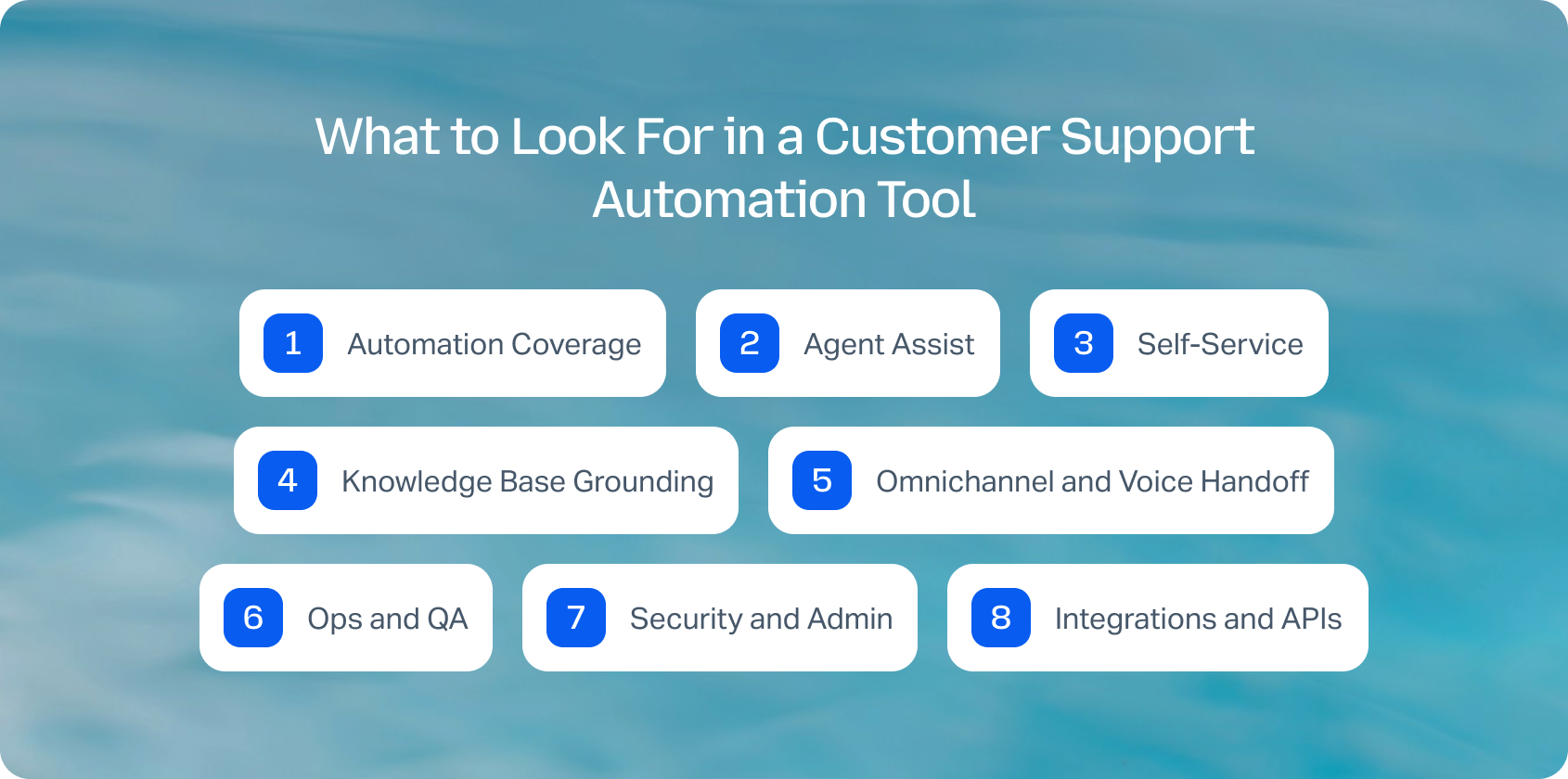
Selecting the right customer support automation tools requires more than feature comparison. The goal is to find a platform that reduces manual work while maintaining quality and consistency across every interaction.
Automation Coverage
A strong platform should handle routing, SLA workflows, escalation logic, and assignment rules without requiring constant manual intervention.
Agent Assist
Look for AI summaries, suggested replies, and macros with guardrails. The best systems ground these suggestions in your knowledge base, not generic AI outputs.
Self-Service
Bots and help centers should actively deflect tickets, not just respond to them. Effective self-service reduces volume while improving customer satisfaction.
Knowledge Base Grounding
Automation is only as good as its source of truth. Platforms should offer version control, governance, and structured content for accurate responses.
Omnichannel and Voice Handoff
Seamless transitions between chat, email, and voice are critical. Voice interactions should link back to tickets with transcripts and notes.
Ops and QA
Built-in analytics, QA frameworks, and workforce management tools help maintain performance as automation scales.
Security and Admin
Features like MFA, audit logs, role-based access, and data controls are essential, especially for enterprise teams.
Integrations and APIs
Your customer support automation platform should integrate with CRM, commerce systems, and BI tools, with webhooks for flexibility.
Pricing Clarity
Understand how automation is priced. Many vendors charge extra for AI features, voice, or advanced workflows, which can significantly increase TCO.
Reading feature lists is one thing. Seeing AI-powered routing, omnichannel support, workforce management, and knowledge-base-grounded automation working together is another.
Start a free 14-day BlueTweak trial (no credit card required), or book a personalised demo to explore how a unified customer support automation platform can help your team work more efficiently.
How We Evaluated Customer Support Automation Tools
Choosing the right customer support automation tools in 2026 requires more than scanning feature lists or relying on third-party rankings. Many platforms position themselves similarly on the surface, but the real differences appear when you look at how automation performs across the full support lifecycle, from routing and agent workflows to self-service and operational oversight.
To make this comparison meaningful, we focused on what teams actually experience post-implementation: how quickly automation delivers value, how well it scales across channels, and how clearly costs can be understood over time. Rather than relying on opinions or aggregated reviews, we grounded our evaluation entirely in vendor-documented capabilities and publicly available information.
Our methodology was designed to reflect how modern support teams buy, implement, and scale automation in real-world environments:
- We reviewed vendor product pages, pricing pages, help documentation, and official marketplaces only, avoiding third-party review sites.
- Each tool was evaluated across core automation layers, including routing, agent assist, bots, knowledge base integration, analytics, workforce management, security, and integrations.
- Pricing was taken from publicly available sources where possible; otherwise, it is marked as ‘varies by plan' or ‘verify'.
- We focused on observable features rather than inferred benefits, ensuring all pros and cons are grounded in vendor-documented functionality.
- Tools were compared based on their ability to support end-to-end automation, not just isolated features.
Must-Have Capability Checklist
While every platform takes a slightly different approach, the strongest customer support automation platforms consistently deliver across a shared set of core capabilities. These are the foundations required to automate support effectively without sacrificing quality or control.
Before shortlisting any tool, teams should ensure these essentials are covered:
- Routing and SLA automation
- AI summaries and suggested replies, ideally grounded in the knowledge base
- Self-service capabilities, including bots and deflection workflows
- An omnichannel inbox covering chat and email, with voice where required
- Analytics, alongside QA or workforce management modules
- Security controls such as MFA, role-based access, and audit logs
- Integrations, APIs, and webhook support
- Clear pricing for automation and AI features
- CSAT, surveys, and sentiment tracking, where available
Scoring Rubric
To create a fair comparison across very different types of tools (from help desks to CCaaS platforms), we applied a consistent scoring framework. This allowed us to evaluate not just feature availability, but how well each platform performs in a typical mid-sized or scaling support environment.
Each tool was rated on a scale of one to five across the following criteria:
- Fit for teams with 20 to 100 agents
- Breadth of automation across routing, agent assist, and self-service
- Knowledge base grounding quality and governance
- Omnichannel and voice capabilities
- Operational depth, including analytics, QA, and workforce management
- Time-to-value and ease of implementation
- Total cost of ownership over a 12-month period
- Security, administrative controls, and integration flexibility
Implementation Playbook
Adopting customer support automation software doesn't require a full transformation overnight. The most effective teams roll out automation in controlled stages.
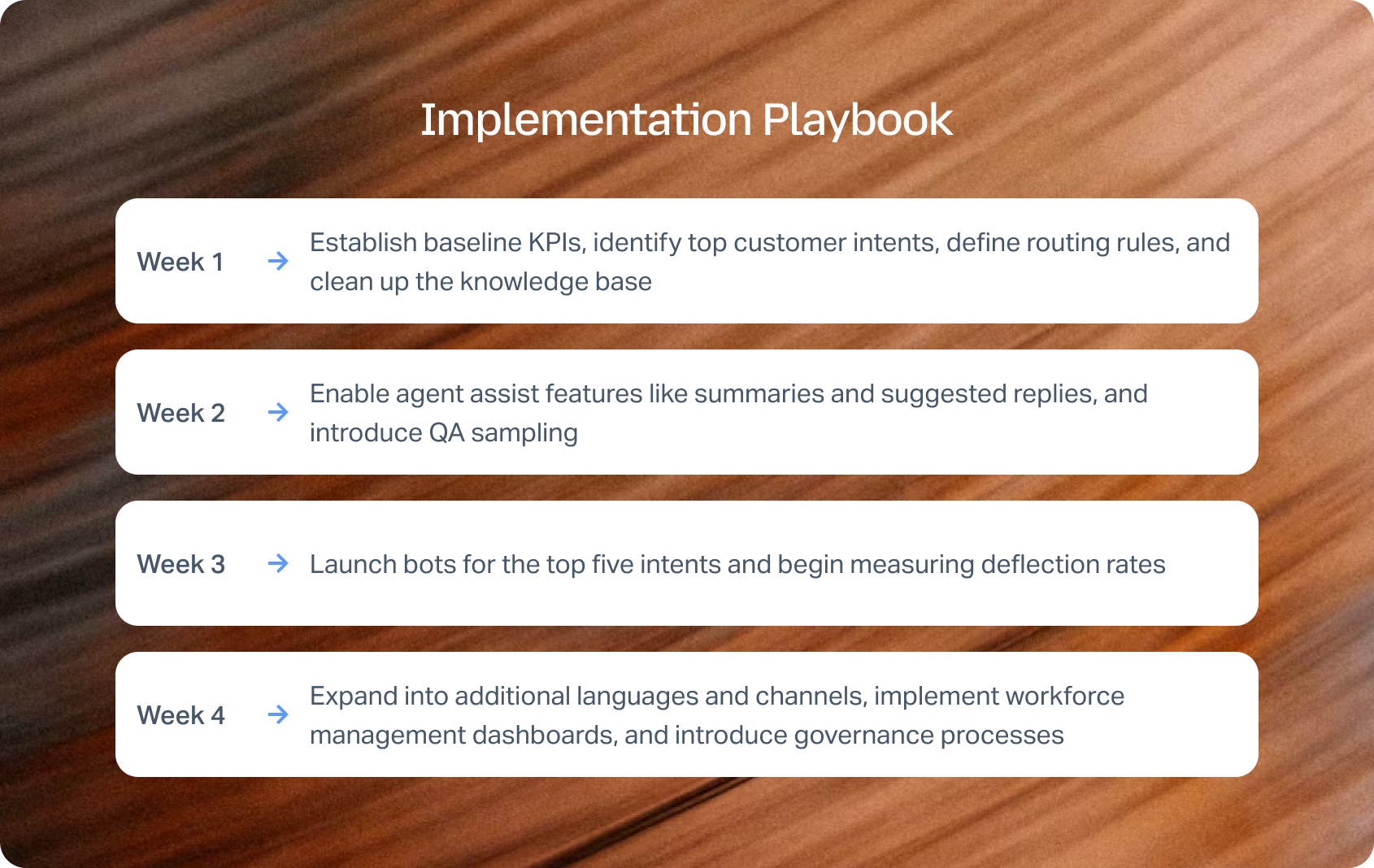
Pricing & ROI Modeling
Understanding ROI is critical when investing in customer support automation tools, especially at scale.
A realistic cost model should include seats, voice minutes, AI usage, integration costs, and QA or localization efforts. Many teams underestimate the impact of add-ons, which can significantly increase long-term spend.
ROI typically comes from:
- Reduced average handle time
- Increased containment and deflection
- Improved first contact resolution
- Lower backlog and faster response times
The key is to model conservatively. Automation delivers measurable gains, but results depend on implementation quality and ongoing optimization.
Automation ROI isn't just about reducing ticket costs. It's about improving agent productivity, increasing first-contact resolution, and scaling customer support without scaling headcount. Calculate your expected savings with the BlueTweak ROI Calculator.
Final Thoughts: How to Choose the Right Customer Support Automation Platform in 2026
The best customer support automation tools aren't necessarily the ones with the most features, but rather the ones that align with how your team operates, scales, and delivers consistent customer experiences under pressure.
In 2026, the real decision isn't just whether to automate, but where that automation lives. Many teams still rely on fragmented systems with separate tools for tickets, chat, voice, AI, and reporting. While flexible on the surface, this often leads to operational drag, inconsistent data, and rising costs as complexity increases.
That's why leading teams are moving toward platforms that combine automation breadth, knowledge-base grounding, operational depth, and pricing clarity within a single system. Increasingly, these platforms are built on cloud-native architectures that make it easier to scale AI, onboard new channels, and support growing customer service operations without adding unnecessary complexity. When automation, data, and workflows sit in one place, teams can maintain consistency across channels, reduce tool-switching, and scale more effectively without introducing friction.
Rather than layering automation on top of disconnected tools, BlueTweak is built as a unified customer support automation platform, bringing together omnichannel communication, AI-driven workflows, and operational tooling into one environment. The result is automation that works cohesively across the entire support lifecycle, not in isolated parts.
That means:
- Connected automation from the start: Routing, classification, and escalation operate within the same system, improving accuracy and response times
- Knowledge-base-grounded AI: Suggested replies and summaries are based on real, governed content, helping maintain consistency
- A unified workspace: Chat, email, voice, and social interactions sit in one timeline, giving agents full context
- Built-in operational visibility: Analytics, QA, and workforce management are included, reducing reliance on external tools
The advantage is simplicity. As automation matures, the biggest challenge becomes coordination. Platforms that unify workflows and data make it easier to scale without increasing operational complexity. Just as importantly, the right platform should be flexible enough to adapt to your workflows. Look for customer support automation software that can be customized to fit your brand, business processes, and customer expectations rather than forcing your teams to work around rigid automation rules.
For teams managing multiple channels, brands, or high ticket volumes, this becomes a key differentiator. In these environments, consolidation is necessary for maintaining a consistent customer experience.
If you're weighing help desk features, comparing pricing models, or evaluating the best customer support automation tools for 2026, focus on platforms that combine AI, automation, omnichannel support, and operational visibility without hidden costs. Organizations that successfully implement AI customer service can reduce service costs by up to 20%, while improving customer satisfaction and agent productivity through smarter automation.
Book a demo to see how BlueTweak helps teams manage customer interactions, streamline support tickets, and deliver consistent customer service at scale.
28 Best Help Desk Software Options for Your Contact Center in 2026
Most businesses don't outgrow their help desk because they're processing more tickets; they outgrow it because support becomes fragmented. One tool handles email, another manages phone support, while reporting, workforce planning, and AI all live somewhere else.
As customer expectations rise, that fragmented approach creates more work instead of less. Agents waste valuable team time switching between systems, manually processing tickets, tracking issues across multiple departments, and searching for answers to common questions instead of helping customers. Without artificial intelligence to automatically route enquiries, surface canned responses, or support knowledge base creation, even simple requests can require far more effort than they should.
BlueTweak was built to solve that problem. By bringing voice, email, chat, automation, workforce management, and quality assurance into one customer experience platform, it helps growing support teams spend less time switching between systems and more time resolving customer issues.
Beyond Tickets: When a Help Desk Isn’t Enough
You probably started with help desk software to keep things simple: one place to organize tickets, track requests, and tidy up your support queue. And for a while, that was enough. But as your team scaled, the cracks began to show.
Ticket volumes climbed. Questions started flooding in from every direction. You needed smarter routing to get the right agent on the right case, and faster. You wanted AI tools that could tag and classify tickets, read tone and sentiment, even draft quick replies using your own knowledge base.
That’s when your old software started to feel small. Maybe it didn’t support every channel. Maybe your reporting lived in one app, your workforce planning in another, and your QA data in a third. Or maybe the pricing tiers kept key features locked behind premium upgrades that doubled your costs.
You want omnichannel depth, AI-powered automation, and seamless integrations that tie your support ecosystem together. And you want predictable pricing that won’t punish you for growing.
This article examines why teams are reevaluating their help desk tools in 2026, what to consider in modern platforms, and which solutions stand out.
Technology Overview: Help Desk Software 2018 to 2026
Help desk software has transformed from simple ticket management systems into comprehensive customer service platforms. Understanding this evolution helps you spot which desk solutions are truly modern and which are still running on outdated technology.
Then (2018): Channel silos fragmented customer conversations. Email lived in one system, chat in another, phone calls in a third. Basic ticket management handled email support requests but struggled with integrating real-time chat and voice. AI capabilities were minimal, maybe basic keyword detection for ticket assignment. Analytics were thin, focusing on ticket volume and simple resolution metrics. Knowledge bases existed, but rarely connected meaningfully to agent workflows.
Now (2026): Omnichannel support is the foundation, not an add-on. Modern help desk tools unify voice, email, chat, and social messaging into one workspace where customer context flows seamlessly between channels. Customer support automation powered by AI handles classification, summarization, and routing automatically. Suggested reply features ground responses in your knowledge base, ensuring agents give consistent, accurate answers. Call transcription software converts voice interactions to searchable text.
Many help desk software examples still operate on 2018 architecture: bolt-on integrations, channel silos, and AI features sold as expensive add-ons. These legacy desk platforms struggle to keep pace with modern customer expectations.
Buyer takeaway: Unify your support channels, integrate your knowledge base deeply into agent workflows, and consolidate analytics for a seamless experience. Avoid stacking point tools that fragment customer data and increase vendor complexity.
Help Desk Software Platforms At A Glance
Here's a quick snapshot of the top 5 platforms on this list. The full rundown of all 28 platforms, including pricing, features, and pros/cons for each, follows below.
| Platform | Best For | Starting Price | Native Voice | WFM Included |
|---|---|---|---|---|
| BlueTweak | Mid-market teams (20–100 agents), all channels | €65/agent/month | Yes | Yes |
| Zendesk | Digital-first teams needing a proven platform | $19/agent/month¹ | Add-on | Upper tiers only |
| Freshworks | Small to mid-sized teams, affordable entry | Free / $19/agent/month | Limited | No |
| Intercom | SaaS and product-led teams | $29/seat/month | No | No |
| Help Scout | Small teams prioritising simplicity | $25/user/month | No | No |
¹ Shown here is Zendesk's Suite Team plan, which is the entry point that actually includes omnichannel support, comparable to the other rows in this table. Zendesk also sells a Support-only plan from $19/agent/month, but that tier is email/ticketing only and doesn't include the channels or AI features being compared here.
The comparison above provides a quick overview, but every business has different requirements when it comes to AI capabilities, phone support, integrations, pricing, and scalability. Below, we'll take a closer look at each platform to help you find the best fit for your customer support team.
Want to experience our top pick before you compare the rest? Start a free 14-day BlueTweak trial (no credit card required) and explore AI-powered ticketing, omnichannel customer support, workforce management, and quality assurance from a single platform.
Top 28 Help Desk Software Providers in 2026
Choosing help desk software in 2026 means weighing a lot more than ticket volume and price per seat. Support teams now need to think about omnichannel coverage, AI automation, workforce management, and how many separate tools they'll have to stitch together to get a complete view of the customer.
To help you cut through the noise, we evaluated 28 leading platforms (from all-in-one customer experience suites to specialized live chat tools and enterprise ITSM systems) on the criteria that matter most: channel coverage, AI capabilities, ease of implementation, pricing transparency, and how well each one scales as a team grows.
Here's how they stack up, starting with our pick for the best overall help desk software in 2026.
1. BlueTweak: Best Overall Help Desk Software for AI-Powered Omnichannel Support
BlueTweak tops our list as the best overall help desk software in 2026, offering a unified customer experience platform built for growing support teams that need far more than a traditional business phone system. While many alternatives focus primarily on business calls, internal calls, video meetings, or basic VoIP functionality, BlueTweak brings voice, email, chat, social messaging, AI automation, workforce management, and quality assurance together in a single platform, making it one of the most complete solutions on the market.
Unlike voice-first providers that bolt on contact center features through separate plans or third-party integrations, BlueTweak equips support teams with everything they need to manage the entire customer journey from one workspace. That combination of breadth and depth is what sets it apart from the competition, and it's why we rank it as the top choice for teams that want a genuinely all-in-one platform. It's especially well-suited to distributed teams and organizations looking for a scalable alternative without the headache of juggling multiple vendors.
Best for: Teams that want the best overall help desk experience – mid-market support organizations that need AI-powered omnichannel capabilities, combining voice, digital channels, automation, workforce management, and quality assurance in one platform.
Features:
- Unified inbox consolidates voice, email, chat, SMS, and social media into one workspace
- Ticketing system with intelligent ticket routing based on skills, language, and priority
- AI voicebot handles routine calls with context-preserving escalation to human agents
- Call transcription software converts conversations to searchable text automatically
- Suggested reply and canned responses grounded in the knowledge base for consistent, fast answers
- AI ticket summary condenses long threads into key points
- Call center workforce management forecasts demand and schedules agents
- Customer service quality assurance with scorecards and calibration
- Customer service analytics track sentiment, SLA performance, and outcomes in real time
- Multilingual customer support with real-time translation across all channels
- Spam detection to filter out junk tickets automatically
- Customer profile view shows the complete interaction history across channels
- Multi-brand routing manages multiple product lines or client accounts in one instance
Who Uses It: Support teams managing 20 to 100 agents who need omnichannel capabilities, AI assistance, and predictable pricing without add-on complexity.
“Modern help desk software shouldn't just help agents manage tickets… it should help them solve customer problems. When AI, omnichannel support, workforce management, quality assurance, and a knowledge base all work together in one platform, support teams spend less time switching between systems and more time delivering exceptional customer experiences." — Radu Dumitrescu, Head of Presale & Digital Transformation, BlueTweak
Pros:
- All-in-one platform eliminates vendor fragmentation
- Multilingual customer support with real-time translation preserves context across languages
- Multi-brand routing manages multiple product lines or client accounts in one instance
- Fast implementation with guided rollout (weeks, not months)
- Customer support automation includes a KB-grounded chatbot and a voicebot
- API-open architecture enables seamless integration with existing systems
- Transparent pricing includes workforce management, quality assurance, and AI features
Cons:
- Newer platform with a smaller marketplace compared to established players
- Less brand recognition than legacy help desk vendors
- Some advanced security features are planned for future releases
BlueTweak in Action:
BlueTweak's impact extends beyond feature lists. One e-commerce customer replaced a fragmented support technology stack with the BlueTweak platform and, within six months, achieved a 45% increase in ticket deflection, reduced interaction times by 30%, and improved overall support team efficiency by 45%. By automating repetitive enquiries with AI while giving agents better tools for the conversations that mattered, the business was able to scale customer support without proportionally increasing headcount.
Pricing: €65/agent/month all-in (ticketing, omnichannel, AI features, WFM, QA, analytics, APIs). See BlueTweak’s pricing page for full details.
Not sure what switching from multiple support tools could save your business? Try BlueTweak's ROI Calculator to estimate your potential cost savings and see the financial impact of consolidating your customer support platform.
2. Zendesk: Best for Enterprise Teams Needing Established Integrations
Zendesk is one of the most recognized names in help desk software, having grown from an email ticketing tool into a full customer service platform with omnichannel routing, workforce management, and AI. Its feature depth is strong, but much of it, including AI and WFM, sits behind higher-priced tiers.
Best for: Zendesk is best for mid-market to enterprise teams that want a widely recognized platform with a large marketplace of integrations, and are willing to pay premium tiers for AI, workforce management, and quality assurance.
Features:
- Multi-channel support, including email, chat, voice, and social media
- Ticket management system with customizable workflows and automation
- Knowledge base with self-service customer portal
- AI-powered features including automatic ticket classification and routing
- Workforce management and quality assurance are available in higher tiers
- Extensive integration capabilities with third-party apps
- Advanced reporting and analytics
- Mobile apps for agents
Who Uses It: Mid-market to enterprise teams needing established help desk software with extensive marketplace integrations.
Pros:
- Established platform with extensive third-party integrations
- Strong marketplace of apps and plugins
- Comprehensive help desk software features across all tiers
- Good documentation and community support
Cons:
- Expensive, especially when adding voice and workforce management
- AI features and advanced automation require premium tiers
- It can feel overwhelming for small teams due to customization options
- Some users report that the interface feels dated compared to newer desk solutions
- It isn't flexible, and support time can feel long in desperate times
Pricing:
- Support Team: $19/agent/month (billed annually)
- Suite Team: $55/agent/month (billed annually)
- Suite Growth: $89/agent/month (billed annually)
- Suite Professional: $115/agent/month (billed annually)
- Suite Enterprise: From $169/agent/month (billed annually)
Note: Higher tiers add AI, WFM, and QA. Entry pricing covers basic desk features, but serious contact center capabilities require upper tiers, so total costs can increase depending on your deployment.
3. Freshworks: Best Budget-Friendly Help Desk for Growing Teams
Freshworks offers affordable help desk software for customer support with a generous free tier and scalable pricing. It targets small to mid-sized teams that need basic help desk tools without the complexity of enterprise solutions.
Best for: Freshworks is best for small to mid-sized teams that want affordable, easy-to-use ticketing with room to add automation and AI as they grow.
Features:
- Email ticketing with automated ticket routing
- Multi-channel support, including chat, phone, and social media
- Knowledge base with customer-facing portal
- Basic AI features for ticket classification
- Automation rules and workflow management
- Team collaboration tools
- Mobile apps for on-the-go support
- Integration with Freshworks ecosystem
Who Uses It: Small to mid-sized businesses needing affordable help desk software with room to scale.
Pros:
- Affordable entry pricing with a generous free tier
- Clean, user-friendly interface with minimal steep learning curve
- Good balance of help desk software features for the price
- Part of the Freshworks suite for unified business tools
Cons:
- Limited advanced features compared to enterprise platforms
- Voice capabilities are less robust than specialized contact center solutions
- Some automation features require higher tiers
- Reporting tools are not as comprehensive as competitors'
Pricing:
- Free: Basic ticketing for up to 10 agents
- Growth: $19/agent/month (annual billing): adds automation and multi-channel support
- Pro: $49/agent/month: advanced features and AI
- Enterprise: $79/agent/month: custom workflows and dedicated support
Note: A free tier is available for small teams. Real cost scales as you add channels and AI capabilities.
4. Zoho Desk: Best for Teams Already Using Zoho
Zoho Desk is part of the broader Zoho ecosystem, offering help desk software that integrates naturally with Zoho CRM, Zoho Analytics, and other Zoho products. It targets teams already using Zoho who want unified customer data.
Best for: Zoho Desk is best for small to mid-sized businesses already invested in the Zoho ecosystem who want help desk software that shares data with their CRM and analytics tools.
Features:
- Multi-channel ticketing across email, phone, chat, and social
- AI assistant (Zia) for ticket classification and response suggestions
- Knowledge base with customer self-service portal
- Automation rules and custom workflows
- Custom ticket fields and status tracking
- Integration with the Zoho ecosystem
- Mobile support for agents
- Basic analytics and reporting
Who Uses It: Small to mid-sized businesses, especially those already using Zoho products.
Pros:
- Tight integration with the Zoho ecosystem
- Affordable pricing for small teams
- An AI assistant helps with project management
- Good for teams wanting a unified Zoho experience
Cons:
- Best value requires using other Zoho products
- Less robust than standalone help desk platforms
- Limited third-party integrations outside the Zoho ecosystem
- Some users report a learning curve for advanced customization
Pricing:
- Free: Up to 3 agents with basic help desk features
- Standard: $14/agent/month (annual) – core ticketing and automation
- Enterprise: $40/agent/month (annual) – advanced AI, live chat, and multi-brand support
Note: Zoho Desk offers competitive pricing with a free plan for small teams and affordable paid tiers that scale from basic ticketing to AI-powered enterprise support.
5. Help Scout: Best for Simple, Human-Centered Support
Help Scout positions itself as help desk software focused on human connection. It emphasizes simplicity and an email-like experience over complex ticketing systems, appealing to teams that want to engage with customers without feeling like a corporate support machine.
Best for: Help Scout is best for small to mid-sized teams that want an email-like shared inbox and prioritize personal customer interactions over complex ticketing features.
Features:
- Shared inbox for email support
- Live chat with proactive messaging
- Knowledge base with customer self-service
- Customer profile view with interaction history
- Collision detection prevents agents from making duplicate replies
- Automated workflows and saved replies
- Basic reporting and analytics
- Integration with popular business tools
Who Uses It: Small to mid-sized teams prioritizing personalized customer interactions over enterprise-grade features.
Pros:
- Clean, intuitive interface feels like email rather than a traditional help desk system
- Strong focus on personalized customer service
- Good knowledge base functionality
- Excellent customer support from the Help Scout team
Cons:
- Limited channels, primarily email and chat, voice requires integration
- Basic reporting compared to enterprise platforms
- Fewer automation features than competitors
- Not suitable for teams needing advanced workforce management
Pricing:
- Standard: $25/user/month (billed annually) – shared inbox, live chat, workflows, and core automation
- Plus: $45/user/month (billed annually) – advanced workflows, reporting, Salesforce, HubSpot, and Jira integrations, plus enhanced collaboration
- Pro: $75/user/month (billed annually) – enterprise-grade security, governance, and scalability
Note: A free plan is available for small teams (up to five users), while paid plans add more advanced automation, integrations, and security features. AI Answers is priced separately based on usage, so organisations relying heavily on AI may see overall costs increase.
6. Intercom: Best for Proactive SaaS Customer Engagement
Intercom combines help desk software with customer engagement tools, positioning itself as a platform for proactive support and sales. It's particularly popular with SaaS companies that want to blend support with user onboarding and product messaging.
Best for: Intercom is best for SaaS and technology companies that want to combine reactive support with proactive messaging, onboarding, and AI chatbot automation.
Features:
- Unified inbox for email, chat, and social messaging
- AI chatbot (Fin) for automated responses
- Proactive messaging and customer engagement tools
- Knowledge base with AI-powered search
- Customer segmentation and targeting
- Product tours and onboarding flows
- Team collaboration features
- Extensive integration capabilities
Who Uses It: SaaS and technology companies wanting to blend customer support with product engagement and sales.
Pros:
- Strong proactive engagement features beyond reactive support
- Modern interface with excellent user experience
- AI chatbot (Fin) delivers good automation for common queries
- Product tours help with customer onboarding
Cons:
- Expensive, especially when AI usage scales
- Pricing complexity with seat costs plus per-resolution AI charges
- Less suitable for teams needing traditional help desk features like workforce management
- Best value comes from using the full Intercom suite, not just support features
Pricing:
- Essential: $29/seat/month (billed annually) – shared inbox, ticketing, live chat, and core customer support features
- Advanced & Expert: Custom pricing – adds more advanced automation, workflows, analytics, security, and multi-brand capabilities
- Fin AI Agent: $0.99 per resolved conversation, charged separately based on usage
Note: Intercom combines per-seat licensing with usage-based AI pricing, so costs can increase as conversation volumes grow. Businesses planning to rely heavily on Fin AI should factor these additional charges into their overall budget.
7. HubSpot Service Hub: Best for HubSpot CRM Customers
HubSpot Service Hub is part of the HubSpot CRM platform, offering help desk software that integrates seamlessly with HubSpot's sales and marketing tools. It's designed for teams already using HubSpot who want unified data across departments.
Best for: HubSpot Service Hub is best for small to mid-sized businesses already using HubSpot CRM who want unified sales, marketing, and service data in one platform.
Features:
- Ticketing system integrated with HubSpot CRM
- Live chat and chatbot builder
- Knowledge base with customer self-service
- Customer feedback surveys and NPS tracking
- Automation workflows
- Conversation routing and team inbox
- Reporting dashboards with CRM data integration
- Integration with the HubSpot ecosystem
Who Uses It: Small to mid-sized businesses using HubSpot CRM who want unified sales, marketing, and service data.
Pros:
- Seamless integration with HubSpot CRM
- Unified data across sales, marketing, and service
- User-friendly interface consistent with the HubSpot ecosystem
- Good for teams prioritizing CRM-driven support
Cons:
- Limited help desk software features compared to specialized platforms
- Voice capabilities require third-party integration
- Pricing can escalate quickly with seat count
- Best suited for existing HubSpot customers; less compelling standalone
Pricing:
- Starter: $20/seat/month (billed annually) – core help desk features, shared inbox, and basic automation
- Professional: $90/seat/month (billed annually) – advanced automation, reporting, customer portal, knowledge base, and customer feedback tools
- Enterprise: $150/seat/month (billed annually) – skill-based routing, advanced permissions, and enterprise governance
Note: HubSpot Service Hub offers a free plan alongside scalable paid tiers that expand automation, reporting, and customer support features. Organisations using AI should also factor in HubSpot Credits, which are included with paid plans but may require additional purchases as usage grows.
8. Salesforce Service Cloud: Best for Large Enterprise Customization
Salesforce Service Cloud is enterprise-grade help desk software built on the Salesforce platform. It offers comprehensive customer service features with deep CRM integration, extensive customization, and AI through Einstein.
Best for: Salesforce Service Cloud is best for large enterprises that need deep CRM integration, extensive customization, and AI through Einstein, and have the budget and resources for complex implementation.
Features:
- Omnichannel routing across email, chat, phone, and social
- Case management with advanced workflows
- Knowledge base integrated with Salesforce data
- AI-powered Einstein for predictive routing and recommendations
- Field service management capabilities
- Extensive customization through Salesforce platform
- Workforce management and quality assurance
- Comprehensive analytics and reporting
Who Uses It: Large enterprises needing a robust platform with extensive customization and Salesforce ecosystem integration.
Pros:
- Enterprise-grade scalability and reliability
- Deep integration with Salesforce CRM
- Extensive customization through the Salesforce platform
- Comprehensive AI capabilities through Einstein
Cons:
- Very expensive, especially for smaller teams
- Steep learning curve and complex implementation
- Best value requires using the broader Salesforce ecosystem
- Overkill for teams not needing enterprise-level customization
Pricing:
- Starter Suite: $25/user/month (billed monthly or annually) – core customer service tools, case management, and built-in AI
- Pro Suite: $100/user/month (billed annually) – enhanced automation, customization, AppExchange access, and advanced service capabilities
- Enterprise: $165/user/month (billed annually) – AI-powered customer service, self-service help center, and advanced workflow automation
Note: Salesforce Service Cloud offers scalable pricing for businesses of all sizes, but the total cost can increase as you add advanced capabilities. Features such as Digital Engagement, Service Cloud Voice, Workforce Engagement, and additional AI functionality may require separate licenses or higher-tier plans.
9. ServiceNow: Best for Unified Enterprise IT and Service Operations
ServiceNow focuses on IT service management (ITSM) but offers customer service management capabilities. It targets enterprises needing unified service operations across IT and customer-facing teams.
Best for: ServiceNow is best for large enterprises that want to unify IT, HR, and customer service operations on a single, highly configurable platform.
Features:
- Unified service platform for IT and customer service
- Advanced workflow automation and orchestration
- Knowledge management with AI-powered search
- Multi-channel support
- Field service management
- Extensive configuration and customization
- AI and machine learning capabilities
- Integration with enterprise systems
Who Uses It: Large enterprises needing unified service management across IT, HR, and customer support.
Pros:
- Enterprise-grade platform with comprehensive capabilities
- Unified service operations across departments
- Strong workflow automation
- Robust security and compliance features
Cons:
- Very expensive with a lengthy implementation timeline
- Steep curve requiring specialized expertise
- Overkill for teams primarily focused on customer support
- Complex pricing and licensing models
Pricing:
ServiceNow Customer Service Management is available through custom enterprise quotes rather than publicly listed per-user plans. CSM Advanced and CSM Prime packages are available, with Prime adding AI Specialists and Workforce Optimization capabilities.
Note: ServiceNow is designed for large enterprise organisations, with pricing based on users, products, implementation, and support requirements. Businesses should also factor in implementation services, platform configuration, and ongoing administration costs when evaluating the total investment.
10. Jira Service Management: Best for Technical and Dev-Adjacent Support Teams
Jira Service Management brings Atlassian's project management approach to help desk software. It's particularly popular with technical teams and companies already using Jira for development.
Best for: Jira Service Management is best for technical teams and Atlassian users that want tight integration between customer support and development workflows.
Features:
- ITSM and customer service ticketing
- Integration with Jira Software for seamless dev handoffs
- Knowledge base and self-service portal
- Automation rules and SLA management
- Custom ticket forms and workflows
- Asset and configuration management
- Mobile apps for agents
- Integration with the Atlassian ecosystem
Who Uses It: Technical teams, IT departments, and companies using Atlassian products who want unified project and service management.
Pros:
- Excellent integration with development workflows via Jira Software
- Familiar interface for teams using Atlassian products
- Strong automation and workflow customization
- Good asset and configuration management
Cons:
- Better suited for internal IT service than customer-facing support
- Learning curve for non-technical users
- Limited omnichannel capabilities compared to customer service platforms
- Voice support requires third-party integration
Pricing:
- Standard: $20/agent/month (billed annually) – incident, request, problem, and change management with automation
- Premium: $40/agent/month (billed annually) – AI-powered service management, virtual agent, asset management, and advanced analytics
- Enterprise: Custom pricing
Note: A free plan is available for small IT teams, while paid plans add AI, asset management, and more advanced service management capabilities. Jira Service Management delivers the greatest value for organisations already using the Atlassian ecosystem, although Marketplace apps and premium features can increase the overall cost.
11. Genesys Cloud CX: Best for Large-Scale Enterprise Contact Centers
Genesys Cloud CX is enterprise-grade contact center software that includes comprehensive help desk capabilities. It targets large operations needing omnichannel routing, AI, workforce management, and quality assurance at scale.
Best for: Genesys Cloud CX is best for enterprise contact centers running hundreds of agents that need sophisticated omnichannel routing, workforce management, and analytics at scale.
Features:
- Omnichannel routing across voice, email, chat, and social
- AI-powered predictive routing and automation
- Workforce management and quality assurance native
- Advanced analytics with sentiment analysis
- Knowledge base integration
- IVR with AI capabilities
- Extensive integrations
- Enterprise-grade security and compliance
Who Uses It: Enterprise contact centers managing hundreds of agents across multiple channels with sophisticated routing and analytics needs.
Pros:
- Enterprise-grade scalability and reliability
- Comprehensive contact center capabilities
- Strong workforce management and quality tools
- Extensive AI and automation
Cons:
- Very expensive, especially for smaller teams
- Complex implementation requires professional services
- Steep curve and technical expertise required
- Overkill for businesses under 100 agents
Pricing:
- Genesys Cloud CX 1: $75/user/month (billed annually)
- Genesys Cloud CX 2: $115/user/month (billed annually)
- Genesys Cloud CX 3: $155/user/month (billed annually)
- Genesys Cloud CX 4: $240/user/month (billed annually)
Note: Genesys includes native AI capabilities across all plans, with higher tiers unlocking more advanced customer experience and workforce engagement features. Some AI functionality consumes AI Experience Tokens, while additional usage-based charges may apply for telephony, AI consumption, and other services.
12. LiveAgent: Best Value Omnichannel Help Desk with Built-In Voice
LiveAgent is a help desk software that combines ticketing, live chat, and call center features at competitive pricing. It targets small to mid-sized teams that want all-in-one capabilities without the enterprise costs.
Best for: LiveAgent is best for small to mid-sized teams that want affordable ticketing, chat, and a built-in call center without paying for separate telephony.
Features:
- Multi-channel ticketing (email, chat, phone, social)
- Built-in call center with IVR
- Live chat with proactive invitations
- Knowledge base and customer portal
- Automation rules and SLA management
- Gamification for agent motivation
- Multi-brand support
- Extensive integration options
Who Uses It: Small to mid-sized support teams needing affordable omnichannel help desk software.
Pros:
- Affordable pricing with voice included
- Great feature set for the price
- Built-in call center eliminates the need for separate telephony
- Good for multi-brand operations
Cons:
- Interface feels dated compared to modern competitors
- Limited AI capabilities
- Basic workforce management
- Smaller ecosystem of integrations
Pricing:
- Small: $15/agent/month (billed annually)
- Medium: $29/agent/month (billed annually)
- Large: $49/agent/month (billed annually)
- Enterprise: $69/agent/month (billed annually)
Note: LiveAgent offers competitively priced plans that scale with your support team's needs, alongside a 30-day free trial. AI-powered features, including AI Answer Assistant and AI Chatbot, are available, while built-in voice capabilities are introduced from the Medium plan onwards.
13. Deskpro: Best for Flexible Cloud or On-Premise Deployment
Deskpro offers help desk software with both cloud and on-premise deployment options. It targets teams with specific data security requirements or those wanting control over hosting.
Best for: Deskpro is best for mid-sized teams with strict data control requirements that need the option to deploy on-premise instead of relying solely on the cloud.
Features:
- Multi-channel ticketing
- Knowledge base with client portal
- Live chat and messaging
- Automation and workflow management
- Custom ticket fields and forms
- Agent productivity tools
- Reporting and analytics
- Cloud or on-premise deployment
Who Uses It: Mid-sized teams needing flexible deployment options or specific data control requirements.
Pros:
- Flexible deployment options (cloud or on-premise)
- Good customization capabilities
- Comprehensive help desk features
- Suitable for teams with strict data requirements
Cons:
- Higher pricing than competitors for similar feature sets
- Interface is less modern than newer platforms
- Smaller user community and marketplace
- On-premises requires internal IT resources
Pricing:
- Team: $39/agent/month (minimum 5 agents)
- Professional: $59/agent/month (minimum 10 agents)
- Enterprise: $99/agent/month (minimum 25 agents)
Note: Deskpro provides flexible cloud and on-premises deployment with a free trial available. As your requirements grow, higher-tier plans unlock AI features, enterprise administration, and more advanced support capabilities.
14. Gorgias: Best Help Desk for E-Commerce Brands
Gorgias specializes in help desk software for e-commerce, with deep integrations into Shopify, Magento, and other commerce platforms. It positions itself as the solution for online retailers who need support tied to order data.
Best for: Gorgias is best for e-commerce brands on Shopify, Magento, or similar platforms that want order data and revenue attribution built directly into support tickets.
Features:
- Deep e-commerce integrations showing order data in tickets
- Multi-channel support (email, chat, social media, SMS, voice)
- Automation rules based on customer and order data
- Macros for common responses
- Revenue attribution for support tickets
- Customer satisfaction tracking
- AI features for automation
- Integration with e-commerce tools
Who Uses It: E-commerce brands using Shopify, Magento, or similar platforms who want order context in every support interaction.
Pros:
- Excellent e-commerce integrations with order data in tickets
- Revenue attribution shows support's business impact
- Unlimited agent seats on paid plans
- Strong automation for common e-commerce scenarios
Cons:
- Limited functionality outside e-commerce use cases
- Ticket-based pricing can become expensive at scale
- AI interactions metered separately
- Less suitable for non-retail businesses
Pricing:
- Starter: From $10/month – includes 50 billable tickets per month
- Basic: From $50/month (billed annually) – includes 300 billable tickets per month
- Pro & Advanced: From $300–$750/month (billed annually) – supports higher ticket volumes and unlocks more advanced capabilities
Note: Gorgias uses a ticket-based pricing model rather than charging per agent, making costs closely tied to support volume. Businesses using AI Agent should also factor in additional usage-based charges for automated resolutions.
15. Hiver: Best for Gmail-Based Support Teams
Hiver transforms Gmail into a help desk software, enabling teams to manage customer inquiries directly within their inbox. It targets small teams who want simple support tools without adopting new platforms.
Best for: Hiver is best for small teams that already live in Gmail and want lightweight ticket assignment and tracking without adopting a new platform.
Features:
- Gmail integration for shared inbox management
- Email-based ticket assignment and tracking
- Collision detection to prevent duplicate responses
- SLA management and reminders
- Basic automation rules
- Email templates and notes
- Reporting on response times and volumes
- Live chat as an add-on
Who Uses It: Small teams using Gmail who want lightweight help desk functionality without learning new platforms.
Pros:
- No learning curve for Gmail users
- Quick deployment without platform migration
- Affordable for small teams
- Familiar email-based workflow
Cons:
- Limited to email and basic chat
- Lacks advanced help desk software features
- No voice or social media support
- Not suitable for teams needing omnichannel or AI capabilities
Pricing:
- Growth: $25/user/month (billed annually)
- Pro: $55/user/month (billed annually)
- Elite: $85/user/month (billed annually)
Note: Hiver offers a free plan alongside scalable paid tiers for growing support teams. Businesses already using Gmail can manage customer support directly from their inbox, while Hiver Omni adds omnichannel capabilities, including voice, live chat, Slack, AI features, and more advanced automation. Voice support is available as an add-on from the Growth plan.
16. Front: Best for Collaborative Shared Inbox Support
Front creates a shared inbox for teams to manage email, chat, and social media conversations. It positions itself as collaborative help desk software for teams who want unified communications without traditional ticketing systems.
Best for: Front is best for small to mid-sized teams that want to collaborate on email, chat, and social conversations in a shared inbox without a traditional ticketing system.
Features:
- Shared inbox for email, chat, SMS, and social media
- Collision detection and internal comments
- Assignment rules and workflows
- Automated actions and routing
- Analytics and reporting
- Integration with business tools
- Mobile apps
- Team performance insights
Who Uses It: Small to mid-sized teams wanting shared inbox collaboration without traditional help desk complexity.
Pros:
- Clean interface focused on collaboration
- Good for teams transitioning from email to help desk software
- Strong analytics showing team performance
- Integrates well with business tools
Cons:
- Limited traditional ticketing features
- Voice support requires third-party integration
- Pricing scales quickly with seat count
- No built-in knowledge base or self-service
Pricing:
- Starter: $25/seat/month, shared inbox basics
- Pro: $65/seat/month, advanced automation and collaboration features
- Enterprise: $105/seat/month, enterprise-grade security, governance, and AI capabilities
Note: Front is designed for teams that prioritise collaborative shared inboxes over a full contact centre platform. As your requirements grow, higher-tier plans unlock more advanced automation, security, and AI features, while some AI capabilities remain available as paid add-ons.
17. HappyFox: Best for Structured Workflow and Task Management
HappyFox offers help desk software with project management and workflow automation. It targets teams that need structure without the complexity of an enterprise.
Best for: HappyFox is best for mid-sized teams that want structured ticketing combined with task management and workflow automation.
Features:
- Multi-channel ticketing (email, chat, phone, social)
- Task management and workflow automation
- Knowledge base with client portal
- SLA management and escalations
- Asset management
- Mobile apps for agents
- Reporting and analytics
- Integration capabilities
Who Uses It: Mid-sized teams needing structured help desk software with workflow management.
Pros:
- Good balance of features and usability
- Strong workflow and task management
- Comprehensive ticketing capabilities
- Mobile support for remote agents
Cons:
- Pricing not transparent (requires sales contact)
- Smaller marketplace than major competitors
- Some advanced features require higher tiers
- Less known brand compared to Zendesk or Freshdesk
Pricing:
- Basic: $24/agent/month (billed annually) – up to 5 agents
- Team: $49/agent/month (billed annually)
- Pro: $99/agent/month (billed annually)
- Enterprise Pro: Custom pricing – enterprise governance, advanced audit logs, dedicated customer success, and premium support
Note: HappyFox offers scalable pricing for growing support teams, with higher tiers adding more advanced automation, reporting, and administration features. Businesses looking for voice, AI automation, and omnichannel support can also choose the AI Contact Center Suite, which starts at $99/agent/month.
18. TeamSupport: Best for B2B Relationship-Driven Support
TeamSupport focuses on B2B customer support, offering help desk software designed for complex, relationship-driven support interactions with business customers.
Best for: TeamSupport is best for B2B companies managing complex customer accounts and internal escalations that need account-based context over individual ticket tracking.
Features:
- Account-based ticketing showing customer relationships
- Collaboration tools for internal escalations
- Customer health scoring
- Product database for asset tracking
- Knowledge base
- Customer self-service portal
- Reporting focused on customer success metrics
- Integration with business tools
Who Uses It: B2B companies managing complex customer relationships and support escalations.
Pros:
- Excellent for B2B relationship management
- Account-based view shows customer health
- Strong collaboration features for internal teams
- Good for managing complex technical support
Cons:
- Less suitable for B2C or high-volume support
- Limited AI and automation
- Smaller integration marketplace
- Higher pricing than consumer-focused help desk tools
Pricing:
- Starter: $45/agent/month
- Professional: $65/agent/month
- Scale: $85/agent/month
Note: TeamSupport is designed specifically for B2B customer support, with paid plans that scale from core ticket management to advanced AI, reporting, and customer relationship features. It's an excellent fit for businesses managing complex customer accounts rather than large-scale, high-volume support centres.
19. Kayako: Best for Cross-Channel Customer Journey Tracking
Kayako offers help desk software emphasizing customer journey tracking across all touchpoints. It positions itself as the platform for teams wanting a complete conversation history.
Best for: Kayako is best for mid-sized teams that prioritize a unified view of the customer journey across every channel and touchpoint.
Features:
- Unified customer view across channels
- Journey tracking showing customer history
- Multi-channel support (email, chat, phone, social)
- Knowledge base and self-service
- Automation and workflow rules
- Team collaboration tools
- Reporting and analytics
- Integration capabilities
Who Uses It: Mid-sized teams prioritizing customer context and journey tracking.
Pros:
- Strong customer journey tracking
- Unified view shows complete interaction history
- Good collaboration features
- Comprehensive omnichannel support
Cons:
- Pricing not transparent (requires sales contact)
- Less market presence than major competitors
- Some users report implementation complexity
- Limited advanced AI capabilities
Pricing:
- Kayako One: Custom pricing for the full customer support platform, including ticketing, a unified inbox, knowledge base, automation, analytics, and AI capabilities
- Kay AI: $1 per AI-resolved ticket – usage-based pricing with no additional seat fees for AI resolutions
Note: Rather than charging per agent for AI, Kayako prices its AI capabilities based on successful resolutions. This can offer good value for teams with high automation rates, although businesses should evaluate overall platform pricing alongside expected AI usage when comparing providers.
20. Re:amaze: Best for E-Commerce Live Chat and Support
Re:amaze provides help desk software integrated with e-commerce platforms and live chat. It targets online businesses needing customer support tied to commerce data.
Best for: Re:amaze is best for small to mid-sized e-commerce businesses that want live chat and ticketing tied directly to commerce data.
Features:
- Multi-channel support (email, chat, social, SMS, voice)
- E-commerce integrations with order data
- Live chat with chatbot automation
- Knowledge base and FAQ builder
- Workflow automation
- Customer satisfaction surveys
- Reporting and analytics
- Integration with commerce platforms
Who Uses It: Small to mid-sized e-commerce businesses needing integrated support and commerce data.
Pros:
- Good e-commerce integrations
- Affordable pricing for small teams
- Live chat with automation
- Multi-channel support included
Cons:
- Limited features outside e-commerce use cases
- Basic workforce management
- Smaller ecosystem than enterprise platforms
- Voice capabilities are less robust than specialized solutions
Pricing:
- Starter: $59/month – unlimited users with up to 500 active conversations per month
- Basic: $29/team member/month (billed annually)
- Pro: $49/team member/month (billed annually)
- Plus: $69/team member/month (billed annually)
Note: Re:amaze combines conversation-based and per-user pricing, giving e-commerce businesses flexibility as they grow. AI Agent is included across all plans, although additional usage charges apply after the included AI resolution allowance.
21. Kustomer: Best for Relationship-First Customer Timelines
Kustomer offers customer service software with a customer-centric approach, showing complete customer timelines instead of traditional ticket-based views. It targets teams wanting relationship management over ticket management.
Best for: Kustomer is best for mid-market to enterprise teams that prefer managing customer relationships through a timeline view rather than individual tickets.
Features:
- Customer timeline view showing complete history
- Omnichannel support (email, chat, phone, social, SMS)
- AI-powered routing and automation
- Workflow builder
- Knowledge base integration
- Customer satisfaction tracking
- Reporting and analytics
- Extensive integration capabilities
Who Uses It: Mid-market to enterprise teams prioritizing customer relationships over individual ticket management.
Pros:
- Innovative customer-centric view
- Strong omnichannel capabilities
- Good AI and automation tools
- Flexible pricing models (seat-based or conversation-based)
Cons:
- Expensive compared to simpler help desk tools
- Learning curve due to non-traditional approach
- Minimum seat or conversation commitments
- Best suited for teams prioritizing relationship management
Pricing:
- Custom pricing: Contact Kustomer for a tailored quote based on your business requirements.
Note: Pricing is customized according to team size, channels, AI usage, and implementation needs. Kustomer is best suited to mid-market and enterprise organisations, with annual commitments and additional deployment costs potentially increasing the overall investment.
22. Gladly: Best for Loyalty-Focused Consumer Brands
Gladly takes a radical approach to help desk software by organizing everything around people, not tickets. Each customer gets a single, lifelong conversation thread across all channels.
Best for: Gladly is best for consumer brands that want to build long-term loyalty through a single, lifelong conversation thread per customer, and can support the premium price tag.
Features:
- People-centric platform (no ticket numbers)
- Single conversation thread across all channels
- Voice, SMS, email, chat, and social media support
- Customer timeline showing complete history
- Agent desktop built for personalized service
- Workforce management capabilities
- Reporting focused on customer experience
- Integration with commerce and CRM platforms
Who Uses It: Consumer brands prioritizing highly personalized service and customer loyalty.
Pros:
- Radical customer-centric approach eliminates ticket numbers
- Excellent for brands prioritizing relationship building
- Strong omnichannel capabilities
- Good for building customer loyalty
Cons:
- Very expensive with high minimums
- Requires a mindset shift from ticket-based workflows
- Not suitable for transactional support
- Limited public pricing transparency
Pricing:
- Custom pricing: Gladly provides tailored quotes based on your organisation's requirements. Contact the sales team for a personalised estimate.
Note: Gladly is designed for mid-market and enterprise customer service teams, with pricing based on factors such as users, channels, and implementation requirements. Organizations using Gladly Voice or AI-powered capabilities should also factor in additional telephony and usage-based costs when estimating the total investment.
23. Crisp: Best Affordable Live Chat for Startups

Crisp offers help desk software built around live chat and messaging, targeting startups and small businesses needing modern customer communication tools.
Best for: Crisp is best for startups and small businesses that want modern, affordable live chat and messaging as their primary support channel.
Features:
- Live chat with chatbot automation
- Multi-channel inbox (email, chat, social)
- Knowledge base and help center
- Shared inbox for team collaboration
- CRM features and client data
- Campaign tools for proactive messaging
- Mobile apps
- Integration capabilities
Who Uses It: Startups and small businesses needing affordable live chat and help desk software.
Pros:
- Affordable entry pricing
- Modern interface focused on messaging
- Good live chat capabilities
- Quick setup for small teams
Cons:
- Limited advanced features
- Basic automation compared to enterprise platforms
- Voice support requires integration
- Best for chat-first support, not comprehensive omnichannel
Pricing:
- Free: $0/month – includes 2 seats, website chat widget, shared inbox, and basic customer messaging features
- Mini: $45/workspace/month – includes 4 seats, shared email inbox, automation, and $5 of AI credits
- Essentials: $95/workspace/month – includes 10 seats, omnichannel inbox, AI chatbot, knowledge base, analytics, and $25 of AI credits
- Plus: $295/workspace/month – includes 20+ seats, advanced AI tools, ticketing, customer portal, advanced analytics, and $75 of AI credits
- Enterprise: Custom pricing – dedicated onboarding, personalised SLAs, enhanced rate limits, and custom features
Note: Crisp uses a flat per-workspace pricing model rather than charging per agent, with each paid plan including a set number of seats and monthly AI credits. Higher tiers unlock more advanced omnichannel, AI, and customer support capabilities, while additional charges may apply for extra agents, AI usage beyond the included credits, and optional add-ons.
24. HelpCrunch: Best All-in-One Tool for Small Budgets
HelpCrunch combines live chat, email marketing, and help desk software into one platform. It targets small businesses wanting unified customer communication tools.
Best for: HelpCrunch is best for small businesses that want to combine support, live chat, and email marketing in one affordable platform.
Features:
- Live chat with proactive messaging
- Email and in-app messaging
- Shared inbox for support
- Knowledge base and help docs
- Chatbot automation
- Data and segmentation
- Mobile apps
- Integrations
Who Uses It: Small businesses wanting to combine support, marketing, and engagement in one affordable platform.
Pros:
- Affordable all-in-one solution
- Combines support and marketing features
- User-friendly interface
- Good for small teams with a limited budget
Cons:
- Limited advanced help desk capabilities
- Basic reporting and analytics
- Voice support not included
- Best suited for very small teams
Pricing:
- Basic: From $15/team member/month for live chat, shared inbox, basic automation, knowledge base, and customer messaging features
- Pro: From $25/team member/month with AI Agents, chatbots, advanced automation, multilingual knowledge base, and additional customization
- Unlimited: Custom pricing – unlimited team members, unlimited AI Agent conversations and data sources, advanced reporting, priority support, and dedicated onboarding
Note: HelpCrunch offers straightforward per-team member pricing, with higher tiers adding AI-powered automation, multilingual support, and more advanced customer service capabilities. Businesses with larger support operations can opt for the Unlimited plan, while organizations using AI Agents should factor in any additional AI conversation and data source usage beyond the included allowances.
25. LiveChat: Best for Chat-First Support and Sales Teams
LiveChat specializes in live chat software with integrated help desk capabilities. It targets teams prioritizing real-time chat conversations over traditional ticketing.
Best for: LiveChat is best for teams that treat live chat as their primary channel and want strong proactive chat and sales-oriented features.
Features:
- Live chat with proactive invitations
- Ticketing system for follow-up
- Chatbot automation (ChatBot add-on)
- Chat routing and queueing
- Customer satisfaction surveys
- Reporting and analytics focused on chat
- Mobile apps
- Integration with business tools
Who Uses It: Teams prioritizing live chat as the primary customer communication channel.
Pros:
- Strong live chat capabilities
- Good for sales and support teams
- Proactive chat features
- Clean, modern interface
Cons:
- Limited features beyond chat
- Email and voice support are basic
- Chatbot requires a paid add-on
- Higher pricing for the full feature set
Pricing:
- Starter: $19/agent/month (billed annually) – core live chat features
- Team: $49/agent/month (billed annually) – adds team management, unlimited chat history, and enhanced reporting
- Business: $79/agent/month (billed annually) – advanced reporting, work scheduler, staffing forecasts, and additional management tools
- Enterprise: Custom pricing – dedicated account management, enterprise security, and tailored support for large organisations
Note: LiveChat offers straightforward per-agent pricing, with higher tiers adding more advanced reporting, workforce management, and administration capabilities. Businesses should also factor in the cost of optional AI products, such as ChatBot, which are priced separately from the core LiveChat platform.
26. HESK: Best Free Option for Technical Teams
HESK is free, open-source help desk software for teams wanting complete control and customization without licensing fees.
Best for: HESK is best for small teams or organizations with in-house technical expertise that want a free, self-hosted, fully customizable help desk.
Features:
- Email-based ticketing system
- Knowledge base
- Client portal
- Custom ticket fields
- File attachments
- Email notifications
- Basic reporting
- Self-hosted deployment
Who Uses It: Small teams or organizations with technical resources wanting free, customizable help desk software.
Pros:
- Completely free for self-hosted deployment
- Full source code access for customization
- No per-user licensing costs
- Good for technical teams wanting control
Cons:
- Requires internal hosting and technical expertise
- Very basic features compared to commercial platforms
- No built-in live chat or voice support
- Limited community support
- Significant ongoing maintenance burden
Pricing:
- Free: Self-hosted version with core help desk features and knowledge base functionality
- HESK Cloud: $29.99/month – supports up to 10 agents with managed hosting, updates, backups, and cloud-only features
- HESK Cloud Pro: $49.99/month – supports up to 50 agents with advanced automation, surveys, recurring tickets, and branding removal
- HESK Cloud MAX: $99.99/month – supports up to 200 agents with additional storage and enterprise-scale capacity
Note: HESK offers both a free self-hosted edition and managed cloud plans with flat monthly pricing rather than per-agent licensing. Higher-tier plans add cloud-exclusive features and support for larger teams, making HESK a cost-effective option for organisations that prefer predictable pricing over traditional per-user subscriptions.
27. ManageEngine ServiceDesk Plus: Best Affordable ITSM for IT Departments
ManageEngine ServiceDesk Plus focuses on IT service management with help desk capabilities. It targets IT departments needing unified ITSM and support.
Best for: ManageEngine ServiceDesk Plus is best for IT departments and MSPs that need ITSM features like asset and change management alongside affordable per-technician pricing.
Features:
- ITSM ticketing and incident management
- Asset and configuration management
- Change and release management
- Knowledge base
- Self-service portal
- Automation and workflow rules
- Reporting and analytics
- Cloud and on-premise options
Who Uses It: IT departments and MSPs needing ITSM with help desk functionality.
Pros:
- Comprehensive ITSM capabilities
- Affordable for IT departments
- Asset and configuration management included
- Good for internal IT service
Cons:
- Better suited for internal IT than customer-facing support
- Interface feels dated
- Learning curve for non-technical users
- Limited omnichannel capabilities for customer service
Pricing:
- Standard: From $13/technician/month (billed annually)
- Professional: From $27/technician/month (billed annually)
- Enterprise: From $67/technician/month (billed annually)
Note: ManageEngine ServiceDesk Plus offers transparent per-technician pricing, with higher tiers adding more advanced IT service management and asset management capabilities. Organisations should also factor in optional add-ons, such as live chat, remote control, and other ITSM modules, when estimating the total cost of ownership.
28. SolarWinds Service Desk: Best for IT Asset Management
SolarWinds Service Desk provides help desk software, integrated with IT service management and asset tracking.
Best for: SolarWinds Service Desk is best for IT departments and MSPs that want strong asset management and tracking bundled with their help desk ticketing.
Features:
- Ticketing and incident management
- Asset management and tracking
- Change management
- Knowledge base
- Self-service portal
- Automation workflows
- Reporting and dashboards
- Cloud-based deployment
Who Uses It: IT departments and MSPs needing help desk software with asset management.
Pros:
- Strong asset management capabilities
- Good for IT service management
- Unlimited end-user support
- Cloud-based with good uptime
Cons:
- Expensive for basic help desk needs
- Best suited for IT departments, not customer service
- Limited omnichannel capabilities
- Some users report complex configuration
Pricing:
- Essentials: $39/technician/month (billed annually)
- Advanced: $99/technician/month (billed annually)
- Premier: $124/technician/month (billed annually)
Note: SolarWinds Service Desk offers transparent per-technician pricing, with higher tiers adding AI-powered automation, enterprise service management, and more advanced ITSM capabilities. Organizations should also factor in asset management licensing and optional AI features when estimating the total cost of ownership.
What Matters for a Help Desk Software in 2026
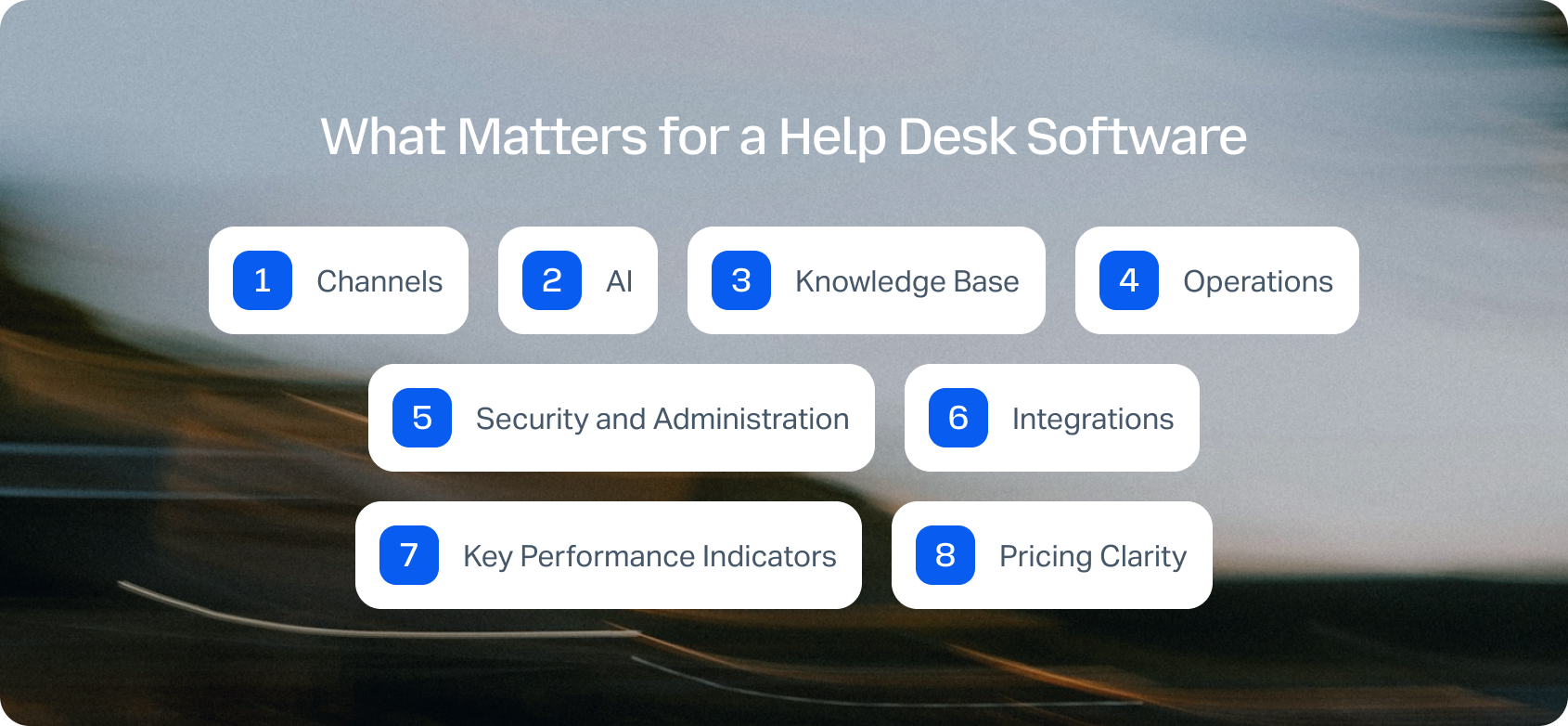
Channels
Modern help desk software for customer support needs to meet people where they are. Whether they want to chat on the phone or via social media, companies need to be agile. A robust help desk system consolidates these multiple support channels into a unified inbox, allowing agents to view the complete customer history regardless of how customers contact you. Seamless handoffs from chat to voice or email to chat prevent customers from repeating themselves and keep your support agents working in one workspace.
AI
AI supports the flow from intake to resolution. Incoming messages are classified with natural language processing, which tags issue type, priority, and required skills to route work to the correct queue. Agents receive a concise AI ticket summary, as lengthy email threads or chats are distilled into key points. During the conversation, suggested replies pull trusted content from your knowledge base to speed up responses and keep them consistent, while real-time translation enables agents to assist customers in any language. In parallel, sentiment analysis flags at-risk conversations, allowing leaders to prioritize follow-up and prevent escalations. Agents are not overwhelmed with redundant tickets due to spam filtering.
Knowledge Base
A smart knowledge base does more than store articles. It integrates into agent workflows, surfacing relevant help articles mid-conversation. For customers, it enables self-service options through a customer portal, thereby reducing ticket volume and enhancing the customer experience. The best help desk tools ground their AI-proposed replies in knowledge base content, ensuring agents provide accurate and consistent information without relying on guesswork.
Operations
Call center workforce management uses ticket trends to forecast demand and schedules agents to meet it. Customer service quality assurance samples interactions, scores them against rubrics, and surfaces coaching opportunities. SLA dashboards show real-time performance by agent, team, channel, and priority. Automated ticket routing distributes workload effectively across your customer support team.
Security and Administration
Administration features, including multi-factor authentication, audit logs, role-based permissions, and data retention policies, are non-negotiable for compliance with regulations like the General Data Protection Regulation. You need controls in place to determine who can change routing rules, access customer data, or modify system configurations. Enterprise help desk software must meet strict data security standards.
Integrations
Your help desk should integrate with CRM systems (such as Salesforce or HubSpot), commerce platforms (like Shopify or Magento), telephony systems, and business intelligence tools. Open APIs and webhooks enable custom workflows without the need for middleware. The best help desk software solutions offer extensive customization options through integration capabilities that connect your entire tech stack.
Key Performance Indicators
Begin with a concise scorecard that tells a single story. First-contact resolution indicates whether issues are resolved on the first interaction, while average handle time reflects agent productivity. In parallel, the containment rate indicates how well your AI voicebot or AI customer service chatbot deflects tickets, and the abandonment rate signals capacity or wait-time problems. Pair these with time-to-resolution to see how quickly cases close; layer in sentiment scores to identify at-risk customers; and use CSAT to confirm that the experience was well-received.
Pricing Clarity
Understand seat-based costs versus usage fees. Some help desk software SaaS platforms charge per user per month for basic features, then meter additional services such as tickets, AI interactions, or support requests separately. Others use ticket-based pricing models that scale with volume. Avoid desk platforms that require expensive add-ons for essential help desk software features, such as automated ticket routing, knowledge base integration, or AI assistance. Look for transparent pricing that includes core capabilities without forcing everything into premium tiers.
Understanding what to look for is one thing, seeing it in action is another. If you'd like to explore how AI-powered ticketing, phone support, workforce management, quality assurance, and omnichannel customer service work together in a single platform, book a personalized BlueTweak demo.
We'll show you how teams can automate ticket routing, improve agent productivity, and deliver faster, more consistent customer support.
How We Evaluated
This customer help desk software comparison draws on publicly available sources, including vendor documentation, feature breakdowns, and real-world case studies.
We also reviewed public customer logos and case studies to see which platforms are being used in practice. When pricing is listed on a vendor’s site, you’ll see it here. If it’s hidden behind a quote request or varies by plan, we’ve also noted that.
The pros and cons aren’t guesses or marketing fluff, either. Our help desk tools comparison is grounded in what’s verifiable. No hype, no filler. Just a straightforward, evidence-based comparison of help desk software to help you choose the right help desk software for your team.
Must-Have Capability Checklist
When evaluating top help desk software, it has to cover these foundational requirements:
- Omnichannel intake: Email, chat, voice, and social messaging, so customer context flows between channels
- Knowledge base integration: Strong KB-grounded answers for consistent support
- AI features: Classification, summarization, proposed reply, and translation to streamline communication
- Analytics: Track 2–3 KPIs, including ticket resolution rates, customer satisfaction, and agent performance
- Workforce management and quality assurance: Native modules or strong first-party integration
- Security and administration: MFA, audit logs, role-based permissions for compliance
- Integration capabilities: APIs and pre-built connections with CRM, commerce, and business systems
- Transparent pricing: Core AI features included, not only sold as add-ons
- Task management: Organizational tools to help agents prioritize and track customer inquiries
Scoring Rubric
These factors guided our evaluation of the best help desk tools:
| Criteria | What to Look For |
|---|---|
| Fit for 20–100 agents | Works for small to mid-sized support teams without requiring enterprise contracts |
| Omnichannel depth | Unifies voice, email, chat, and social media into one workspace |
| AI coverage | Agent assist features plus knowledge base grounding, not just basic automation |
| WFM and QA | Native modules reduce vendor complexity and speed time-to-value |
| Time to value | How quickly can you deploy and start seeing results? |
| Total cost to operate | Licensing, usage fees, integrations, and support costs combined |
| Security and control | Compliance-ready features for regulated industries |
| Ease of use | Minimal learning curve so agents can work productively from day one |
Choosing the Right Help Desk Software in 2026
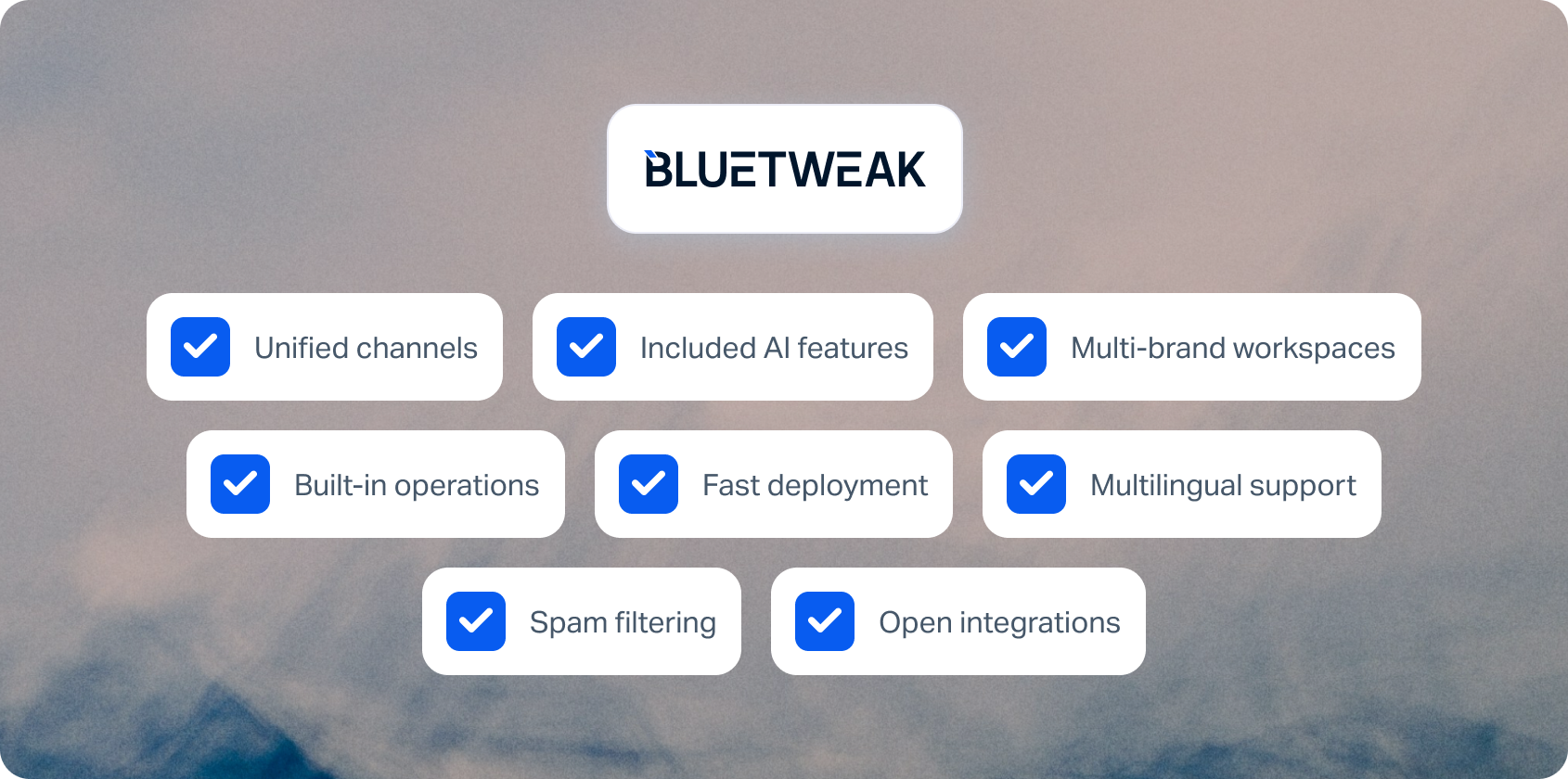
The best help desk software in 2026 depends on your team size, channel requirements, AI needs, and operational complexity. If you're a small team primarily handling email support with occasional chat, platforms like Help Scout, Freshdesk, or Zoho Desk offer simplicity and affordable entry pricing. For enterprises managing hundreds of agents across multiple channels, Salesforce Service Cloud, ServiceNow, and Genesys Cloud CX provide extensive capabilities, albeit with greater complexity and higher costs.
For customer support teams with 20 to 100 agents that need true omnichannel coverage, AI-powered automation, and workforce management without relying on multiple disconnected tools, BlueTweak stands out. It combines voice, email, chat, and social messaging with AI-powered ticket summaries, suggested replies, call transcription, workforce management, quality assurance, and transparent pricing in a single platform.
BlueTweak is a strong fit if you:
- Need a customer service platform that unifies voice, email, chat, and social channels
- Want AI features like call transcription, ticket summarisation, and knowledge base-grounded suggested replies included without expensive add-ons
- Manage multiple brands or client accounts from a single workspace
- Need built-in workforce management and quality assurance instead of third-party integrations
- Want to deploy in weeks rather than months
- Support multilingual customers with real-time translation
- Need automated spam detection to keep agents focused on genuine customer enquiries
- Prefer an API-first platform that integrates with your existing business systems
Ready to see BlueTweak in action? Book a personalised demo to explore its omnichannel capabilities, AI-powered automation, workforce management, and unified analytics. You can also use the ROI Calculator to estimate how much your business could save by consolidating customer support into a single platform.



