



TL;DR
IVA and IVR both help contact centers handle inbound calls and provide 24/7 customer support, but they work in very different ways. An interactive voice response (IVR) system uses menu options, keypad inputs, or predefined voice commands for tasks such as basic call routing, while an intelligent virtual agent (IVA) uses voice recognition technology, natural language understanding, and AI to understand what customers need and respond conversationally. For simple tasks, businesses may find IVR sufficient, while an IVA can handle more complex queries, detect customer sentiment, and escalate to a human agent when needed, helping support improved customer satisfaction.
When a customer calls for support, the first few seconds can shape the entire interaction. They might need to check an order, update their information, resolve a billing issue, or speak to someone about a problem that doesn't fit neatly into a menu. An IVR can route that call. An IVA can understand it.
That distinction matters as customer expectations move beyond rigid menu trees and pre-recorded messages. Customers don't necessarily want to listen to a list of options and work out which one best matches their problem. They want to explain what they need and get the right response, whether that's a quick self-service answer or help from a human agent.
For contact centers dealing with high call volumes, the difference can also affect customer service efficiency. Choosing between traditional IVR technology and an IVA isn't simply about adding more AI to the call flow. It's about understanding what your customers need to accomplish and how much complexity your voice support needs to handle.
BlueTweak brings voice support into the same platform as chat and email, so when a conversation does need human intervention, the agent can receive the context from the interaction rather than starting again from scratch.
What Is The Difference Between IVR And IVA?
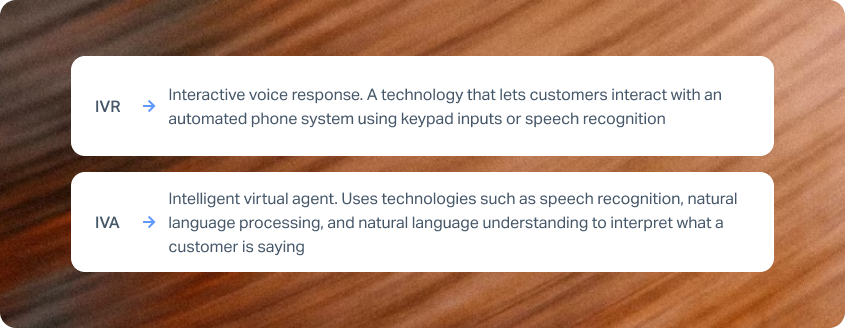
The key difference between IVR and IVA is how they understand and respond to customer inputs. An IVR follows predefined rules and routes calls based on keypad selections or specific spoken commands, while an IVA uses AI to understand natural language and respond to the intent behind a customer's request.
What Is An IVR?
IVR stands for interactive voice response. It's a technology that lets customers interact with an automated phone system using keypad inputs, known as dual-tone multi-frequency (DTMF), or speech recognition.
A traditional IVR system might greet a caller and say:
"Press 1 for sales, press 2 for billing, or press 3 for technical support."
The caller chooses an option, and the IVR follows the predefined call flow to route them to the correct department or provide a basic piece of information.
This makes IVR useful for straightforward tasks and efficient call routing. A well-designed IVR can handle basic inquiries, direct calls to the right team, and reduce the number of calls that require human customer service.
The limitation is that the system generally works within the options and rules it has been given. If a customer's request doesn't fit the menu, the caller may have to navigate several steps before reaching a human agent.
What Is An IVA?
IVA stands for intelligent virtual agent (or sometimes, intelligent virtual assistants). An IVA uses technologies such as speech recognition, natural language processing (NLP), and natural language understanding (NLU) to interpret what a customer is saying.
Instead of asking a customer to select from a fixed set of menu options, an IVA can let them describe what they need in their own words. For example, a customer might say:
"I was charged twice for my order and I'd like to know what's happened."
Rather than matching that statement to a single menu option, an IVA can identify the customer's intent, access relevant customer data where appropriate, and respond or take the next step according to the workflows it's been configured to handle.
That makes IVA systems better suited to more complex customer queries, personalized responses, and conversations where the customer's intent isn't obvious from a predefined menu.
The distinction becomes particularly important when a customer needs human support. An IVA can pass relevant conversation context to a human agent, helping the customer avoid repeating information they've already provided.
IVR Vs. IVA: The Key Differences
The difference between IVR and IVA comes down to how much the system can understand, rather than simply how a customer interacts with it. Both can automate customer interactions and route calls, but they use different approaches to understanding customer inputs and deciding what happens next.
An IVR system is effective when the customer journey is predictable. If a caller simply needs to choose a department, check a basic piece of information, or complete a straightforward self-service inquiry, there's little reason to make the interaction more complicated.
An IVA becomes more useful when customers don't necessarily know which option they need, or when their request involves several pieces of information. Instead of forcing the caller to work their way through a decision tree, the intelligent virtual agent can interpret the request and determine what needs to happen next.
This is where technologies such as speech recognition, natural language processing, and natural language understanding make a practical difference. The system isn't just recognizing what a customer said. It's using that information to understand the intent behind the request and respond accordingly.
The result can be a more natural customer experience, particularly when an interaction doesn't fit neatly into the menu options of a traditional IVR.
When Is An IVR Enough?
Not every contact center needs an IVA for every inbound call. Traditional IVR still has a useful role when customers have simple, predictable needs and the call flow doesn't require much interpretation.
For example, an IVR may be sufficient for:
- Directing customers to sales, billing, or technical support
- Providing opening hours or basic account information
- Collecting a customer ID before connecting the call
- Handling simple self-service requests
- Routing calls during periods of high call volumes
- Providing pre-recorded information that doesn't need personalization
For these types of interactions, menu-based routing can be quick and easy to maintain. A caller who knows they need the billing department doesn't necessarily benefit from having an AI conversation before being connected to the right team.
IVR can also provide a useful first layer of automation in a larger support operation. It can collect basic information, reduce unnecessary transfers, and make sure calls reach the correct department.
The important question is whether the IVR is helping customers complete their task or simply making them navigate the system before they can reach a human agent.
A poorly designed IVR can create friction when menu options don't match the way customers describe their problems. A customer might know exactly what they need, but still have to listen to several options, choose the closest match, and potentially repeat the same information after being transferred.
That's where an IVA can offer a different approach.
When Should You Choose An IVA Over Traditional IVR?
An IVA becomes more valuable when customer interactions are too varied, complex, or conversational for a fixed call flow. If customers regularly ask questions in their own words, need personalized support, or move between several parts of a service journey, an intelligent virtual agent can handle more of the interaction before human intervention is needed.
Consider a customer calling to ask why their latest order hasn't arrived. With a traditional IVR, they may need to select an option for orders, another for delivery, and potentially another option depending on the status of the order.
An IVA could instead understand the customer's request, identify the relevant intent, retrieve the information it needs, and provide a response. If the issue can't be resolved automatically, it can route the call to a human agent with the relevant context.
This distinction becomes particularly important for contact centers handling complex customer requests. The value of an IVA isn't simply that it can answer more questions. It's that it can understand the customer's request within the context of the interaction and determine whether it can resolve the issue, gather more information, or escalate it.
As Radu Dumitrescu, BlueTweak's Head of Presale & Digital Transformation, explains:
“It’s not [just about] when to escalate, but how the escalation actually works. If the agent doesn’t inherit the full story, the system has already failed, regardless of how accurate the routing logic is.”
That principle applies directly to IVA and IVR design. Getting a customer to the correct department is only part of the experience. If the customer then has to explain the entire problem again, some of the efficiency gained through automated call routing is lost.
An IVA can make the handoff more useful by carrying information from the automated interaction into the human conversation. BlueTweak's approach is built around this connected experience, with AI customer support voice operating alongside chat and email rather than as a separate layer.
That makes an IVA particularly relevant when a contact center needs to balance self-service with human customer service. Routine tasks can be automated where appropriate, while complex customer issues can still reach a human agent with the information they need to continue the conversation.
IVA Vs. IVR: Which Is Right For Your Contact Center?
The choice between IVA and IVR depends on the type of customer interactions your contact center needs to handle. If most inbound calls involve simple, predictable requests, an IVR can provide efficient call routing and self-service without unnecessary complexity. If customers regularly make complex inquiries or expect conversational, personalized support, an IVA may be better suited to the job.
A useful way to think about the difference is to look at the complexity of the customer's request.
This isn’t a simple matter of replacing every IVR system with an IVA; it's about matching the technology to the customer journey. For example, a business that mainly needs to route calls to the correct department may find that an IVR provides everything it needs. A contact center where customers frequently explain problems in their own words, ask follow-up questions, or move between multiple issues may need the more advanced AI capabilities of an IVA.
There can also be a place for both. An IVA can handle conversational interactions, while existing IVR technology continues to support simple call flows where menu-based routing is appropriate. The important thing is to understand what you're trying to automate before choosing the technology.
What Can An Intelligent Virtual Agent Handle?
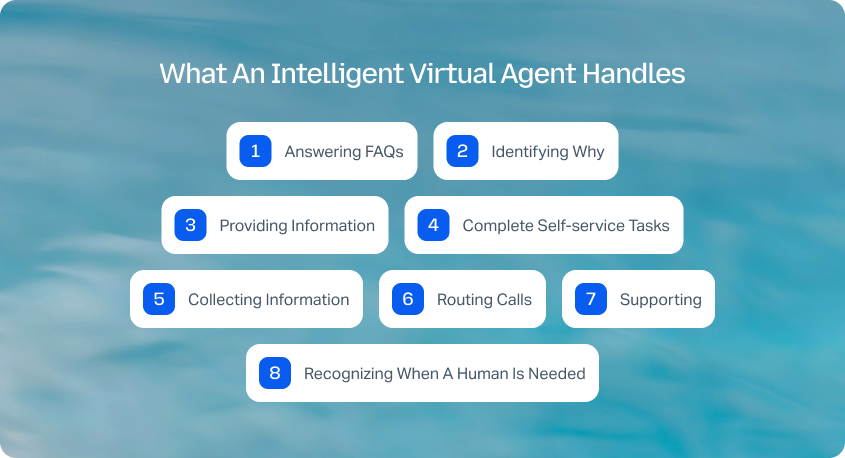
An intelligent virtual agent can handle more than basic call routing because it can interpret the meaning behind a customer's words. Using speech recognition technology, natural language processing, and natural language understanding, an IVA can identify intent and use that information to determine an appropriate response or next action. This is the basic role of an AI voicebot: understanding spoken requests, determining what the customer needs, and responding or routing the interaction according to the workflow behind it.
Depending on how the IVA is configured and what systems it can access, it may be able to:
- Answer frequently asked customer inquiries
- Identify why a customer is calling
- Provide account or order information
- Complete defined self-service tasks
- Collect information before a human handoff
- Route calls based on customer intent
- Answer questions using a connected knowledge base
- Support customers in multiple languages
- Recognize when human intervention is needed
This means customers don't necessarily need to know the right department, menu option, or terminology before they can get help. They can describe what they need, and the IVA can interpret the request and determine where it belongs. For contact centers, that can help automate customer interactions without forcing every customer into the same rigid call flow.
However, an IVA isn't a substitute for human customer service in every situation. Complex customer issues may require judgment, discretion, or access to information the IVA isn't authorized to handle. An IVA should therefore be designed to recognize its boundaries and make a useful handoff when it reaches them.
That's where the quality of the underlying customer data, workflows, knowledge base, and escalation process matters just as much as the voice technology itself.
Why Context Matters When An IVA Escalates To A Human Agent
Automation doesn't end when an IVA transfers a call to a human agent. In many cases, that's where the quality of the overall customer experience becomes most obvious.
Imagine a customer spends several minutes explaining a billing problem to an IVA. The IVA identifies the issue correctly, gathers the relevant information, and then transfers the call to a human agent.
If the agent answers with, "How can I help you today?", the customer may have to start again. The routing worked, but the experience didn't.
A more effective handoff carries the relevant context from the automated interaction into the human conversation. The agent can see what the customer was trying to accomplish, what information they've already provided, and what the IVA has already done.
This can reduce repetition for the customer while giving the human agent a clearer starting point. It can also help protect customer data by limiting the need for customers to repeatedly provide sensitive or identifying information during the same interaction.
For this reason, an IVA shouldn't be evaluated only on how many calls it can answer or how accurately it can recognize intent. The handoff process is part of the customer experience too.
This is one of the key differences between adding a voice layer to an existing support operation and using voice as part of a connected customer service platform.
When voice, chat, and email operate within the same environment, the context of a customer interaction can follow the customer across channels. A human agent doesn't have to treat the voice call as an entirely new conversation simply because the automated part of the journey has ended.
BlueTweak takes this connected approach by bringing AI voice support into the same customer service platform as its other support channels. That means an IVA can handle the initial interaction, while human agents can step in when the request requires human intervention, with the relevant context available to continue the conversation.
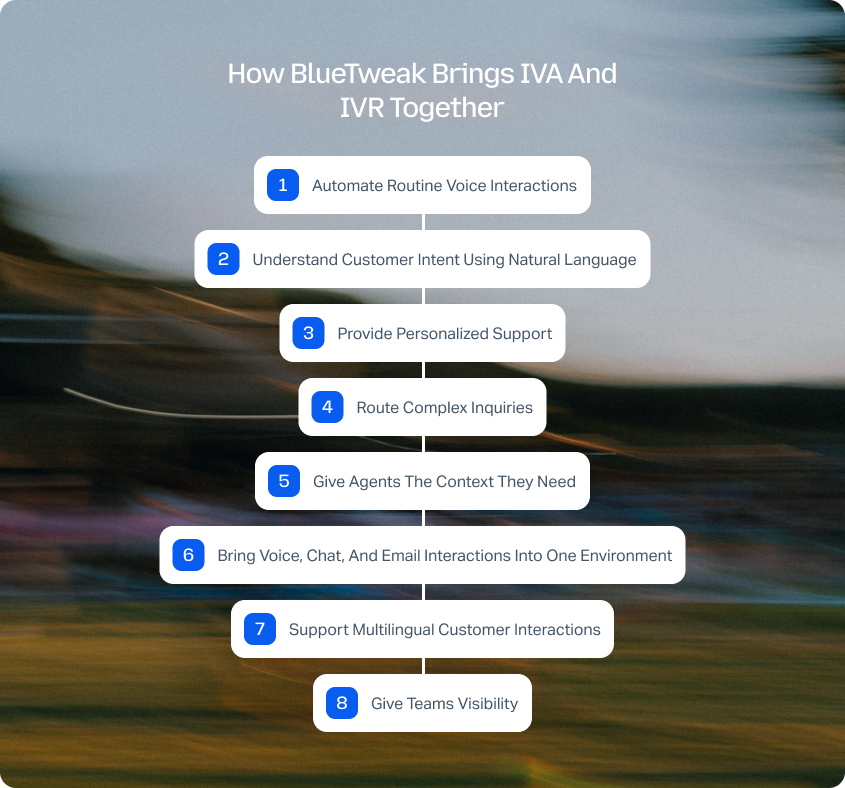
How BlueTweak Brings IVA And IVR Together
BlueTweak gives contact centers a way to use AI voice support without treating voice as a separate layer from the rest of their customer service operation.
Its conversational AI voice capabilities can understand customer requests using speech recognition and natural language understanding, respond to customers, and route conversations when human intervention is needed. But the bigger difference is what happens around the voice interaction: voice sits within the same platform as chat, email, knowledge management, ticketing, and analytics. This is part of a broader conversational AI customer service approach, where voice and chat can draw on the same knowledge and interaction history rather than operating as separate systems.
That connected approach matters because customer interactions rarely exist in isolation. A customer might start with an email, move to chat, and then call when they need something resolved more quickly. If each channel operates separately, the customer may have to repeat their information at every stage. The right mix of voice and text support also depends on the type of interaction, customer preferences, and how much complexity the issue involves.
With BlueTweak, the relevant customer context can stay connected across the support journey. This can help contact centers:
- Automate routine voice interactions without forcing customers through rigid menu options
- Understand customer intent using natural language rather than relying only on keypad inputs
- Provide personalized support using relevant customer data and conversation context
- Route complex inquiries to the appropriate human agent
- Give agents the context they need when a conversation is escalated
- Bring voice, chat, and email interactions into one customer service environment
- Support multilingual customer interactions through AI-powered voice capabilities
- Give teams visibility into voice interactions alongside their other support data
The result is a voice channel that's connected to the wider customer service operation. That can make a difference to both customer experience and agent productivity. Customers don't have to navigate a separate system simply because they've chosen to call, while agents don't have to piece together what happened before a conversation reached them.
For businesses looking to move beyond traditional IVR, that connection can be just as important as the AI itself. The best way to understand what that can look like in practice is to experience the platform across a real customer service workflow, from the initial voice interaction through to self-service, escalation, and human support.
BlueTweak offers a 14-day free trial with no credit card required, so teams can explore how AI-powered voice support fits into their existing customer service operation and see how connected interactions can work in practice.
How To Implement An IVA Without Compromising Security
Adding an IVA to a contact center means giving an AI system access to customer conversations, and potentially to the systems and data needed to resolve customer requests. Security and user experience therefore need to be considered together from the beginning.
An IVA shouldn't have unrestricted access to customer data simply because that data might be useful. Access should be limited to the information and actions the system needs to perform its defined tasks, with appropriate controls around authentication, permissions, and escalation.
When evaluating IVA solutions, consider questions such as:
- What customer data can the IVA access?
- Which systems can it connect to?
- What actions is it allowed to take?
- How is sensitive information protected?
- What happens when the IVA can't confidently resolve a request?
- Can conversations be escalated to a human agent?
- What information is passed to the agent during the handoff?
- How are voice interactions monitored and reviewed?
These questions are particularly important for contact centers handling personal, financial, or otherwise sensitive customer information. Strong security controls can help reduce the risk of unauthorized access or security breaches, while clear escalation rules ensure that the IVA doesn't attempt to handle complex tasks beyond its remit.
The customer should also remain in control of the interaction. An automated system can be efficient, but customers need a clear route to human customer service when automation isn't appropriate.
In other words, successful IVA implementation isn't just about making the AI capable of handling more calls. It's about defining what the system should handle, what it shouldn't, and how those boundaries work in practice.
IVA Vs. IVR: Moving From Call Routing To Connected Customer Service
IVR and IVA solve different problems. Traditional IVR systems are still useful for straightforward tasks, predefined call flows, and basic call routing. They're a practical option when customers can easily select the right menu option and the interaction doesn't require much interpretation.
An IVA can take that further by allowing customers to explain what they need naturally. With speech recognition, natural language processing, and natural language understanding, it can identify intent, handle a broader range of customer queries, and provide personalized responses before involving a human agent when necessary.
But the technology itself isn't the whole story; the quality of the customer experience depends on what happens before, during, and after the automated interaction. An IVA that understands a complex request but leaves the customer repeating everything to a human agent has only solved part of the problem.
For contact centers considering IVA and IVR solutions, the more useful question may therefore be: how well does the technology fit into the customer service operation around it?
When voice is connected to chat, email, customer data, knowledge bases, ticketing, and human agents, automation becomes part of a continuous support experience rather than a standalone call-routing tool.
BlueTweak takes this approach; its AI-powered voice support works within the same customer service platform as other channels, allowing businesses to automate appropriate interactions while keeping human customer service connected to the conversation when it's needed.
Ready to see how connected voice support could work for your team? Book a demo with BlueTweak today.

As Head of Digital Transformation, Radu looks over multiple departments across the company, providing visibility over what happens in product, and what are the needs of customers. With more than 8 years in the Technology era, and part of BlueTweak since the beginning, Radu shifted from a developer (addressing end-customer needs) to a more business oriented role, to have an influence and touch base with people who use the actual technology.



