



TL;DR
Customer service quality monitoring often relies on reviewing a small sample of customer interactions, but that sample can’t tell you what’s happening across your entire support operation. A stronger approach combines QA scorecards, customer feedback, and service data to identify quality issues at scale while giving human reviewers the context they need. BlueTweak brings these signals together, including customer satisfaction surveys on every resolved contact, so support leaders can see where quality is strong, where it’s slipping, and where closer review is needed.
You can’t improve what you can’t see. And if your customer service quality monitoring process only reviews a fraction of the interactions your team handles, there’s a lot you can’t see.
Most support teams use sampling for a practical reason: manually reviewing every ticket, chat, and call simply isn’t feasible. But the contacts that make it into your QA queue may not represent the wider customer experience. A sample can show you whether those interactions met your standards. It can’t tell you whether the same is true for everything else.
That leaves support leaders with a difficult question: How do you know your quality scores reflect the customer experience as a whole?
BlueTweak takes a broader approach, combining QA scorecards with customer satisfaction surveys, interaction data, and analytics. Instead of relying on a small selection of contacts to understand quality, you can use feedback from every resolved interaction to spot patterns and identify where human QA can have the greatest impact.
Why Sampling Limits Customer Service Quality Monitoring
Customer service quality monitoring is the process of evaluating customer interactions against defined standards for accuracy, resolution quality, communication, compliance, and customer experience. Sampling makes that evaluation manageable, but it also introduces a blind spot: the interactions you review are only a fraction of the interactions your customers have.
A sample can be useful for assessing individual agents, calibrating reviewers, and identifying coaching opportunities. The problem comes when that sample is treated as a reliable proxy for overall service quality.
Consider what can happen when contacts are selected manually:
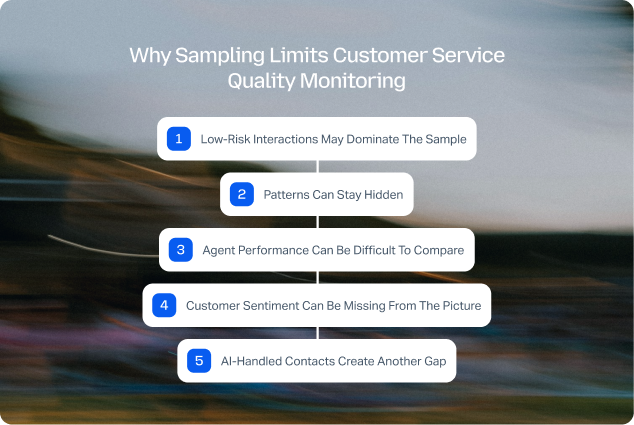
- Low-risk interactions may dominate the sample. Straightforward contacts can be easier to identify and review, while complex or unusual cases may be missed.
- Patterns can stay hidden. If a recurring issue affects a small percentage of contacts, it may not appear often enough in a sample to trigger investigation.
- Agent performance can be difficult to compare. A handful of interactions may not reflect how an agent performs across different channels, customers, or types of request.
- Customer sentiment can be missing from the picture. A reviewer can assess whether an interaction followed the right process, but that doesn't necessarily tell you how the customer felt about the outcome.
- AI-handled contacts create another gap. If your QA process was designed around human interactions, it may not give you the visibility you need as more contacts are handled or assisted by AI.
The answer isn't to abandon human QA. Detailed interaction reviews are still essential for coaching, calibration, compliance, and understanding what happened in a specific contact.
The bigger opportunity is to stop asking QA sampling to answer questions it wasn't designed to answer. A sample is one source of insight. To understand customer service quality across the operation, you need more signals.
What Should You Monitor When You Can’t Review Everything?
Effective customer service quality monitoring isn’t about measuring every possible detail of every customer interaction. It’s about combining the right quality metrics to understand whether your service delivery meets customer expectations, where agent performance is falling short, and what needs closer attention.
For a contact center or call center, that means looking beyond individual calls or tickets and considering the broader patterns in your quality monitoring data. Your quality assurance process should give you visibility into areas such as:
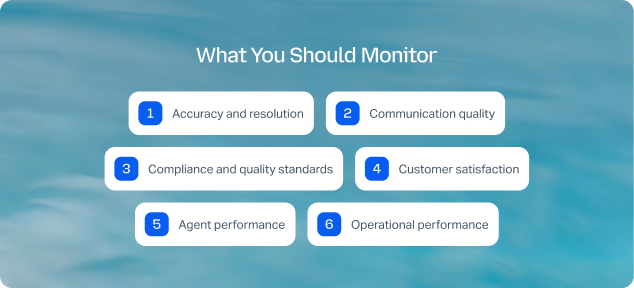
- Accuracy and resolution: Did the agent provide the right information, follow the correct process, and resolve the customer’s issue? First call resolution (FCR) is particularly useful here because it shows whether customers are getting the help they need without repeat contacts.
- Communication quality: Did the agent demonstrate active listening, communicate clearly, and adapt their response to the customer? Call monitoring and interaction reviews can help assess these behaviors in more detail.
- Compliance and quality standards: Did the interaction meet your required policies, processes, and consistent service standards?
- Customer satisfaction: How did the customer rate the interaction? Customer satisfaction scores and post-call surveys provide a perspective that an internal QA review can’t capture on its own.
- Agent performance: Are particular agents, teams, channels, or interaction types showing recurring strengths or weaknesses? Performance data can help your QA team identify where agent development or training could make the biggest difference.
- Operational performance: Are quality issues connected to key performance indicators such as first call resolution, response times, repeat contacts, or other customer service metrics?
The important point is that these measures answer different questions. A high QA score doesn't necessarily mean customers are satisfied, just as a strong customer satisfaction score doesn't tell you whether an agent followed every required process.
Taken together, however, they give call center managers and other support leaders a much more useful view of service quality. You can identify patterns across customer service interactions, investigate customer pain points, and decide where detailed quality assurance is most valuable.
Build a QA Scorecard Around What Good Looks Like
A QA scorecard customer service teams can use turns your quality standards into a consistent framework for evaluating customer interactions. It gives your quality assurance team a shared definition of good service, so agents aren't being assessed differently depending on who reviews their work.
When building a QA scorecard customer service teams can apply consistently, focus on the areas that have the biggest impact on service quality. A useful scorecard should reflect the things that actually matter to your customers and your business. Depending on your support model, that might include:
The exact categories will vary by business, but consistency matters more than creating the longest possible scorecard. A QA process with dozens of criteria can become difficult for reviewers to apply consistently and difficult for agents to understand.
Your scorecard should also distinguish between critical requirements and areas where agents have room to use their judgment. For example, a compliance failure may need to carry more weight than a minor variation in wording. That makes the resulting customer service quality score more meaningful and gives managers clearer priorities for agent training and coaching.
It’s also worth reviewing your scorecard as customer expectations, products, and service processes change. If your quality standards haven’t changed in years, they may no longer reflect what customers actually value.
Most importantly, a scorecard shouldn't exist in isolation. Connect QA scores with customer feedback, customer satisfaction scores, performance tracking, and other quality monitoring data wherever possible. That gives your QA team more context when deciding whether a low score represents an isolated interaction or part of a wider pattern.
Use More Than One Signal to Measure Customer Service Quality
Customer service quality is too broad to capture in a single score. A stronger quality management approach combines QA results with customer feedback, operational data, and customer satisfaction to show what’s happening across the customer experience.
Think of each signal as answering a different question:
It’s important to note that the signals don't always move together. An agent might achieve a high QA score while customers consistently report frustration because the process they’re following creates unnecessary effort. Another agent might have slightly lower scores against a rigid scorecard but consistently receive positive customer feedback because they’re particularly effective at handling complex or sensitive cases.
That doesn't mean one measure is right and the other is wrong. It means the combination gives you a more complete picture of call center quality and contact center quality.
For call center managers and center managers, this broader view makes quality monitoring more actionable. Instead of simply asking whether an agent passed a QA review, you can ask whether the underlying issue is affecting customer satisfaction, first call resolution, operational efficiency, or customer loyalty.
It also helps your QA team prioritize its time. When quality monitoring software brings together interaction data, customer feedback, and performance data, you can identify patterns across a much wider set of customer service interactions and then use detailed call monitoring or ticket reviews to understand what's driving them.
That’s a more useful role for quality assurance: not trying to manually inspect everything, but using broader signals to identify where human review can make the biggest difference.
Move From Ticket Sampling to Feedback on Every Resolved Contact
Customer feedback from every resolved contact can give support leaders a broader view of customer service quality than ticket sampling QA alone. Instead of relying only on the interactions selected for manual review, you can use post-call surveys, chat surveys, or other post-contact feedback to understand how customers experienced service delivery across the operation. A QA reviewer evaluates an interaction against your internal quality standards, while the customer evaluates the experience from their own perspective.
Those perspectives should inform each other. For example, a QA scorecard might show that an agent followed the correct process, provided accurate information, and achieved a strong customer service quality score. But if customers consistently report that the process was confusing or took too long, there's a quality issue worth investigating.
This is where surveys can add valuable context to a QA process. When feedback is tied to the specific customer interaction that generated it, your quality assurance team can move from a broad signal to a specific example.
A useful customer feedback process can help you:
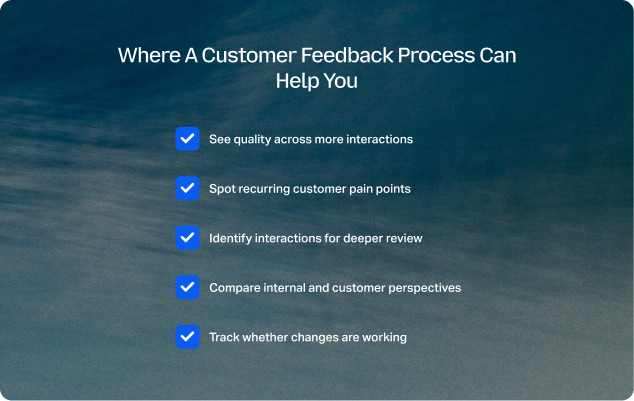
- See quality across more interactions: Feedback from every resolved contact gives you a broader data set than a manually selected sample.
- Spot recurring customer pain points: Patterns in customer satisfaction scores can highlight issues that may otherwise be missed by ticket sampling.
- Identify interactions for deeper review: Low scores, negative comments, or unusual feedback can give your QA team a reason to investigate the underlying interaction.
- Compare internal and customer perspectives: Looking at QA scores alongside customer satisfaction can reveal where your quality standards and customer expectations don't quite align.
- Track whether changes are working: Customer feedback can show whether coaching, agent training, or process changes are actually improving customer satisfaction over time.
This doesn't make manual quality assurance less important. It makes it more focused. Rather than asking a QA team to review more and more random contacts, you can use customer feedback and quality monitoring data to help determine which customer service interactions deserve closer attention.
That creates a more sustainable quality management approach: use broad signals to find the issues, then use detailed QA to understand them.
Use Customer Service Quality Scores to Find What Needs Human Review
A customer service quality score is most useful when it helps you decide what to investigate, rather than acting as a standalone verdict on an agent or interaction. Combining QA scores with customer feedback and performance data can help your QA team identify patterns and direct human review where it can have the greatest impact.
For example, imagine your contact center sees a cluster of low customer satisfaction scores after a particular type of interaction. That doesn't automatically mean the agents handling those contacts are performing poorly.
There could be several explanations:
- The process may be creating unnecessary friction.
- Agents may have a knowledge gap.
- Customers may have expectations the current service can't meet.
- A product or policy change may be generating confusion.
- The issue may be concentrated in one channel or customer segment.
- Agents may be following the required process correctly, but the process itself may need to change.
This is why quality monitoring shouldn't stop at identifying a low score. The next step is understanding why the score is low.
A connected QA process can help you compare customer satisfaction, quality scores, interaction data, and other key performance indicators to find those patterns. Your QA team can then review relevant calls, tickets, or chats in detail, using the interaction itself to establish what happened.
That changes the role of call center quality monitoring. Instead of trying to review enough random calls to feel confident about your results, you can use broader quality monitoring data to tell you where to look.
It can also make coaching more specific. If several low-scoring interactions reveal the same knowledge gap, for example, the answer may be targeted agent training rather than individual performance management. If the interactions show that agents are struggling with a particular workflow, the issue may sit with service delivery rather than the agents themselves.
The result is a more useful quality assurance process for both managers and agents. Quality monitoring becomes a way to support agent development, identify knowledge gaps, and improve customer service, rather than simply producing a score.
For a deeper look at how BlueTweak brings QA data, interaction insights, and coaching workflows together, explore the BlueTweak platform or book a demo to see how it can help your team turn quality insights into better customer experiences.
Which Customer Service QA Metrics Should You Track?
Customer service QA metrics should help you understand three things: whether your team is meeting quality standards, whether customers are getting the experience they expect, and where the operation can improve. The right mix will depend on your support model, but most contact centers should look beyond a single QA score.
The most useful customer support metrics are those that help you connect service quality with wider operational performance, rather than treating QA as a measure in isolation.
Here are some of the most useful metrics to consider:
Don’t be tempted to track every metric available; too many measures can make quality monitoring harder to interpret, particularly when teams aren't clear about what action each metric should trigger.
Instead, choose quality metrics that connect to your customer experience and business outcomes. If first call resolution is falling while customer satisfaction is also declining, for example, that's a stronger signal than either metric viewed independently. If QA scores remain high while satisfaction scores fall, it's worth investigating whether your scorecard still reflects what customers value.
Consider your call center KPI benchmarks when assessing whether changes in performance are significant or simply normal variation. Benchmarks can provide useful context, but they shouldn't replace looking at your own historical data, customer feedback, and quality trends.
It's also useful to segment quality monitoring data rather than looking only at an overall average. Break down performance by agent, team, channel, interaction type, or customer segment where the data supports it. This gives you a more useful view when you need to assess help desk performance across different areas of the operation and can help call center managers and contact center leaders identify patterns that an overall customer service quality score would hide.
Remember, metrics are signals, not explanations. A dashboard can tell you where performance has changed. The QA process, customer feedback, and interaction data help you understand why. That distinction is what turns quality monitoring into continuous improvement.
“The goal of quality monitoring isn't to review every interaction manually. It's to have enough visibility to know where quality is changing, and enough context to understand why. When customer feedback, performance data, and QA work together, teams can focus human attention where it has the greatest impact.” — Radu Dumitrescu, Head of Presale & Digital Transformation, BlueTweak
Don’t Forget AI-Handled Interactions
The sampling problem becomes even more important as AI takes on a greater role in customer service interactions. If your quality assurance process only reviews a selection of human-handled contacts, you may have limited visibility into how AI-assisted or AI-handled interactions are performing.
AI interactions also need to be evaluated against criteria that reflect how they operate, rather than simply applying a human-agent QA scorecard unchanged.
The principles are similar: you need broad visibility, consistent quality standards, and a way to identify interactions that need closer review. But the evaluation itself needs to account for the role AI played in the interaction.
How BlueTweak Supports Customer Service Quality Monitoring
BlueTweak brings the different signals used in customer service quality monitoring into the same system, giving support leaders a broader view of service quality without asking QA teams to manually review every interaction.
QA scorecards provide a consistent framework for evaluating customer interactions, while customer satisfaction surveys can be triggered when a contact is resolved. Because feedback is connected to the relevant ticket, chat, or call, your team can move from a customer satisfaction score or comment to the interaction that generated it.
That connection is important. Instead of treating QA, customer feedback, and performance data as separate sources, you can use them together to identify patterns and decide where human review is most valuable.
For example, a cluster of negative customer feedback can flag an interaction, agent, workflow, or issue for closer investigation. Your QA team can then review the relevant contact, use the scorecard to assess what happened, and determine whether the right response is coaching, agent training, a process change, or further investigation.
Analytics and reporting provide the wider view, helping teams track quality monitoring data alongside other performance indicators and identify changes over time. Performance management then gives managers a way to turn those insights into targeted coaching and agent development.
The result is a quality assurance process that uses automation to expand visibility while keeping human judgment at the center of quality management.
Ready to see how BlueTweak can support your quality monitoring process? Start your 14-day free trial and explore how customer feedback, QA scorecards, analytics, and performance management can work together in one system.
Turn Quality Monitoring Into a Continuous Improvement Loop
Effective customer service quality monitoring shouldn't end when an interaction receives a score. The real value comes from using what you learn to improve service delivery, then measuring whether that improvement actually worked.
A practical quality management loop looks like this:
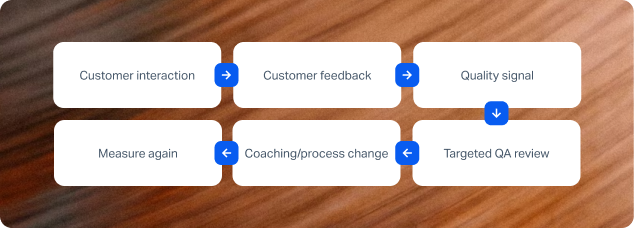
Customer feedback shows how the experience felt from the customer's perspective. Quality signals and performance data help identify patterns across the wider operation. Targeted QA review gives your team the detail needed to understand what's happening in individual interactions.
From there, managers can decide what needs to change. An agent may need additional training or coaching. A workflow may need to be simplified. A knowledge gap may need to be addressed. Or the quality standards themselves may need to be revisited because customer expectations have changed.
The final step is just as important as the first: measure again.
If customer satisfaction improves after coaching, that's useful evidence. If the same issue continues to appear in customer feedback, the underlying problem may not have been addressed. If QA scores improve but customers still report frustration, it may be time to question whether your scorecard is measuring the things that matter most.
This is where quality monitoring becomes part of continuous improvement rather than a periodic QA exercise. It gives managers a way to connect individual customer service interactions with broader business outcomes, while giving agents clearer feedback and opportunities for development.
That can support more than call center performance. A consistent approach to quality can improve employee engagement by making coaching more relevant, help teams deliver a more consistent service, and ultimately strengthen customer satisfaction and loyalty.
Essentially, focus shouldn’t be on eliminating human quality assurance but on giving your QA team better information about where their attention is needed.
When customer feedback, interaction data, QA scorecards, analytics, and performance management work together, quality monitoring becomes an ongoing feedback loop: see what's happening, understand why, make a change, and measure the result.
BlueTweak helps bring these quality signals together so your team can identify the interactions that need attention, coach more effectively, and turn customer feedback into continuous improvement. Book a demo to see how BlueTweak can support your customer service quality monitoring process.

As Head of Digital Transformation, Radu looks over multiple departments across the company, providing visibility over what happens in product, and what are the needs of customers. With more than 8 years in the Technology era, and part of BlueTweak since the beginning, Radu shifted from a developer (addressing end-customer needs) to a more business oriented role, to have an influence and touch base with people who use the actual technology.



