



TL;DR
A customer service plan template gives your team a structure for turning customer service goals into clear processes, responsibilities, and measurable outcomes. But a plan only works when it reflects how your team actually handles customer interactions, uses knowledge, manages automation, and measures service quality. This guide shows you what to include in your customer service plan, how to make it measurable, and how tools such as BlueTweak can help put it into practice.
A customer service plan can look great on paper and still fail your customers. You might have clear objectives, service standards, and a long list of customer service KPIs, but if agents can't find the information they need, requests aren't reaching the right people, or your metrics aren't telling you where customers are struggling, the plan isn't doing much to improve the experience.
That's the gap between documenting a service strategy and actually delivering it. A useful customer service plan connects what you want your customers to experience with the processes, knowledge, people, and technology that make it possible. BlueTweak brings those elements together, giving teams a way to turn their service strategy into consistent day-to-day support while measuring what's working and where there's room to improve.
In this guide, we'll break down what to include in a customer service plan template, how to set meaningful objectives and KPIs, and how to build a plan your team can actually use.
What is a Customer Service Plan?
A customer service plan is a practical document that sets out how your organization will deliver, manage, and improve customer service. It turns your broader customer service strategy into specific objectives, processes, responsibilities, resources, and measures that customer service teams can use in their day-to-day work.
A service plan should connect three things: what your customers need, what your business wants to achieve, and how your support operation will deliver both.
That could mean defining how quickly customers should receive a response, which communication channels you'll support, when an issue should be escalated, what information agents need access to, or which interactions are suitable for automation. It should also explain how you'll know whether those decisions are producing the intended results.
For example, a customer service goal might be to improve customer satisfaction. The plan then needs to go further by defining what will change to support that goal, which team owns the work, and which key performance indicators will show progress.
This is what makes a customer service plan different from a list of customer service best practices. It's a working framework for your particular organization, customers, processes, and business goals.
A customer service plan might cover:
- Customer needs and expectations: What customers value, where they experience pain points, and what they need from support.
- Customer service objectives: The specific outcomes your team is working toward.
- Service standards: Expectations for response times, resolution, communication, and quality.
- Processes and responsibilities: How requests are handled, routed, escalated, and resolved, and who owns each stage.
- Knowledge and resources: The information, templates, tools, and training agents need to provide consistent service.
- Automation and human support: Which tasks can be automated, where agents should be assisted by technology, and where human judgment is required.
- Customer service KPIs: The metrics you'll use to measure customer satisfaction, service quality, efficiency, and progress.
The exact details will vary from one business to another; that's why a customer service plan template is most useful as a starting structure, rather than something to copy and fill in without adapting it to your team's unique needs.
What Should a Customer Service Plan Include?
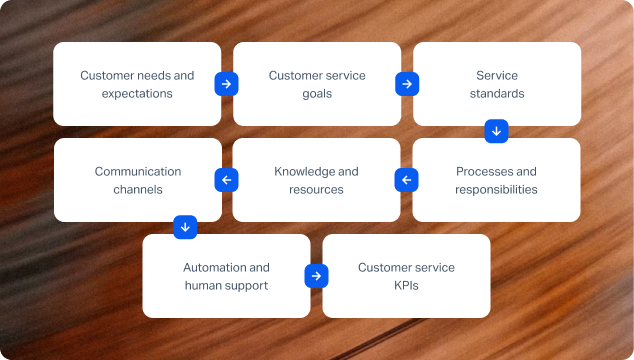
A customer service plan should cover the people, processes, resources, and measures your team needs to deliver the level of service your customers expect. While the exact structure will depend on your organization, a clear plan should give everyone a shared understanding of what you're trying to achieve, how you'll deliver it, and how you'll measure progress.
A useful customer service plan template should include the following key elements:
- Customer needs and expectations: Who are your customers, what do they need from your support team, and where do their biggest pain points occur?
- Customer service goals: What do you want your service operation to achieve, and how do those goals connect to wider business goals?
- Service standards: What should customers expect when they contact your team, including response times, availability, communication standards, and escalation procedures?
- Processes and responsibilities: How should common requests be handled, who owns different types of issues, and when should an interaction be escalated?
- Knowledge and resources: What information do agents need to resolve customer questions consistently, and where should they find it?
- Communication channels: Which channels will you support, and how should the customer experience remain consistent across them?
- Automation and human support: Which interactions can be handled or assisted by automation, and which require human judgment or intervention?
- Customer service KPIs: Which key performance indicators will tell you whether the plan is delivering the intended results?
The important thing is not to treat these as separate parts of the plan. They should work together. Your customer service goals should influence your service standards, your processes should support those standards, and your KPIs should tell you whether the whole system is working.
That's also why a template shouldn't become a document that gets completed once and then forgotten. Your customer service plan should be something your team can refer to, measure against, and update as customer needs and business priorities change.
“A customer service plan gives teams a shared direction, but its real value comes from turning that direction into consistent action. When goals, processes, and the right technology work together, teams can deliver better experiences without adding unnecessary complexity.” — Radu Dumitrescu, Head of Presale & Digital Transformation, BlueTweak
How to Set Customer Service Objectives That You Can Measure
Customer service objectives define the specific outcomes your team is working toward, giving your service plan a clear direction and a way to measure progress. The most useful objectives connect customer needs with business goals and can be translated into observable changes in customer interactions or service performance.
A broad goal such as "provide excellent customer service" might describe an ambition, but it doesn't give your team much to work with. A stronger objective gives that ambition some definition.
For example, if you want to improve customer satisfaction, your plan could set an objective to increase CSAT from its current baseline to a specific target within a defined period. The team can then identify what needs to change to make that improvement possible, whether that's reducing response times, improving first-contact resolution, giving agents better access to knowledge, or addressing a recurring customer pain point.
A useful way to structure customer service objectives is to make them:
- Specific: Clearly state what you want to change
- Measurable: Identify the metric or evidence you'll use to track progress
- Relevant: Connect the objective to customer needs and wider business goals
- Time-bound: Set a timeframe for achieving or reviewing the objective
For example:
The exact targets will depend on your current performance, customer expectations, resources, and business priorities. Avoid choosing a number simply because it looks ambitious. Your baseline should tell you where you are now, while your customer service plan should explain what you're going to change to move that number.
This is where customer service KPIs become more useful than a collection of impressive-looking metrics. Each KPI should have a reason for being in the plan and a clear relationship to a customer service objective. If a metric doesn't help your team understand customer satisfaction, service quality, efficiency, or progress toward a defined goal, question whether it needs to be there.
Define How Your Team Will Deliver the Customer Experience
Once you've established what your customer service team needs to achieve, your service plan needs to explain how those outcomes will be delivered. This means documenting the processes, communication channels, knowledge, responsibilities, and escalation paths that shape everyday customer interactions.
Start with the customer journey rather than the tools you currently use. Think about the most common reasons customers contact you and what needs to happen from the moment a request arrives through to resolution.
For each major request type, your plan should make it clear:
- Where the request starts: Which communication channel does the customer use, and what information is available when the interaction begins?
- Who handles it: Should it go to a general support queue, a specialist, another internal team, or an automated workflow?
- What information is needed: What should the agent or automation have access to in order to provide an accurate response?
- When it should be escalated: Which situations require human judgment, specialist knowledge, or involvement from another team?
- What a successful resolution looks like: How will you know the customer's need has been addressed?
- How the interaction is measured: Which customer service KPIs or feedback mechanisms will show whether the process is working?
This level of detail is particularly important when you're introducing automation tools. Automation shouldn't simply be added wherever there's a high volume of customer interactions. Your plan should define which requests are suitable for automation, which need human approval, and where customers should be able to move from an automated interaction to a person.
Knowledge is another important part of this process. Agents can't consistently deliver high-quality service if the information they rely on is scattered across outdated documents, internal messages, and different systems. A centralized knowledge base gives customer service teams a shared source of information, while governance processes help keep that information accurate as products, policies, and customer needs change.
Your customer service plan should therefore document not only what your team should do, but also what they need to do it well. That might include a knowledge base, customer relationship management system, help desk workflow, reporting tools, training resources, or automation capabilities.
When these elements are defined together, the plan becomes more than a statement of customer service goals. It becomes a practical framework for delivering a consistent customer experience, and a foundation for identifying where better processes or technology could improve service delivery.
Customer Service Plan Template: a Section-by-Section Framework
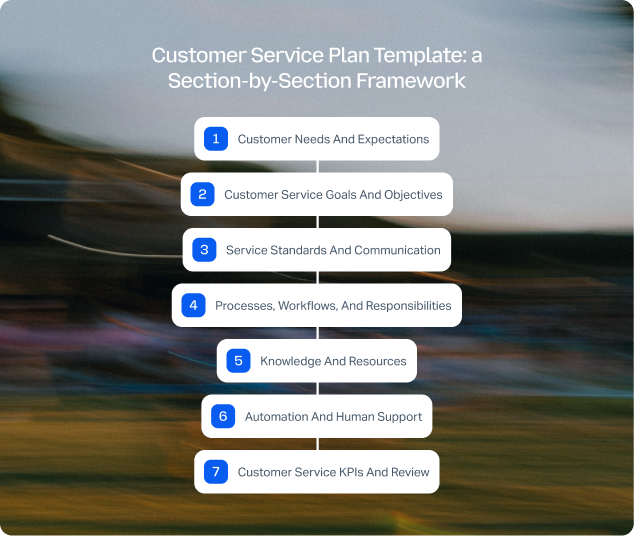
A customer service plan template gives you a practical structure for documenting your service strategy, from customer needs and objectives to processes, resources, and KPIs. Use the framework below as a starting point, then adapt each section to your customers, team, channels, and business goals.
1. Customer Needs and Expectations
Start by defining who you're supporting and what they expect from your customer service teams. Look at the questions customers ask most often, the points where they experience friction, and the issues that have the greatest impact on customer satisfaction and retention.
Your plan should describe your main customer groups, their common needs and pain points, and their expectations around response and resolution times. It should also account for preferred communication channels, feedback from surveys and reviews, CSAT results, and other customer research. Recurring issues may point to problems elsewhere in the customer journey, so include those too.
This section gives the rest of your plan a customer-focused foundation. Without it, it's easy to build a service strategy around what is convenient for the business rather than what customers actually need.
2. Customer Service Goals and Objectives
Next, define what your customer service operation needs to achieve. Your goals should support wider business goals, while your objectives should make those goals specific enough to act on and measure.
For each goal, explain the objective, the timeframe for achieving or reviewing it, and the teams or individuals responsible for delivering it. You should also identify the metrics you'll use to measure progress.
For example, "improve customer satisfaction" is a useful goal, but your objective could be to increase CSAT by a defined amount over the next six months by improving response times and resolving more issues at first contact.
3. Service Standards and Communication
Define what customers should experience when they contact your business. This gives agents and other internal teams a consistent reference point for service delivery.
Your plan should cover supported communication channels, expected response times, resolution targets where appropriate, tone and communication standards, availability, and support hours. It should also explain when an issue needs to be escalated and how handovers should work between teams or channels.
Your standards don't need to be identical across every channel. What's important is that they're clear, realistic, and aligned with customer expectations and the resources available to your team.
4. Processes, Workflows, and Responsibilities
Document how common customer requests should move through your organization. This is where your customer service strategy becomes an operational plan.
Describe the types of requests your team handles, how they're routed and assigned, and who owns each stage of the process. Clear ownership is an important part of effective customer support management, particularly when responsibilities span agents, specialists, and other internal teams. Include escalation paths, approval requirements, internal handoffs, and standard workflows for recurring issues. You should also explain how your team will identify and resolve repeat problems.
Where possible, keep these processes simple. A detailed plan isn't necessarily an effective customer service plan if agents need to navigate unnecessary steps to resolve a straightforward request.
5. Knowledge and Resources
Identify the information and resources your team needs to provide accurate, consistent service. This should include both the information customers need and the internal knowledge agents rely on.
Your plan might cover knowledge base content, product and service information, policies, procedures, troubleshooting guidance, customer service email templates, customer account information, and training materials. It should also establish who owns this information and how often it will be reviewed.
A knowledge base can become particularly valuable here because it gives agents a shared source of information instead of leaving important answers scattered across documents, messages, and individual employees' knowledge.
6. Automation and Human Support
Your service plan should also define where automation fits into the customer experience. Rather than treating automation as a separate technology decision, consider it alongside your processes and the types of support customers need.
Explain which interactions are suitable for automation and which require human judgment. Your plan should also clarify where human approval is needed, when an interaction should be escalated to an agent, how customers can request human support, and how automated interactions will be monitored and reviewed.
This makes your approach to automation more deliberate. High-volume requests may be suitable for automation, while complex, sensitive, or exception-based interactions may need a person from the outset or a clear route to human support.
7. Customer Service KPIs and Review
Finally, define how you'll know whether the plan is working. Choose a manageable set of customer service KPIs that reflect both the customer experience and the performance of the operation.
For each KPI, record the current baseline, target, reporting frequency, and person or team responsible. You should also explain what action will be taken if performance moves outside the expected range.
Your template is now more than a document describing how customer service should work. It gives your team a structure for connecting customer needs, service delivery, and measurable outcomes.
Choose the Right Customer Service KPIs
Customer service KPIs show whether your service plan is producing the results you intended, but the right metrics depend on the objectives you've set. Rather than tracking every available number, choose KPIs that help your team understand customer satisfaction, service quality, efficiency, and the health of the customer relationship.
For example, if your objective is to improve how quickly customers get help, response time may be relevant. If you're trying to reduce the effort involved in resolving issues, resolution time or first-contact resolution may provide more useful insight. If your priority is understanding how customers feel about the experience, CSAT or Net Promoter Score may be more appropriate.
Commonly used customer service KPIs include customer satisfaction, Net Promoter Score, first-contact resolution, first response time, average resolution time, SLA performance, ticket or interaction volume, and quality assurance scores. Each provides a different perspective: CSAT shows how customers rate a specific interaction, NPS indicates sentiment and willingness to recommend your business, and resolution metrics show how effectively your team handles requests. SLA performance measures whether service commitments are being met, while volume and quality scores provide context around demand and service standards.
The important question isn't whether your team is improving every metric at the same time. It's whether the metrics you're tracking help you understand progress toward the objectives in your service plan.
It's also worth looking at metrics together rather than in isolation. A faster response time doesn't necessarily mean customers are receiving better service if resolution times are increasing or customer satisfaction is falling. Similarly, a reduction in interaction volume could indicate that customers are finding answers more easily, or that they're struggling to reach your team.
Your reporting should therefore help you identify the relationship between operational performance and the customer experience. That's where a customer service plan becomes particularly useful: it gives your team a reason for tracking each metric and a framework for deciding what to do with the information.
How to Turn Your Customer Service Plan Into an Ongoing Process
A customer service plan shouldn't sit in a shared document until someone remembers to review it. To improve service over the long term, the plan needs to connect with the systems, workflows, knowledge, and reporting your team uses every day.
That starts with making your plan visible in day-to-day operations. If you've defined an escalation process, agents need a workflow that supports it. If you've identified your knowledge base as a critical resource, that knowledge needs to be easy to access and kept up to date. If you've set customer service KPIs, your team needs regular reporting that shows whether you're moving toward your targets.
The same applies to automation. If your service plan says that certain interactions can be automated, you need a way to monitor those interactions and identify when the results aren't meeting your standards. Human oversight should remain part of the process, particularly when an automated response could affect customer satisfaction, service quality, or the customer relationship.
Regular reviews can then turn the plan into a cycle of improvement:
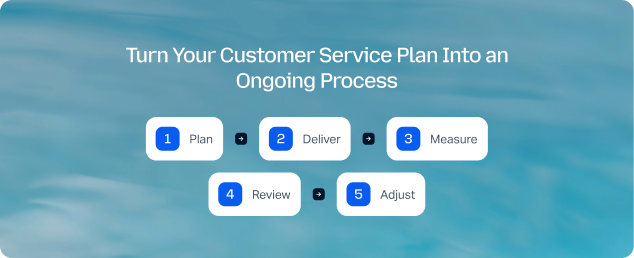
For example, your reporting might show that resolution times have increased for a particular request type. Reviewing those interactions could reveal that agents are struggling to find the relevant information. Updating the knowledge base or simplifying the workflow may then address the underlying problem more effectively than simply asking agents to work faster.
This is why the tools supporting your customer service operation matter. A plan can define the experience you want to deliver, but your knowledge base, workflows, automation, QA, and analytics need to make that experience achievable and measurable.
With BlueTweak, those capabilities sit within the same customer support platform. Teams can manage their knowledge, workflows, AI-assisted support, quality processes, and analytics in one operational system, making it easier to connect the strategy in your service plan with what happens in customer interactions.
The result is a customer service plan that can evolve with your business rather than becoming another document that goes out of date.
How BlueTweak supports your customer service plan

BlueTweak helps customer service teams turn the strategy in their service plan into the systems, workflows, knowledge, and measurement they use every day. Instead of managing these elements across disconnected tools, teams can bring customer interactions, AI assistance, knowledge management, quality assurance, and analytics together in one platform.
That can support several parts of your customer service plan:
Keep Customer Service Knowledge Consistent
BlueTweak's knowledge base gives agents and AI a shared source of verified information. Teams can manage and govern their content so agents have access to the guidance they need when handling customer interactions.
Put Workflows into Practice
Your plan can define how different types of requests should be routed, escalated, and resolved. BlueTweak provides tools for routing, intent detection, priority management, and no-code workflows, helping teams turn those decisions into repeatable processes.
Introduce Automation at the Right Pace
Not every customer interaction needs the same level of automation. BlueTweak supports AI-assisted workflows alongside more autonomous customer interactions, allowing teams to decide where automation makes sense and where human involvement should remain part of the process.
Monitor Service Quality
Your plan should define what good customer service looks like, but you also need a way to check whether interactions are meeting those standards. BlueTweak's QA capabilities support scorecards, calibration, and interaction review, while AI can help identify patterns across customer conversations.
Connect Performance to Customer Outcomes
BlueTweak's analytics provide visibility into response times, resolution, workload, SLA performance, agent performance, and customer satisfaction across channels. This gives teams a way to connect the KPIs in their service plan with what is happening in the operation.
The result is a more connected approach to service delivery. Your customer service plan sets the direction, while the systems supporting your team help turn that direction into consistent action and measurable progress.
Ready to put your customer service plan into practice? Try BlueTweak free for 14 days , no credit card required.
Make Your Customer Service Plan Work For Your Team
A customer service plan is most useful when it gives your team more than a list of goals. It should explain what customers need, what your organization is trying to achieve, how support should be delivered, and how you'll know whether it's working.
A customer service plan template gives you a starting point, but the finished plan needs to reflect your own customers, processes, communication channels, resources, and priorities. It should also evolve as those things change.
Most importantly, don't separate the plan from the operation. Your knowledge base should support the service standards you've defined. Your workflows should reflect your processes. Your automation should follow the rules you've established for human support and escalation. And your analytics should show whether the changes you're making are improving service quality and customer satisfaction.
When those pieces work together, your service plan becomes a practical tool for improving customer experiences rather than another document sitting in a shared folder.
If your current support operation makes that difficult because knowledge, workflows, customer interactions, and reporting are spread across different systems, BlueTweak can bring those capabilities together in one platform.
Book a demo to see how BlueTweak can help your team turn its customer service plan into a more connected, measurable, and effective operation.

As Head of Digital Transformation, Radu looks over multiple departments across the company, providing visibility over what happens in product, and what are the needs of customers. With more than 8 years in the Technology era, and part of BlueTweak since the beginning, Radu shifted from a developer (addressing end-customer needs) to a more business oriented role, to have an influence and touch base with people who use the actual technology.



