



TL;DR
Understanding how conversational AI reduces customer service costs starts with knowing what AI can actually resolve without human involvement. When conversational AI handles repetitive customer queries, such as order status checks and password resets, it can reduce support ticket volume and the cost of each interaction while human agents focus on more complex issues. The savings build over time as AI resolution accuracy improves and more routine customer interactions move to self service. Depending on the use case and level of automation, AI can reduce customer service costs by 30–40%.
Customer service leaders are under constant pressure to do more with the same, or even smaller, budgets. Support teams are expected to handle rising ticket volumes, maintain service quality, and meet customer expectations, while labor costs, overtime pay, and other operational costs continue to add up.
If you’re evaluating conversational AI because you’ve been told it can cut those costs, the important question is how. The answer isn’t that AI suddenly makes an entire support operation cheaper. The savings come from using AI to handle repetitive, high-volume customer queries that would otherwise require human agents, then gradually expanding what it can resolve as its accuracy improves.
This article explains how conversational AI reduces customer service costs, where the savings come from, what can limit them, and what your support operation needs in place before deploying AI. It also looks at the metrics support leaders should track to determine whether AI is actually reducing costs without compromising customer satisfaction or service quality.
BlueTweak’s conversational AI can handle certain customer interactions without a human agent, creating opportunities to reduce customer support costs while giving support teams more capacity for work that requires human judgment.
Where Conversational AI Actually Reduces Customer Service Costs
Conversational AI reduces customer service costs by taking on repetitive customer interactions that would otherwise require a human agent.
Think about the questions a support team answers hundreds or thousands of times: Where is my order? What’s the status of my delivery? How do I reset my password? What are your opening hours? Can I change my shipping address?
These queries may be simple, but they still consume agent time. At high volume, that time becomes a significant operational cost.
When conversational AI can understand the customer’s query, access the relevant information, and provide an accurate answer without human intervention, the cost per interaction can fall. At high volume, even simple queries consume agent time and become an operational cost. An AI chatbot can handle over 2 million sessions daily during peaks, showing why conversational AI can become particularly valuable for support operations dealing with large volumes of routine customer interactions.
Self-service interactions cost just a few cents each, compared with the considerably higher cost of interactions that require human involvement. Customers get an immediate response, while human agents can focus on more complex issues that require their judgment.
That creates a straightforward path to cost reduction:
More routine queries resolved through self service > fewer interactions requiring human agents > lower support costs.
The important point is that AI doesn’t need to replace an entire support team to generate savings. It needs to reliably resolve a meaningful share of the interactions that don’t require a person in the first place.
Not Every Support Ticket Is a Candidate for AI
The potential for cost savings depends on what customers are contacting your team about. A support operation handling large numbers of repetitive queries has more opportunities to use conversational AI than one where most interactions involve complex troubleshooting, sensitive situations, or decisions that require human judgment.
For example, a customer asking for an order update may be able to get an answer entirely through AI. A customer reporting a complicated billing issue may still need a human agent who can investigate the account and decide what to do next.
This distinction matters when assessing whether AI can reduce customer support costs. Rather than looking at the total number of support tickets, look at the proportion of those tickets that are routine, high-volume, and resolvable with reliable information.
BlueTweak’s conversational AI is designed to support this kind of self-service experience, allowing customers to get answers to routine questions while more complex interactions can be handed to human agents when needed.
The Savings Build as AI Resolves More Repetitive Tasks

The cost savings from conversational AI aren’t usually immediate. They build as the technology takes on a larger share of suitable customer interactions and reduces the amount of human involvement needed to resolve them.
Imagine a support team handling 100,000 customer interactions a month. If conversational AI can reliably resolve 10% of those interactions without an agent, the team has fewer routine queries to handle. If that rises to 30%, the effect on support operations becomes more significant.
The underlying calculation is simple: every customer interaction resolved without a human agent represents time that your support team can spend elsewhere. As the number of AI-resolved interactions increases, the cost per interaction can decrease, creating a gradual reduction in overall support costs.
That doesn’t necessarily mean reducing the number of people on your support team. In many cases, the initial efficiency gain comes from giving existing agents more capacity. They can spend less time on repetitive queries and more time on complex issues, customer relationships, and interactions where human judgment makes a difference.
Radu Dumitrescu, Head of Presale & Digital Transformation at BlueTweak, puts the economics into perspective:
“The biggest opportunity with conversational AI isn’t replacing your support team overnight. It’s reducing the amount of human-time needed for interactions that don’t require human judgment. As AI resolves more of those routine queries accurately, the cost structure of the support operation starts to change.”
AI Can Reduce Repetitive Tasks Without Replacing Your Support Team
It’s easy to interpret “AI reduces customer service costs” as “AI means fewer support agents.” That’s not necessarily how the savings appear.
Human agents cost more per interaction than an automated system because their work involves salaries, benefits, payroll taxes, training, office space, and other operating costs. Those costs don’t disappear just because you introduce AI. Instead, conversational AI can reduce how much of your team’s time is spent on routine tasks.
For example, an agent who spends part of every day answering order status questions is using the same capacity that could be spent resolving a complex complaint. If AI can handle those status checks accurately, the agent can focus on work that requires investigation or human judgment.
That can improve operational efficiency without compromising service quality. It can also help a support team absorb higher ticket volumes without increasing headcount at the same rate.
This is particularly valuable when customer interactions are unevenly distributed. A sudden spike in routine queries can create overtime, longer wait times, and pressure on agents. A robust self-service experience can absorb some of that demand before it reaches the human queue.
The result is a different way to think about cost reduction: AI doesn’t need to eliminate the human cost of customer support to create savings. It needs to reduce unnecessary human involvement.
The Real Cost Depends on What AI Can Resolve

Not every AI interaction creates the same financial benefit. A conversational AI system might handle thousands of customer queries, but the important metric is how many it can resolve accurately without requiring a human agent to step in. A system that answers simple questions but frequently escalates them may improve the customer experience, but it won’t deliver the same cost reduction as one that achieves a high rate of first contact resolution.
This is why AI resolution accuracy matters as much as ticket volume.
Consider two support operations with the same number of monthly customer queries. In the first, conversational AI successfully resolves a large proportion of routine queries using relevant knowledge base articles and customer context. In the second, customers regularly receive incomplete or incorrect answers and end up being transferred to a human agent anyway.
Both companies have deployed AI. Only one is meaningfully reducing support costs. The same principle applies to the complexity of the questions being handled. Password resets, order tracking, delivery updates, and other routine queries can often be structured around clear, repeatable answers. Complex billing disputes, sensitive complaints, or unusual technical problems may still require human involvement.
That means the potential cost saving depends on several factors:
- Ticket volume: More high-volume, repetitive queries create more opportunities for automation.
- Resolution rate: AI needs to resolve interactions, not simply respond to them.
- Resolution accuracy: Incorrect answers can create more work for human agents rather than less.
- Query complexity: Routine tasks are generally easier to automate than complex issues.
- Human handoff: When AI can’t resolve an issue, the transition to a human agent needs to be efficient.
- Knowledge quality: AI needs access to accurate, relevant information to resolve customer queries reliably.
The result is that there’s no universal percentage for how much conversational AI can reduce customer service costs. The potential depends on your existing support operation, the types of customer interactions you receive, and how effectively AI can resolve them.
That’s also why simply deploying an AI tool isn’t a cost reduction strategy in itself. The financial impact comes from what the technology can reliably take off your support team’s plate.
Your Knowledge Base Determines How Much AI Can Handle
Conversational AI can only be as useful as the information it can access. If the underlying knowledge base is incomplete, outdated, or difficult for AI to interpret, customers may receive answers that are inaccurate, irrelevant, or inconsistent.
That matters directly to cost savings. An AI agent that gives customers the wrong information doesn’t reduce support costs. It can create additional work when customers return with the same question, contact another channel, or need a human agent to correct the answer.
For example, imagine a retailer changes its returns policy but doesn’t update the information available to its conversational AI. Customers asking about returns could receive outdated guidance, leading to more follow-up queries and unnecessary contact with the support team.
A strong customer service knowledge base gives AI a reliable source of information to work from. It should contain current policies, product information, processes, and answers to common customer questions, with a clear way to identify and address knowledge gaps. A well-structured help center can deflect 40–60% of incoming tickets, provided customers can easily find accurate answers to the questions they’re asking. For conversational AI, that same underlying knowledge can help the system provide relevant answers without requiring a human agent.
AI deployment isn’t a standalone technology project. Support leaders should assess whether the information AI needs is accessible, accurate, and regularly updated before expecting it to reduce costs.
The better the underlying knowledge, the more confidently conversational AI can support self service. And the more queries it can resolve accurately without human involvement, the greater the potential for meaningful cost savings.
Human Handoffs Still Matter to Cost and Customer Experience
Even the most capable conversational AI won’t resolve every customer query. Some interactions are too complex, sensitive, or unusual to handle without human judgment.
That doesn’t make those interactions a failure. What matters is how efficiently AI recognizes when it can’t help and gets the customer to the right person.
A poorly managed handoff can erase some of the efficiency gains from AI. If a customer has to repeat their question, explain what they’ve already tried, or start the conversation again with a support agent, the business may end up paying for two interactions instead of one.
An effective AI-to-human handoff should preserve the relevant customer context and conversation history. The human agent should be able to see what the customer asked, what AI has already told them, and why the interaction was escalated.
That creates a more efficient support experience for everyone involved.
It also allows businesses to use AI where it creates the most value without trying to automate interactions that genuinely need human involvement. Routine queries can remain with AI, while complex issues move to human agents with the information they need to resolve them. The same approach can extend beyond text-based support. BlueTweak’s conversational AI voice can handle suitable customer interactions over the phone, while more complex conversations can be routed to human agents when needed.
This balance can improve both operational efficiency and customer satisfaction. Customers get quick answers when their questions are straightforward, while more complicated issues reach a human without unnecessary friction.
Measure Cost Savings Beyond Ticket Deflection

Ticket deflection is often presented as the headline measure for AI customer service. But if you want to understand whether conversational AI is actually reducing customer service costs, you need to look beyond the number of tickets that never reach an agent.
Start with the cost of handling an interaction before and after AI deployment. Then look at the proportion of customer queries AI resolves without human involvement, how often customers need to contact support again, and whether human agents are spending less time on routine tasks.
Average handling time can also fall significantly when AI handles routine interactions or gives agents the information they need before a handoff. In some cases, AI can cut average handling time from 11 minutes to under 2 minutes, showing how even interactions that still involve human agents can contribute to cost savings when AI reduces the amount of work required.
Useful metrics include:
- AI resolution rate: How many customer interactions does AI resolve without human involvement?
- First contact resolution: Are customers getting a complete answer without needing to contact support again?
- Average handling time: Are human agents spending less time on the interactions that reach them? AI can reduce average handling time by 40%, although the actual improvement will depend on the type and complexity of customer interactions.
- Ticket volume: Is the number of support tickets reaching human agents falling as self service improves?
- Escalation rate: How often does AI need to transfer an interaction to a human?
- Customer satisfaction: Are cost savings being achieved without damaging the customer experience?
- Cost per interaction: How does the cost of an AI-resolved interaction compare with one handled by a human agent?
These metrics should be viewed together. A high AI resolution rate means little if customers aren’t satisfied with the answers or frequently return with the same issue.
Likewise, a reduction in average handling time can be valuable even when an interaction still reaches a human agent. If AI gathers customer information, identifies the issue, or provides relevant context before the handoff, the agent may be able to resolve the query more efficiently. Faster responses can also have an operational impact. AI reduces first response times by up to 37%, giving customers an answer sooner while reducing the number of routine interactions waiting in the human queue.
The aim is to understand whether AI is creating genuine efficiency gains across the support operation, rather than simply producing a more impressive automation statistic.
BlueTweak’s customer support ROI calculator can help support leaders model the potential financial impact by looking at the relationship between interaction volume, handling costs, and automation.
Cost Savings Depend on How You Deploy AI
The technology itself is only one part of the equation. How you deploy conversational AI has a direct effect on the cost savings you can achieve.
Starting with every possible customer interaction can make an AI deployment harder to manage and harder to measure. A more practical approach is to identify the repetitive queries that make up a meaningful share of support volume and have clear, reliable answers.
These might include:
- Order and delivery updates
- Password resets
- Product or service information
- Account questions
- Opening hours and basic policies
- Common troubleshooting steps
These interactions provide a useful starting point because they tend to be high volume, relatively predictable, and easier to resolve through self service. BlueTweak’s conversational AI chat can help automate these routine interactions, giving customers a way to find answers without waiting for a support agent.
From there, support leaders can monitor AI resolution accuracy, customer satisfaction, escalation rates, and other key metrics. If the results are strong, AI can gradually be given responsibility for a broader range of customer interactions.
This staged approach also makes the economics easier to understand. Rather than assuming a fixed percentage of support costs will disappear after deployment, teams can see how each increase in AI resolution affects ticket volume, human involvement, and cost per interaction.
It also creates an opportunity for continuous improvement. When AI struggles with a particular customer query, the support team can identify the underlying knowledge gap, improve the relevant content, and determine whether the interaction is now suitable for automation.
Over time, those improvements can expand the range of routine tasks AI can handle and increase the efficiency gains from the investment.
Reduce Customer Service Costs With BlueTweak
BlueTweak helps support teams use conversational AI to resolve routine customer interactions while keeping human agents involved when their judgment is needed. By bringing AI-powered customer service into the same support operation as human agents, teams can automate suitable customer queries without losing the ability to step in when an interaction becomes more complex.
That approach can be particularly valuable for organizations dealing with high volumes of customer interactions across multiple channels. For example, Nvidia moved its EMEA consumer support from Zendesk to BlueTweak, bringing email and chat support together in one platform. The migration was completed in under two months without interrupting service, giving the team a unified foundation for managing customer interactions as support needs grew.
The point isn’t that every customer interaction should be automated. It’s that the right interactions can be handled more efficiently, giving human agents more capacity while helping the overall support operation manage volume without adding the same level of manual effort.
You can explore BlueTweak’s conversational AI for customer service to see how AI-powered customer service can fit into your existing support operation.
Ready to see what the numbers could look like for your team? Start your 14-day free trial, no credit card required, and see how conversational AI can help reduce repetitive work and support costs.
What Needs to Be in Place Before Conversational AI Can Reduce Costs
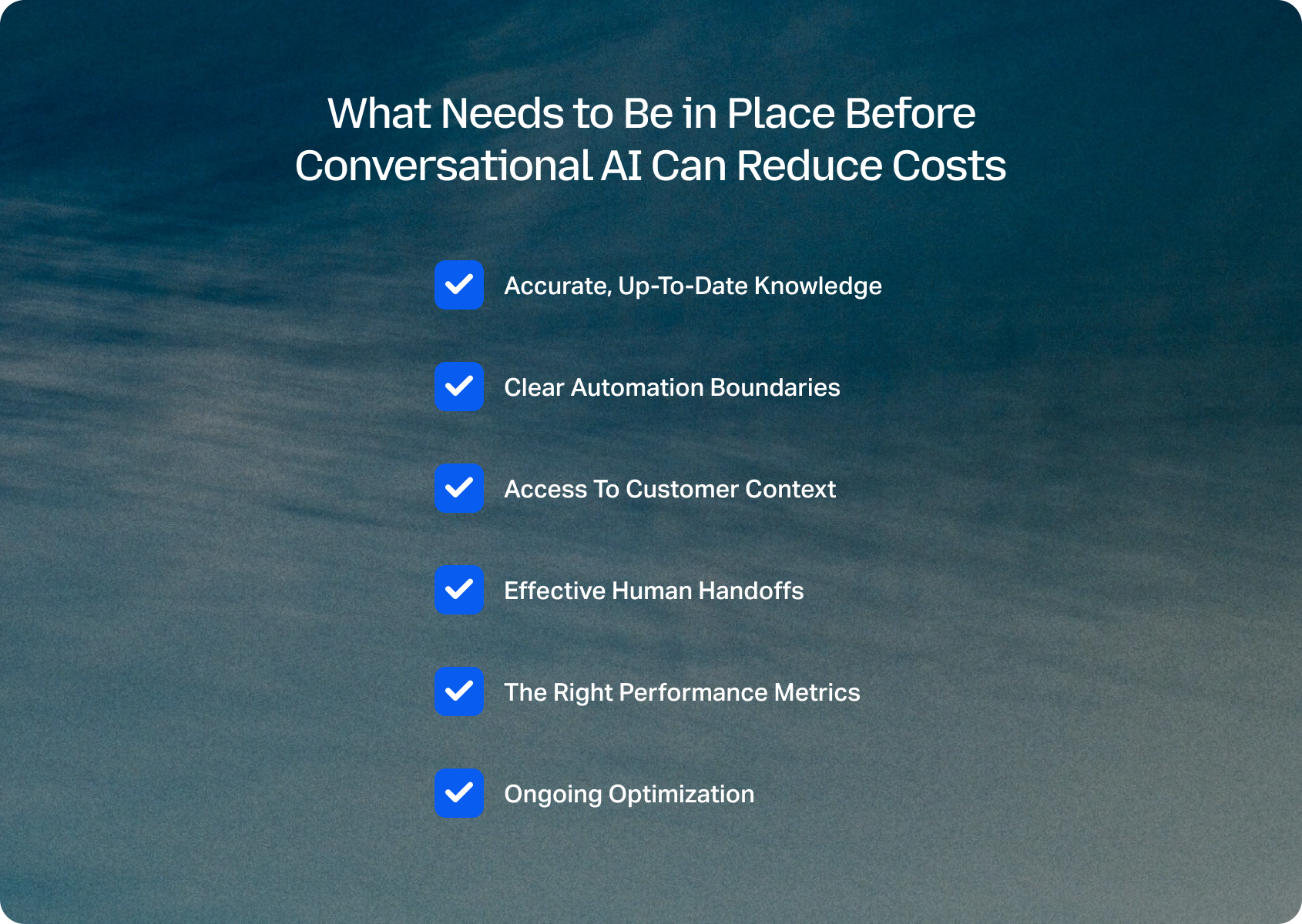
Conversational AI can reduce customer service costs, but the technology alone isn’t enough. Before expecting significant cost savings, support leaders need the right foundations in place.
At a minimum, that means:
- Accurate, up-to-date knowledge: AI needs reliable information about your products, services, policies, and processes.
- Clear automation boundaries: Teams need to decide which customer interactions AI can handle and which require human judgment.
- Access to customer context: AI needs the right information from relevant systems to give useful, personalized answers rather than generic responses.
- Effective human handoffs: Complex issues should move smoothly to human agents without customers having to repeat themselves.
- The right performance metrics: Resolution rate, customer satisfaction, average handling time, ticket volume, and cost per interaction can show whether AI is creating genuine efficiency gains.
- Ongoing optimization: AI resolution accuracy should be monitored and improved as products, policies, and customer questions change.
These foundations determine how much of your support operation AI can realistically handle. They also help prevent a common mistake: measuring the success of an AI deployment by how much automation it has, rather than by whether that automation actually improves operational efficiency and customer experience.
When conversational AI can reliably resolve the right customer queries, the economics become clearer. More routine interactions can move to self service, human agents can spend more time on complex issues, and the cost of handling each interaction can gradually come down, leading to lower operational costs overall.
Want to see what conversational AI could do for your support operation? Book a demo with BlueTweak to explore how it could fit your team.

As Head of Digital Transformation, Radu looks over multiple departments across the company, providing visibility over what happens in product, and what are the needs of customers. With more than 8 years in the Technology era, and part of BlueTweak since the beginning, Radu shifted from a developer (addressing end-customer needs) to a more business oriented role, to have an influence and touch base with people who use the actual technology.




