




TL;DR
A chatbot hallucination happens when an AI chatbot generates a response that sounds convincing but contains incorrect, unsupported, or fabricated information. In customer service, these errors can turn a tool designed to reduce support volume into a source of more work, frustrated customers, and lost trust. While hallucinations can't be eliminated entirely, businesses can reduce the risk by grounding AI responses in a trusted knowledge base, keeping humans in the loop for the right interactions, and automatically escalating queries when the AI lacks the information or context to answer accurately. BlueTweak takes this approach by grounding AI responses in a controlled customer service knowledge base, giving agents proposed replies to review before sending, and providing escalation paths when a conversation requires human judgment.
The pressure to automate customer service is growing, but so is the risk of getting automation wrong. When support queues are already overflowing, the last thing a team needs is an AI chatbot giving customers incorrect information that agents then have to untangle.
That's what makes chatbot hallucinations such a serious concern, and it's a concern business leaders are already voicing. In its 28th Annual Global CEO Survey, PwC found that only around a third of CEOs feel highly confident about embedding artificial intelligence into core business processes, and a similar share put their trust in it at only moderate even as roughly half expect generative AI to lift company profitability over the next year. That gap between enthusiasm for what AI tools can do and confidence in trusting them with real customer conversations is exactly the tension support leaders are navigating.
A single wrong answer can undermine trust, create repeat contacts, and leave agents cleaning up an interaction that AI was supposed to handle. For support leaders, the question isn't simply whether AI can answer customers quickly. It's whether it can answer them accurately and safely.
The good news is that businesses don’t have to choose between AI efficiency and reliable customer service. With the right controls, AI can be grounded in trusted information, its answers can be checked by human agents, and conversations can be escalated when the system shouldn’t answer on its own. BlueTweak brings these safeguards together to help teams use AI without giving it a free pass to make things up.
What Is a Chatbot Hallucination?

A chatbot hallucination occurs when an AI chatbot generates information that isn't supported by the data or context available to it. The response may be grammatically correct, relevant to the conversation, and delivered with confidence, but the underlying information is inaccurate or completely fabricated.
This happens because large language models don't work like traditional databases. They generate outputs by identifying patterns in data and predicting what information is likely to come next – a limitation that shows up across generative models generally, not just text. Image tools like DALL-E can misidentify objects or blend real and invented details into a single picture; text-based AI tools do the equivalent with facts.
Researchers who study why AI hallucinations occur tend to point to a handful of recurring causes: insufficient training data on a specific topic, a gap between high quality training data and the messier real data a business actually operates on, vague prompt engineering that leaves the model guessing at intent, or a user interface that invites open-ended questions the system was never equipped to answer. When the model doesn't have a reliable answer, it fills the gap with something that sounds plausible rather than something that's actually correct.
None of this is unique to customer service. MIT Technology Review has covered the issue extensively, noting that this habit of inventing plausible-sounding answers remains one of the main barriers to wider chatbot adoption, even as the underlying models keep improving The same reporting pointed to the World Health Organization's SARAH chatbot inventing addresses for clinics that don't exist, and to Air Canada being held to a bereavement-fare policy its own chatbot had made up. It's a useful reminder that this isn't a hypothetical risk confined to a research article; it plays out in live conversations with real customers at real companies.
For example, imagine a customer asks an AI chatbot:
"Can I return this item after 30 days?"
If the company's actual return policy allows returns within 14 days, an accurate AI system should say no. But if the model doesn't have access to the company's current policy, it might generate a plausible response based on patterns learned from other information:
"Yes, you can return the item within 30 days as long as it's unused."
That answer sounds perfectly reasonable and it may even resemble policies used by other businesses, but if the company's actual policy is 14 days, it's a hallucination.
The same problem shows up in customer service in several recognizable forms:
The important distinction is that a chatbot hallucination doesn't necessarily look like an obvious mistake. The more convincing the wrong answer sounds, the greater the risk, especially in high stakes domains like billing, refunds, or account access. For customer service teams, this makes AI chatbot accuracy less about finding a model that never makes mistakes (no generative model is fully immune, whether the cause is biased training data or something as deliberate as adversarial attacks) and more about designing a system that double-checks itself against reliable information and knows when to involve a human. Mitigating hallucinations, in other words, is a design problem as much as a research one.
Why Do AI Chatbot Hallucinations Occur?
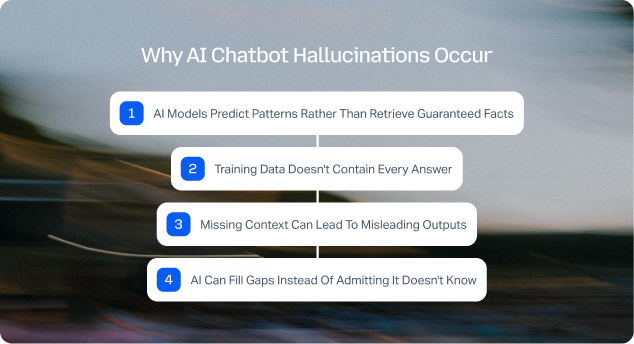
AI chatbot hallucinations happen because language models are designed to generate plausible responses, not to verify that every statement is factually correct. When a model doesn't have the right information, context, or instructions to answer a question, it can fill in the gaps with a response that sounds convincing but isn't supported by reliable data.
AI Models Predict Patterns Rather Than Retrieve Guaranteed Facts
Large language models are trained to recognize patterns across vast amounts of data and generate likely sequences of words. This makes them remarkably effective at understanding questions and producing natural-sounding responses, but it also means they can produce an answer without having a reliable source to verify it against.
In other words, an AI chatbot isn't necessarily asking, "Is this information true?" It's generating the response that best fits the patterns it has learned and the context provided to it.
That's why a chatbot can confidently give a wrong answer. The response may be linguistically convincing even when the underlying information is incorrect.
Training Data Doesn't Contain Every Answer
AI models are trained on large datasets, but no training dataset contains every piece of information a customer might ask about. More importantly, a general-purpose model's training data isn't the same thing as your company's source of truth.
Your AI chatbot may know a great deal about ecommerce, shipping, refunds, or customer service in general. That doesn't mean it knows your current return policy, product catalog, warranty terms, or escalation process.
This distinction is particularly important in customer service. A plausible answer based on general patterns isn't enough when customers need accurate information about a specific business.
Missing Context Can Lead to Misleading Outputs
Even when the relevant information exists somewhere in an AI system, the model may not have enough context to use it correctly.
A short customer question can leave important details unstated. For example, "Can I cancel my order?" could depend on the order status, product type, shipping stage, location, or payment method.
Without that context, an AI chatbot may make assumptions and generate an answer that doesn't apply to the customer's situation.
AI Can Fill Gaps Instead of Admitting it Doesn't Know
One of the biggest risks with generative AI is that it can produce an answer even when the information needed to answer accurately isn't available.
A customer doesn't see the model's uncertainty. They see a confident response in a familiar chat interface. Unless the AI has been designed to recognize when it lacks sufficient information and take the appropriate next step, it may guess rather than escalate.
That's why preventing hallucinations isn't simply about giving an AI model more training data. It requires controls around what information the AI can access, how it uses that information, and what happens when the information isn't enough.
That brings us to the bigger question for support teams: what happens when a plausible AI-generated answer is wrong?
Why Chatbot Hallucinations Are a Customer Service Problem
A chatbot hallucination can turn a customer service interaction into a bigger problem by giving customers incorrect information, creating repeat contacts, and forcing agents to repair the damage. The impact goes beyond one inaccurate answer because customers often assume information provided by a company's chatbot reflects the company's actual policies and processes.
Wrong Answers Create More Support Work
AI is often introduced to reduce repetitive support volume. But when a chatbot gives an incorrect answer, the interaction may simply move the work further down the support process.
A customer who receives the wrong information may contact the business again, ask to speak to an agent, or follow instructions that create another issue. The result is more work for a team that was already trying to reduce its workload.
For example, if a chatbot incorrectly tells a customer that a refund has been processed, the customer may wait for money that isn't coming. An agent then has to investigate the original interaction, explain what actually happened, and resolve the underlying issue.
Incorrect Information Can Damage Customer Trust
Customers don't necessarily distinguish between an AI chatbot and the company behind it. If the chatbot confidently provides incorrect information, the customer may see that as a failure of the business rather than a technical limitation of the AI.
This makes accuracy particularly important for questions involving pricing, refunds, subscriptions, product availability, delivery, warranties, or account information.
A fast answer isn't valuable if the customer can't rely on it.
Hallucinations Can Create Operational and Compliance Risks
Not every chatbot error has the same consequences. A minor factual mistake may frustrate a customer, while an incorrect answer about a refund, contractual term, eligibility requirement, or regulated process can create a much more serious problem.
The risk increases when AI is allowed to answer without appropriate guardrails in situations where accuracy matters more than speed.
Support leaders therefore need to think beyond whether an AI chatbot can produce a fluent response. They need to understand whether the response is grounded in trusted information and whether the system knows when it shouldn't answer independently.
The Problem Isn't AI Itself, It's Uncontrolled AI
This doesn't mean businesses need to abandon AI-powered customer service. It means AI needs the same kind of operational controls that support teams apply to other customer-facing processes.
Realistically, you don’t want your AI chatbot to answer every question. Instead, the focus must be on making sure it can reliably handle the questions it is equipped to answer, recognize when it lacks the information or context it needs, and hand the conversation to a human when appropriate.
So, how can support teams reduce the likelihood of chatbot hallucinations without giving up the efficiency benefits of AI?
How to Prevent Chatbot Hallucinations in Customer Service
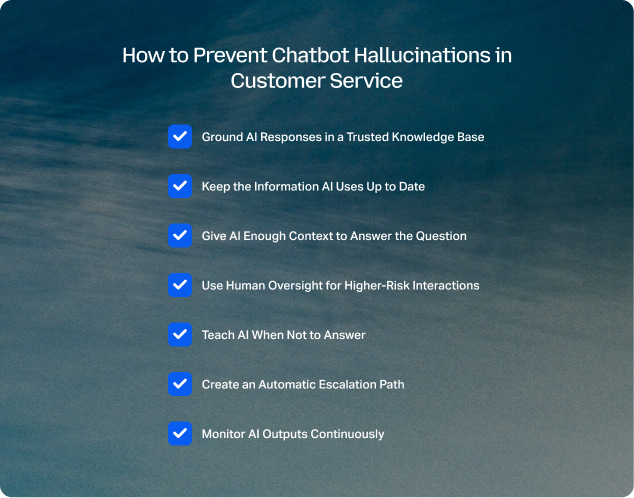
The most effective way to prevent chatbot hallucinations is to control the information and conditions under which AI generates customer-facing responses. Rather than relying on a more capable model alone, support teams can reduce hallucinations by grounding AI in trusted information, limiting what it can confidently answer, and creating clear paths to human support.
1. Ground AI Responses in a Trusted Knowledge Base
A customer service AI should have access to an authoritative source of information about your business.
A well-maintained knowledge base can provide the policies, product information, processes, and other factual information an AI needs to answer customer questions. Instead of relying solely on information learned during model training, the AI can use current, business-specific information when generating a response.
This is one of the most important controls for reducing hallucinations because it gives the AI a defined source of truth to work from.
A knowledge base is only useful, however, if the information inside it is accurate and maintained. BlueTweak's customer service knowledge base is designed to give support teams a controlled foundation for customer-facing information.
2. Keep the Information AI Uses Up to Date
Grounding an AI chatbot in a knowledge base doesn't solve the problem if that knowledge base contains outdated information.
Support teams should regularly review information that changes frequently, including pricing, promotions, return policies, product availability, shipping times, and terms and conditions. Outdated information can be just as problematic as missing information.
The goal is to make sure the information available to AI reflects the information the business would expect an agent to use when answering the same question.
3. Give AI Enough Context to Answer the Question
Accuracy also depends on context. The more information an AI system has about the customer's situation, the less it needs to rely on assumptions.
Customer intent, previous messages, account or order context, product details, and other relevant information can all help an AI determine what the customer actually needs.
For example, "Can I change it?" is impossible to answer reliably without knowing what "it" refers to. Understanding customer intent and conversation context can help an AI identify when a question needs more information before it can provide an answer.
4. Use Human Oversight for Higher-Risk Interactions
Not every customer interaction needs to be answered autonomously.
For more complex or sensitive conversations, a human-in-the-loop approach allows AI to assist an agent without giving it complete control over the customer interaction. AI can generate a proposed response while the agent reviews it, corrects it if necessary, and decides whether it's appropriate to send.
This approach can preserve much of the efficiency of AI while keeping human judgment in the process. BlueTweak's proposed reply feature supports this model by giving agents an AI-generated response to review before it reaches the customer.
5. Teach AI When Not to Answer
One of the most important safeguards is also one of the simplest: an AI chatbot should be able to say when it doesn't know.
If the system doesn't have enough information to provide a reliable answer, it shouldn't be encouraged to guess. Instead, it can ask a clarifying question, offer an appropriate alternative, or escalate the conversation to a human agent.
This changes the objective from "answer every question" to "resolve every question safely."
6. Create an Automatic Escalation Path
Escalation shouldn't be treated as a failure of AI; it's an essential part of a well-designed customer service system.
When a conversation requires human judgment, involves insufficient information, or falls outside the AI's defined capabilities, the customer should have a clear route to an agent.
An effective AI-to-human handoff preserves the conversation context so the customer doesn't have to start again from scratch. This makes escalation a continuation of the support experience rather than a dead end.
7. Monitor AI Outputs Continuously
Even well-designed AI systems need ongoing monitoring. New products, policies, customer questions, and edge cases can introduce situations the system wasn't previously handling.
Support teams should review AI interactions for incorrect or unsupported answers and use those findings to improve the underlying knowledge, prompts, workflows, and escalation rules.
Quality assurance can help identify patterns that aren't obvious from individual conversations.
The common thread across all these safeguards is control. You don't need to eliminate every possibility of hallucination to use AI safely. You need to make sure the AI has reliable information, operates within clear boundaries, and has a safe fallback when it reaches those boundaries.
Once those controls are in place, the next challenge is knowing whether they're actually improving AI chatbot accuracy.
How to Improve AI Chatbot Accuracy
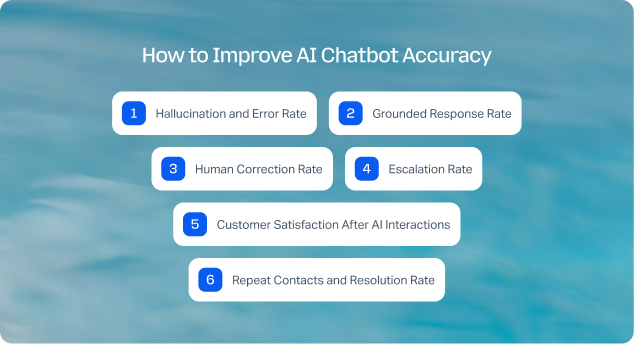
Improving AI chatbot accuracy means measuring more than whether a chatbot resolves conversations. Support teams need to know how often AI gives correct, grounded answers, when it needs human intervention, and whether customers are actually getting better outcomes.
A chatbot can have a high resolution rate while still producing problematic answers. If customers accept an incorrect answer without challenging it, a conventional resolution metric might even suggest that the interaction was successful.
Instead, customer service teams should track a combination of accuracy, quality, and outcome metrics.
Hallucination and Error Rate
Track how often an AI chatbot provides information that is incorrect, unsupported, or inconsistent with your approved knowledge.
This can be measured through automated quality checks, human review, or a combination of both. Looking for patterns in incorrect responses can also help identify gaps in the knowledge base, prompts, or AI workflows.
Grounded Response Rate
A grounded response rate measures how often chatbot answers are supported by the trusted information available to the AI.
A high rate indicates that the system is consistently using approved sources rather than generating answers based primarily on its underlying model knowledge.
Human Correction Rate
For AI-generated responses that are reviewed by agents, track how frequently those responses need to be changed before they're sent to the customer.
A high correction rate could indicate that the AI doesn't have enough context, the knowledge base needs attention, or the system is being used for interactions beyond its capabilities.
Escalation Rate
Escalation isn't necessarily a sign that an AI chatbot is performing poorly. In many cases, a well-designed system should deliberately escalate conversations that require human judgment.
The important question is whether the chatbot is escalating the right conversations. Tracking escalation alongside accuracy and resolution can help teams distinguish sensible handoffs from unnecessary ones.
Customer Satisfaction After AI Interactions
CSAT can provide another indication of whether AI is improving the customer experience, but it shouldn't be viewed in isolation.
A chatbot that resolves simple questions quickly may generate strong CSAT while still struggling with more complex interactions. Segmenting customer satisfaction by interaction type, escalation, and AI involvement can provide a much clearer picture of performance.
Repeat Contacts and Resolution Rate
If a customer has to contact support again because an AI chatbot gave them incomplete or incorrect information, the initial interaction wasn't truly successful.
Tracking repeat contacts alongside resolution rate can reveal problems that a single-interaction metric might miss. The focus shouldn’t be on finding one metric that proves an AI chatbot is accurate. Rather, it should aim to build a broader picture of whether the AI is giving customers reliable information and delivering the outcomes the support team expects.
For many businesses, the safest way to improve those outcomes isn't to remove humans from the process, but is to give AI the right role within it.
Human-in-the-Loop AI: The Safety Net for Customer Service
Human-in-the-loop AI keeps human judgment involved when an AI system isn't trusted to handle an interaction independently. Instead of asking AI to answer every customer question autonomously, businesses can use it to assist agents, generate proposed responses, identify customer intent, or handle straightforward interactions while people remain responsible for decisions that require judgment.
This approach is particularly valuable when the cost of an incorrect answer is high.
AI Can Assist Without Making the Final Decision
A human-in-the-loop model doesn't mean an agent has to write every response from scratch. AI can analyze the conversation, retrieve relevant information, and generate a proposed reply based on the available context. The agent can then review the suggestion, make any necessary changes, and send the final response.
This gives support teams the efficiency benefits of generative AI without assuming that every AI-generated answer is ready to send.
For example, if a customer asks about a return, AI could retrieve the relevant policy and draft a response. The agent can then check that the answer applies to the customer's specific circumstances before sending it.
Not Every Interaction Needs the Same Level of Oversight
Human oversight doesn't have to mean manually reviewing every chatbot interaction. Simple, low-risk questions with clear answers may be suitable for automated handling. More complex or sensitive queries can trigger additional checks, agent review, or an immediate handoff.
This allows businesses to apply human oversight where it adds the most value rather than slowing down every customer interaction.
Human Review Can Improve AI Over Time
Agent corrections are useful for both the individual customer conversation and for revealing where an AI system is struggling. If agents repeatedly correct answers about the same product, policy, or process, that pattern may point to outdated knowledge, missing information, or a workflow that needs to be adjusted.
This creates a feedback loop: AI assists the support team, humans identify where it falls short, and those insights are used to improve the system.
BlueTweak's approach to human-in-the-loop AI puts this principle at the center of AI-assisted customer service.
The objective is to design the system so that human judgment is available wherever AI accuracy, context, or risk makes it necessary, rather than to make AI perfect before humans become involved.
What Happens When the AI Doesn't Know the Answer?
When an AI chatbot doesn't have enough information to answer accurately, the safest response is to avoid guessing and move the conversation toward the right source of help. That might mean asking the customer for more context, retrieving additional information, or escalating the conversation to a human agent.
This is an important shift in how businesses think about AI customer service. The goal shouldn't be to make an AI answer every question. It should be to make sure every customer gets an appropriate answer, even when AI isn't the right system to provide it.
Ask For Clarification When Context is Missing
Sometimes the AI has the right information but not enough information about the customer's situation. If a customer asks, "Can I change my order?" the chatbot may need to know which order they're referring to, whether it has already shipped, or what they want to change.
Rather than making an assumption, the AI can ask a targeted follow-up question. Understanding customer intent and conversation context is therefore an important part of reducing incorrect answers.
Use the Knowledge Base as the Source of Truth
If the AI can't find reliable information in the approved knowledge base, that should be a signal to stop and reassess rather than an invitation to guess. This is where grounding becomes particularly important. The system should be able to distinguish between information it can support and information it doesn't have sufficient evidence to provide.
Escalate When Human Judgment is Needed
Some questions simply aren't suitable for an automated answer. A customer may have a complex complaint, an unusual account issue, a sensitive request, or a situation where company policy needs to be interpreted rather than simply retrieved.
In these cases, escalation gives the customer access to someone who can assess the situation and make an appropriate decision. A well-designed AI-to-human handoff should also pass the relevant conversation context to the agent, so the customer doesn't have to repeat everything they've already explained.
Treat "I Don't Know" as a Successful Outcome
This may sound counterintuitive, but an AI chatbot recognizing its limits can be a sign of a well-designed system.
A transparent handoff is far less damaging than a confident but fabricated answer. For support leaders, the measure of successful AI isn't whether the chatbot speaks in every interaction. It's whether customers receive accurate information and reach the right outcome with as little unnecessary effort as possible.
That means a useful AI system needs both the ability to answer and the ability to know when not to answer.
With those safeguards in place, businesses can start thinking about AI accuracy as something they actively manage rather than something they simply hope their chosen model gets right.
How BlueTweak Helps Reduce Chatbot Hallucinations
BlueTweak helps reduce chatbot hallucinations by grounding AI in trusted customer service information, keeping human agents involved where needed, and providing clear escalation paths when AI can't reliably resolve an interaction. Rather than expecting an AI model to know every answer, BlueTweak gives support teams greater control over the information AI uses and how it responds to customers.
Ground AI in a Controlled Knowledge Base
BlueTweak's customer service knowledge base provides a central source of trusted information that AI can use when generating responses. This helps move customer conversations away from generic model knowledge and toward the policies, products, processes, and information that are specific to the business.
That distinction matters because even a highly capable AI model can't be expected to know your latest product information or internal policies simply because it has been trained on vast amounts of data.
By giving AI access to controlled, business-specific information, support teams can establish a more reliable foundation for customer-facing answers.
Give Agents AI-Generated Replies They Can Check
For interactions that need human oversight, BlueTweak's proposed reply capability allows AI to generate a response for an agent to review before it's sent.
The agent remains in control of the final answer, while AI handles some of the work involved in understanding the conversation and drafting a relevant response. This can help teams increase efficiency without treating every AI output as automatically safe to send.
It's a practical example of human-in-the-loop AI: AI does the preparation, while the human retains the judgment.
Escalate Conversations When AI Reaches its Limits
Some customer questions shouldn't be answered by AI alone. When a conversation requires additional context, specialist knowledge, or human judgment, escalation gives the customer a route to an agent rather than leaving the AI to guess.
BlueTweak supports this approach by connecting AI-assisted interactions with human support, allowing teams to use automation where it makes sense while maintaining a fallback when it doesn't.
Monitor Quality and Improve Over Time
Preventing hallucinations isn't a one-time exercise. As products, policies, customer questions, and AI systems change, support teams need visibility into how AI is performing.
BlueTweak's customer service quality assurance capabilities can help teams review interactions, identify issues, and spot patterns that may indicate problems with AI-generated responses or the information underpinning them.
Together, these controls create a more measured approach to AI-powered customer service. The aim isn't to give AI unrestricted freedom to answer every question. It's to give it the right information, define its boundaries, and make sure a human can step in when necessary.
“AI is only as reliable as the information and controls behind it. If you want AI to deliver accurate customer service, you need to give it trusted knowledge, define where it can act independently, and make sure a human can step in when the situation requires judgment.” — Radu Dumitrescu, Head of Presale & Digital Transformation, BlueTweak
Ready to reduce chatbot hallucinations and improve your customer service workflow? Try BlueTweak free for 14-days (no credit card required) and see how AI-assisted support can work for your team.
Can AI Hallucinations Be Fully Eliminated?
AI hallucinations can't currently be guaranteed to disappear completely, but businesses can significantly reduce their likelihood and limit their impact. Even highly capable AI models can produce incorrect or unsupported information, so the goal for customer service teams should be controlled, measurable risk rather than the promise of perfect accuracy.
This distinction is important when evaluating AI chatbot technology. A vendor promising that its AI will never hallucinate is making a difficult claim to substantiate. A more useful question is: What happens when the AI is wrong?
No AI Model is Perfect
Changing to a newer or more capable language model may improve performance, but it doesn't remove the fundamental possibility of incorrect outputs.
AI models generate responses based on patterns, context, and available information. They can still misunderstand a question, lack relevant information, misinterpret context, or produce an answer that sounds plausible but isn't supported by the available evidence.
That's why model selection is only one part of an effective hallucination-prevention strategy.
Controls Reduce Risk
Grounding AI in trusted information can reduce the opportunity for it to invent answers. Clear instructions can define what the system should and shouldn't handle. Human review can catch errors before they reach customers. And escalation can prevent the AI from being forced to answer when it doesn't have enough information.
These controls don't make hallucinations impossible. They make the overall system more resilient when an AI output isn't reliable.
Accuracy Should be Treated as an Ongoing Process
AI chatbot accuracy isn't something a support team can check once and then forget about. New products, updated policies, unusual customer questions, and changes to the AI system can all introduce new risks. Regular monitoring, quality assurance, and analysis of AI interactions help teams identify problems and improve the system over time.
Ultimately, the safest customer service AI isn't the system that claims it can answer everything. It's the one that knows what it can answer, knows when it needs help, and has the controls to prevent an uncertain answer from becoming a confident mistake.
How to Reduce AI Chatbot Hallucinations in Customer Service
Chatbot hallucinations are a real risk, but they're not a reason to rule out AI-powered customer service. The bigger risk is deploying AI without the controls needed to keep inaccurate answers away from customers.
These risks aren't confined to customer support; in 2023, a lawyer cited fake legal cases generated by ChatGPT in a real court filing, a reminder that even outside a chat window, generative AI tools can produce convincing information that simply isn't true. The stakes look different in a courtroom than in a support inbox, but the underlying failure is the same: an AI system generating a plausible answer instead of a verified one.
Support teams can reduce that risk by grounding AI in a trusted knowledge base, monitoring the accuracy of its outputs, keeping humans involved where judgment matters, and giving AI a clear path to escalation when it doesn't have the information or context it needs. BlueTweak helps support teams put these safeguards into practice, combining AI-assisted customer service with trusted information, agent oversight, and clear escalation paths.
The focus should be on reliable customer service with generative AI tools in the right role.
When AI can handle straightforward interactions accurately, assist agents with more complex conversations, and recognize when a human needs to take over, businesses can reduce support workload without putting customer trust at risk.
To see how BlueTweak can help your team deliver safer, more effective AI-powered customer service, book a demo today.

As Head of Digital Transformation, Radu looks over multiple departments across the company, providing visibility over what happens in product, and what are the needs of customers. With more than 8 years in the Technology era, and part of BlueTweak since the beginning, Radu shifted from a developer (addressing end-customer needs) to a more business oriented role, to have an influence and touch base with people who use the actual technology.



