



TL;DR
Agentic AI examples in customer service range from classifying and routing contacts to answering customer queries using relevant customer data and conversation history. The difference between basic automation and agentic AI is its ability to use context, work across connected systems, and take action with minimal human intervention. BlueTweak supports AI-powered customer interactions today, while more autonomous, multi-step workflows represent where customer service agentic AI is heading.
If you lead a customer service team, you’ve probably heard plenty about AI agents that can supposedly do far more than answer a customer question. But when you look at your own support queue, the useful question is more practical: what can AI actually take off your team’s plate today?
Customer service teams already use AI to handle repetitive customer requests, classify support tickets, suggest responses, and route contacts to the right human agents. The next step is more autonomous AI that can understand context, work with relevant systems, and complete multi-step tasks rather than simply generating a response.
BlueTweak sits in that transition. Its AI tools can support customer interactions across channels, from conversational AI that handles customer queries to AI-powered classification, routing, and proposed replies. Understanding what these capabilities can do today, and where agentic AI is heading next, makes it easier to separate useful automation from the hype.
What Is Agentic AI in Customer Service?

Agentic AI in customer service refers to AI systems that can understand a customer’s request, determine what needs to happen, and take action toward an outcome rather than simply generating an answer.
That distinction matters because not every AI tool used by a support team is an AI agent. A generative AI tool might draft a response based on a knowledge base article. A task-specific AI agent can go further by interpreting the request, retrieving relevant data, deciding which step to take, and potentially interacting with other systems to complete the task.
For example, imagine a customer asking, “Where’s my order?” A basic AI assistant might explain how to check an order status. A more agentic AI system could understand the request, access the customer’s purchase history and order information, retrieve the current status from a connected system, and provide the relevant answer. If the request requires human intervention, it could also pass the conversation to a support agent with the relevant context and conversation history attached.
That ability to work toward an outcome is what makes agentic AI different from basic automation. Instead of following a fixed rule such as “if the customer mentions an order, send this article,” an agentic system can use context and available tools to determine what the customer needs and what action makes sense.
In practice, however, the level of autonomy varies. Some customer service AI agents today are designed to answer questions or assist human agents, while more advanced agentic AI systems are being developed to handle complex workflows involving multiple systems and multi-step tasks. Human oversight remains important, particularly when an action could affect a customer, transaction, or business-critical process.
Classifying and Routing Customer Requests
One of the most practical agentic AI examples in customer service is deciding what should happen to an incoming request before a human agent ever sees it.
Support teams deal with customer communications across multiple channels, often covering everything from simple account questions to urgent service issues. Manually reading, categorizing, prioritizing, and routing every contact creates work that adds little value for experienced customer service agents.
AI can analyze the content of a customer interaction, identify its intent, and assign the appropriate category or priority. It can then route the request to the right queue or support team based on factors such as topic, channel, language, or urgency. Agentic AI also supports multilingual capabilities, understanding local dialects and cultural nuances. That means customers don't need to describe their problem in the support team's primary language for their request to reach the right place.
For example, a customer might contact support to report that their service is unavailable. An AI system can recognize the issue as a potential service outage, classify the contact accordingly, and route it to the team responsible for handling those cases. A question about an invoice can take a different path, while a product question can be directed toward agents with the relevant knowledge.
This is already more useful than basic rules-based automation because AI can interpret natural language rather than relying entirely on predefined keywords. Natural language processing and generative AI can help identify the meaning and context of customer requests even when customers describe the same problem in very different ways.
It also gives customer service teams a foundation for more agentic workflows. Once an AI system can understand what a customer needs and identify the relevant workflow, it can potentially determine which information, tools, or systems are needed for the next step.
Answering Customer Queries With Relevant Context
Answering customer queries is another area where AI can already reduce the workload on support teams. The difference is in how much context the AI can use to produce a useful response.
A basic chatbot might match a question to a predefined answer or knowledge base article. More advanced AI can use retrieval augmented generation (RAG) to find relevant information from approved knowledge sources and generate a response in natural language.
For example, a customer asking about a product's return policy doesn't necessarily need a human agent. An AI assistant can identify the question, retrieve the relevant knowledge base articles, and provide an answer directly within the conversation. This can help customers get answers through self service while allowing human agents to focus on more complex tasks. For routine queries like this, agentic AI provides zero wait times and 24/7 availability, so customers can get help in the evenings, at weekends, or on holidays when the support team may be offline. As a result, agentic AI can reduce customer response time to under two minutes, even during busy periods.
The same principle can apply when the answer depends on customer-specific information. If the AI system has access to relevant customer data and connected systems, it can use information such as account details, transaction history, or purchase history to make the response more useful.
That context can make a significant difference to the customer experience. Instead of asking a customer to repeat information that's already available in the conversation, the AI can use conversation history and relevant data to understand what has already happened.
This is also where the distinction between an AI assistant and a customer service AI agent becomes important. An assistant may help a human agent find information or draft a response. An AI agent can potentially use that information to determine what should happen next and carry out a task within the systems it has access to.
For BlueTweak, conversational AI can already support customer interactions by answering questions and handling routine requests. You can learn more about how this works in our guide to conversational AI for customer service.
Escalating to Human Agents With the Right Context
Not every customer request should be handled entirely by AI. Some situations require human judgment, emotional intelligence, or access to information and decisions that AI shouldn't make independently.
A useful AI-to-human handoff therefore isn't simply a transfer from a chatbot to a support agent. The AI should give the human agent enough context to continue the conversation without making the customer start again from the beginning.
For example, an AI system might recognize that a customer has an unusually complex issue or that the conversation has reached a point where human intervention is appropriate. Rather than simply placing the customer in a queue, it can pass relevant details to the human agent, including the customer's request, conversation history, identified intent, and information already gathered during the interaction.
That can reduce repetition for the customer and give the support agent a clearer starting point. It can also help the customer service team maintain service quality when AI reaches the limits of what it can safely handle.
Human oversight remains particularly important as organizations move toward more agentic AI. A customer service AI agent might be able to identify the next step in a workflow, but that doesn't mean it should automatically make every decision or take every action available to it.
The most effective approach is often to define where AI can operate independently, where it should ask for human approval, and where a human agent should take over completely. This is the foundation of human-in-the-loop AI: using automation to handle appropriate work while keeping human involvement where judgment, accountability, or customer sensitivity matters.
For support leaders, that makes escalation an important part of the agentic AI conversation. The question isn't simply whether AI can handle more customer interactions. It's whether it knows when it should stop, what information it should pass to a human, and how to make that handoff as seamless as possible.
Where Agentic AI Is Heading: From Answering to Taking Action
The next stage of AI in customer service is moving from answering customer questions to taking action on their behalf.
Today, an AI assistant might tell a customer where their order is. A more advanced agentic AI system could eventually check the order status, determine whether the customer is eligible to make a change, access the relevant system, and initiate that change without requiring a human agent to step in.
That distinction is important. An AI that generates an answer is useful, but an AI that can understand a request and work toward an outcome has the potential to change how customer service teams operate.
Consider a customer who wants to change a delivery address. A conventional chatbot might explain the company's policy and direct the customer to a form. An agentic AI agent could potentially understand the request, check the order's status, verify whether an address change is still possible, access the relevant order system, and complete the permitted change.
The same principle could apply to other customer requests, such as checking an account, updating information, rescheduling a service, or working through a more complex support issue. Instead of treating each interaction as a question that needs an answer, agentic AI can treat it as a task that needs to be completed.
This is where system integration becomes particularly important. To act effectively, an agentic AI system needs access to the relevant information and tools. Depending on the workflow, that could mean interacting with a CRM, order management platform, knowledge base, billing system, or other enterprise systems.
More advanced workflows could involve multiple systems and several steps. An AI agent might gather information from one system, use it to make a decision, perform an action in another, and then communicate the result to the customer.
Proactive support is another potential direction. Rather than waiting for a customer to report a problem, an AI system could identify relevant signals in customer data and trigger an appropriate communication. For example, if a system detects a recurring service issue affecting a customer, it could potentially notify them and provide relevant information before they contact support.
These are examples of where agentic AI in customer service is heading, rather than capabilities every AI platform offers today. The more autonomy an AI system has, the more important it becomes to define its permissions, data access, escalation rules, and human oversight.
What Makes Agentic AI Agents Truly Agentic?
The term “agentic” is increasingly used to describe everything from chatbots to sophisticated AI systems, so it helps to look at what agentic AI agents actually need to do.
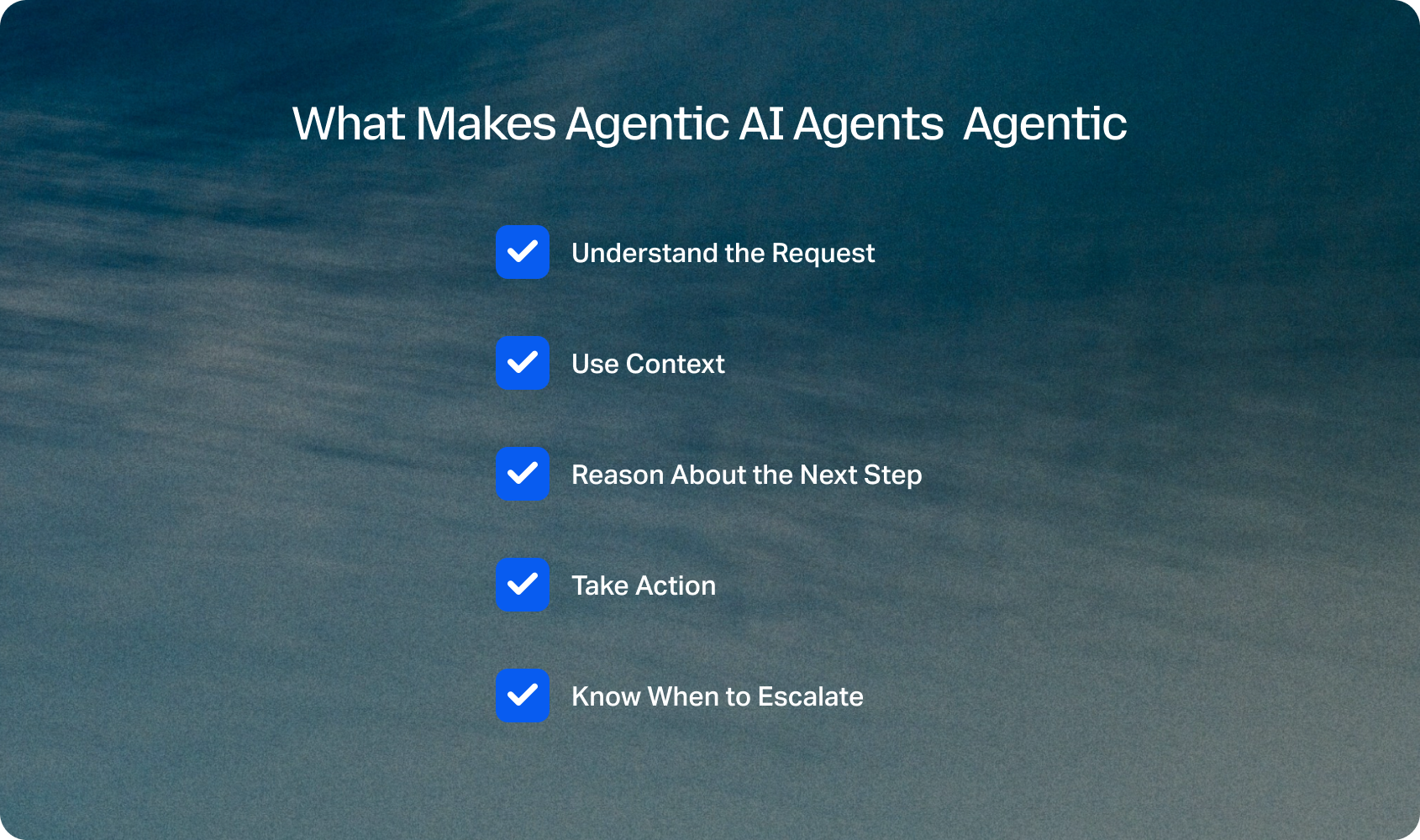
A useful way to think about agentic AI is as a progression from understanding a request to taking an appropriate action. The more of that process an AI system can handle independently, the more agentic its behavior becomes.
1. Understand the Request
An agent needs to understand what the customer is actually asking for, even when the request isn't phrased in a predictable way.
Natural language processing can help identify intent, while generative AI can interpret the broader context of the conversation. This allows an AI system to distinguish between different customer needs that might use similar words.
2. Use Context
Understanding the request isn't enough if the AI doesn't have the information needed to respond appropriately.
An agentic AI system can use relevant data such as conversation history, customer information, purchase history, or knowledge base articles. In more advanced implementations, retrieval augmented generation can help an AI system retrieve relevant information before generating a response.
Agentic AI also retains long-term memory for personalized customer interactions. A customer who reported a problem last week shouldn't have to explain it all again when they get back in touch.
Context also helps the AI determine whether it can handle a request itself or whether it needs human intervention.
3. Reason About the Next Step
An AI agent needs some way of determining what should happen next. For a straightforward customer query, that might mean finding the relevant answer. For a more complex request, it could involve identifying several steps, choosing which tools or systems to use, and determining when the task has been completed.
This is one of the biggest differences between agentic AI and basic automation. A rules-based workflow follows a predetermined path. An agentic system can use the information available to it to determine which path is appropriate for a particular customer interaction.
4. Take Action
The defining feature of a more advanced AI agent is its ability to do something rather than simply tell someone what to do.
That action might be relatively simple, such as routing a support ticket, or more complex, such as interacting with a connected system to complete part of a customer workflow.
The AI needs appropriate permissions and access to the relevant systems for this to work. Without those connections, even a sophisticated model is limited to generating information or recommendations.
“Most organisations don't struggle with choosing features; they struggle with connecting them in a way that actually improves outcomes.” — Radu Dumitrescu, Head of Presale & Digital Transformation, BlueTweak'
5. Know When to Escalate
Agentic doesn't mean autonomous at all costs. A customer service AI agent should be able to recognize when it doesn't have enough information, when a request falls outside its permissions, or when human judgment is needed. In those situations, escalating to a human agent is part of operating effectively, not a failure of the technology.
Human oversight is particularly important when an AI system can affect customer accounts, transactions, refunds, or other consequential outcomes.
Taken together, these capabilities provide a more useful definition of agentic AI than simply asking whether a platform uses AI. The important question is how independently the system can understand a customer's needs, access relevant information, determine what to do, take an appropriate action, and involve a human when necessary.
Agentic AI vs. Basic Automation, AI Assistants, and AI Agents
Not every AI tool used by a customer service team is agentic. The terminology can get confusing because basic automation, AI assistants, AI agents, and agentic AI can all appear in the same support workflow.
A practical way to distinguish them is to look at how much responsibility the technology has for moving an interaction toward an outcome.
| Approach | What it does | Customer service example |
|---|---|---|
| Basic automation | Follows predefined rules or triggers | Sends a confirmation email after a customer submits a form |
| AI assistant | Helps a human complete a task | Suggests a response based on the customer's message and relevant knowledge |
| AI agent | Interprets a request and can complete a defined task | Answers a customer query using relevant data and available tools |
| Agentic AI | Coordinates understanding, reasoning, tools, and actions toward an outcome | Handles a multi-step customer request across connected systems, with human intervention when needed |
Basic automation still has an important role in customer service. If a workflow is predictable and the rules are clear, there's no reason to introduce a more complex AI system simply for the sake of it.
An AI assistant adds another layer by helping human agents work more efficiently. It might summarize a conversation, retrieve information, recommend a response, or surface relevant knowledge base articles. The human agent remains responsible for deciding what to send or do.
An AI agent goes further by taking responsibility for a defined task. For example, it might answer a customer query using information from a knowledge base or retrieve relevant account information to resolve a routine request.
Agentic AI describes a broader level of autonomy and coordination. Rather than performing one isolated task, an agentic system can potentially determine the steps needed to reach an outcome, use multiple tools or systems, and adapt its approach based on the information it finds.
These categories aren't rigid industry standards, and the boundaries will continue to change as AI tools become more capable. For customer service leaders, the more useful question is what the system can actually do: what information can it access, what decisions can it make, what actions can it take, and when does a human agent need to become involved?
That makes it easier to evaluate an AI system based on the work it can perform rather than the label attached to it.
What Should Customer Service Teams Automate First?
If you’re considering deploying AI agents, it’s tempting to start with the most impressive workflow you can imagine. But the best starting point is usually much simpler: identify the customer requests that are frequent, predictable, and low risk.
That might include order status questions, basic product or service FAQs, password resets, account access issues, or requests for information that already exists in a knowledge base. These interactions can take up a significant amount of a support team's time without necessarily requiring human judgment.
Classification and routing are also strong candidates. AI can analyze incoming support tickets, identify intent, detect customer sentiment, and send each interaction to the appropriate queue. This reduces manual triage while helping contact center agents and customer support teams start with a clearer understanding of what the customer needs.
AI can also assist human agents rather than handling the customer interaction independently. An AI assistant can summarize conversation history, retrieve relevant information, suggest a response, or surface knowledge base articles. The human agent remains in control, but spends less time searching for information and more time resolving the customer's issue.
More complex tasks require greater care. If a workflow involves financial decisions, sensitive customer data, exceptions to company policy, or actions across multiple systems, the business needs to establish clear boundaries around what the AI can do and when human intervention is required.
A useful starting point is to consider four questions:
- How often does this request happen?
- How predictable is the correct outcome?
- How much customer or business risk is involved?
- Can the AI access everything it needs to resolve the request?
The answers can help support leaders identify where AI is most likely to create measurable business value without introducing unnecessary risk.
Starting small also makes it easier to measure the impact. Instead of judging an AI deployment by how many interactions it touches, teams can look at metrics such as containment, resolution time, customer satisfaction scores, agent performance, and cost per resolved contact.
The aim is to find the point where automation improves operational efficiency and the customer experience. If an AI system reduces the number of contacts reaching human agents but creates repeat contacts because customers didn't actually get their issue resolved, the apparent efficiency gain isn't a real improvement.
Choosing an Agentic AI Platform and Keeping Human Oversight
Choosing an agentic AI platform isn't simply about finding the system with the most advanced model or the longest list of features. The more capable an AI system becomes, the more important it is to establish clear boundaries around how it operates, what information it can access, and which actions it can take.
That starts with choosing a specific workflow rather than trying to automate the entire customer journey at once. A support team might begin with order status queries, for example, and define exactly what information the AI can access, what answers it can provide, and when it should escalate to a human agent.
The next step is making sure the AI has reliable information to work with. An agent can only operate effectively if the underlying knowledge base, customer data, and existing systems are accurate and accessible. Retrieval augmented generation can help ground responses in approved information, while system integrations give AI agents access to the data and tools needed for more complex workflows.
Permissions matter just as much as access. Being able to retrieve information doesn't necessarily mean an AI agent should be able to change it. Support teams should define which actions an AI can take independently, which require approval, and which should always be handled by a human.
This is where human-in-the-loop and human-on-the-loop approaches become important. In some workflows, a human agent may need to approve an action before it happens. In others, AI can handle routine interactions independently while human agents monitor performance and step in when predefined conditions are met.
Escalation rules should also account for more than technical failure. Sentiment analysis can help identify signs of frustration or dissatisfaction, while uncertainty, unusual requests, repeated failed attempts, or a request that falls outside an approved workflow can also be reasons to involve a human.
Measurement needs to be part of the implementation from the beginning. Support leaders should monitor whether AI is actually improving outcomes across metrics such as resolution, customer satisfaction, service quality, service management, operational efficiency, and agent performance. Agentic AI continuously evaluates workflows to improve customer interactions, surfacing recurring issues or points where customers frequently escalate. Those insights give support leaders a clear basis for deciding what to refine next.
A useful principle is to measure what happens after the AI interaction, not just what the AI itself does. A high automation or deflection rate means little if customers have to contact the support team again to resolve the same issue.
How BlueTweak Puts AI Into Practice
BlueTweak gives customer service teams a way to apply AI across the support operation today, from conversational AI and ticket classification to proposed replies, routing, summaries, and AI-assisted workflows.
The emphasis is on using AI where it can reduce repetitive work and improve the customer experience while keeping human agents involved when a case requires judgment or context. BlueTweak's conversational AI can handle common customer enquiries, while AI-powered classification and routing can identify intent and direct interactions to the right team.
Real customer deployments show what this looks like in practice. For example, Nvidia moved its EMEA consumer support operation from Zendesk to BlueTweak, bringing email and chat, knowledge, reporting, and AI into one platform. BlueTweak also built a conversational AI solution for voice to handle common enquiries before they reach an agent, allowing the team to focus on cases requiring human judgment. The first phase of the migration delivered a 15–20% improvement in first-contact resolution and a 25% improvement in reporting accuracy, while 100% of interactions in the migrated EMEA markets now run through BlueTweak.
Conectys provides another example of how AI and a more connected support operation can contribute to measurable outcomes. By centralizing data and giving agents technology-driven tools, Conectys reduced resolution times by 25%, improved customer satisfaction scores by 35%, increased reporting efficiency by 40%, and reduced operational costs by 20%.
These examples aren't examples of fully autonomous agentic AI taking over an entire customer journey. They show something more useful: how AI can already handle defined parts of customer service while giving teams a stronger foundation for further automation.
As AI agents become more capable of working across connected systems and completing multi-step tasks, that foundation can support increasingly sophisticated workflows without requiring support teams to automate everything at once.
What Agentic AI Means for the Future of Customer Service
Agentic AI has the potential to change customer service by moving AI beyond generating answers and toward completing tasks.
But that doesn't mean every customer interaction needs an autonomous AI agent. For many support teams, the most valuable applications will continue to be relatively focused: answering routine customer queries, classifying and routing contacts, finding relevant information, assisting human agents, and escalating complex cases with the right context.
The opportunity is to build from those foundations. Once an organization understands which customer requests can be automated safely, has reliable customer data and connected systems in place, and has clear human oversight, it can start exploring more complex workflows.
That could eventually mean AI handling a multi-step request across several systems, taking approved actions on a customer's behalf, or proactively identifying an issue before the customer needs to contact support.
For support leaders, the important question isn't simply whether a tool calls itself agentic. It's whether it can solve a real customer problem, improve service quality, reduce unnecessary work for human agents, and deliver measurable business value.
BlueTweak can provide a practical starting point, with AI-powered customer service capabilities that teams can use today and a platform designed to bring customer interactions, data, automation, and human support together.
If you're exploring where AI could make the biggest difference in your support operation, try BlueTweak’s free 14-day trial (no credit card required) to see how we can help your customer service team or book a demo for a guided tour through the platform.

As Head of Digital Transformation, Radu looks over multiple departments across the company, providing visibility over what happens in product, and what are the needs of customers. With more than 8 years in the Technology era, and part of BlueTweak since the beginning, Radu shifted from a developer (addressing end-customer needs) to a more business oriented role, to have an influence and touch base with people who use the actual technology.




