


Genesys vs Zendesk vs BlueTweak: Which To Use In 2026?

Choosing the Right Engine for Your Support Team
Choosing the right customer service infrastructure in 2026 is no longer just about picking a "software. It’s about deciding whether your operation is driven by voice, structured ticketing, or unified efficiency.
While enterprise legacy players like Genesys and Zendesk continue to dominate their respective niches, the gap between "complex voice" and "digital ticketing" has created a massive operational headache for mid-market teams. Managing 20 to 100 agents often means either overpaying for enterprise features you won’t use or stitching together a fragmented "Franken-stack" of add-ons for AI, workforce management, and telephony.
In this guide, we break down the three distinct paths for 2026: Genesys Cloud CX for the voice-first enterprise, Zendesk for the marketplace-driven ticketing team, and BlueTweak for the team that needs a high-performance, all-in-one platform without the "add-on" tax.
Customer Service Software Comparison at a Glance
To help you navigate these options, the following table summarizes how each platform handles critical 2026 requirements, from native AI depth to total cost of ownership.
| Feature | Genesys Cloud CX | Zendesk | BlueTweak |
| Ideal For | Enterprise (100+ agents) | Ticketing-first (Any size) | Mid-market (20-100), BPOs |
| Core Strength | Voice-first CCaaS & Routing | Structured ticketing & Marketplace | Unified stack (Voice/AI/WFM) |
| Voice | Native global telephony & IVR | Via "Talk" add-on | Native voice & Multilingual bots |
| AI Capabilities | Transcription & Voice AI | Bots/Assist (Plan dependent) | KB-grounded replies & Translation |
| KB / Self-Service | Via integrations | Mature Help Center & Localized | Smart KB & Multi-brand routing |
| WFM / QA | Built-in (CX 3+ tiers) | Via partners or add-ons | Built-in analytics & WFM |
| Security | Enterprise residency controls | Tier-based residency & MFA | MFA, audit logs, & data controls |
| Pricing Note | Seat + Minutes + Implementation | Seat + Add-ons (AI/Voice) | €65/agent/month (All-in) |
Claims from vendor pages, where unclear, are marked as "Varies by plan / Verify."
What Each Contact Center Platform Is
Genesys Cloud CX

Genesys Cloud CX is a voice-first CCaaS platform designed for enterprise contact centers to manage complex routing, IVR flows, and global telephony at scale. Excels at queue management, ACD (automatic call distribution), and outbound campaigns. Digital channels are available, but voice remains the core strength. More complex implementations typically require professional services and telephony migration expertise.
Zendesk
Zendesk is a ticketing-led suite that began with email and help desk workflows and has expanded to include chat, messaging, and voice capabilities. The massive marketplace ecosystem (1,200+ apps) supports extensive customization. Voice depth, WFM capabilities, and advanced analytics vary significantly by tier and often require add-ons. Strong at structured ticket workflows and self-service knowledge management.
BlueTweak
BlueTweak is a unified platform that combines tickets, chat, voice, AI agent customer support, WFM, analytics, and KB-grounded AI into a single stack. Built specifically for mid-market teams and BPOs managing 20-100 agents across multiple brands. Simpler rollout than enterprise CCaaS, lower TCO than stitching together separate tools. Nativeomnichannel customer support without fragmented systems.
Key Features Comparison

Beyond the high-level differences, the "devil is in the details" regarding how your agents will actually spend their day. Whether it's the depth of call routing or the intelligence of your knowledge base, here is how these three solutions compare across the most critical functional areas
AI, Automation & Deflection
Genesys Cloud CX: Voice AI capabilities include transcription, post-call notes, and sentiment analysis. Agent Copilot (CX 4 tier) provides AI assistance during calls. IVR and bot automation handle routine inquiries.
Zendesk: AI assist and bot capabilities vary significantly by plan tier. Answer Bot provides basic automation on higher tiers. Advanced AI features (ticket summarization, intent classification, suggested replies) often require separate add-ons.
BlueTweak: AI-generated ticket summaries automatically condense conversation threads.Suggested replies are grounded in your knowledge base, preventing hallucinated responses. Real-time translation across 35+ languages maintains context during multilingual customer interactions. Call transcription, post-call notes, and spam filtering are included in the base platform—no separate AI add-ons required.
Knowledge Management & Self-Service
Genesys Cloud CX: Knowledge base functionality typically requires integration with third-party knowledge management platforms. Self-service workflows route through IVR and voice bots.
Zendesk: Mature Help Center (Guide) with content blocks, versioning, and publishing workflows. Dynamic content personalizes articles using Zendesk customer data and attributes. Strong localization flows support translation management across multiple languages. Articles surface in both the agent workspace and customer-facing portals. SEO optimization and analytics show which content drives deflection.
BlueTweak: An advanced, smart knowledge base that powers both agent-suggested replies and bot responses from a single source of truth. Multi-brand article routing ensures customers see content relevant to their specific brand. KB grounding prevents AI from generating inaccurate responses.
Omnichannel & Voice
Genesys Cloud CX: Native telephony with global PSTN access, advanced IVR design tools, and sophisticated call routing by skills, language, and priority. The strongest platform for complex voice operations that require detailed queue management. Outbound campaign capabilities support proactive calling. Digital channels (chat, email, messaging) are available, but voice remains the core of the architecture.
Zendesk: Omnichannel ticketing consolidates email, chat, and messaging in unified queues. Voice available through Zendesk Talk, which integrates with ticketing workflows. Confirm handoff details between channels.
BlueTweak: Chat, voice, and email unified with an automatic ticket system, linking, and transcription flowing into conversation history. Native voice includes IVR, call recording, and multilingual AI voicebot handling routine inquiries with instant escalation to human agents when needed. Context is preserved across channel switches, so agents see the complete customer interaction history regardless of how customers reach out.
Case Management, Escalation & Collaboration
Genesys Cloud CX: Contact center workflows emphasize queue management and real-time agent status. Confirm how escalations flow from voice interactions into structured ticketing—some implementations require middleware to bridge voice queues and case management systems.
Zendesk: Ticket hierarchy, SLAs, and side conversations are native to the platform. Structured workflows support complex escalation paths with conditional routing. Internal notes, @mentions, and collision detection prevent duplicate work. Strong at managing high-volume ticket operations with detailed audit trails.
BlueTweak: Unified queue across all brands with SLA tracking and agent collaboration AI tools built in. Internal notes and @mentions facilitate teamwork. Ticket linking automatically links related customer requests. Multi-brand workspace segmentation ensures agents see only relevant cases while supervisors maintain visibility across all brands.
Analytics, WFM & QA
Genesys Cloud CX: Enterprise WFM and QA capabilities included starting at CX 3 tier ($155/agent/month). Deep routing analytics show queue performance, abandonment rates, and service levels. Workforce engagement management (WEM) provides forecasting, scheduling, and adherence monitoring. Quality management includes call recording, evaluation forms, and calibration workflows.
Zendesk: Reporting solid with Explore analytics on higher tiers. Custom dashboards track ticket volume, resolution times, and CSAT scores. WFM and QA typically require partner integrations (Tymeshift, Playvox) or marketplace apps. Analytics focus on ticket metrics; the depth of voice analytics varies by Talk tier.
BlueTweak: Built-in analytics, WFM, and QA tuned specifically for 20-100 agent operations. Real-time dashboards show SLA compliance, sentiment analysis, and outcome tagging. Forecasting and scheduling handle multilingual skill routing. QA scorecards with calibration workflows measure agent performance. Multi-brand views segment reporting by client or product line.
Security/Admin & Compliance
Genesys Cloud CX: Enterprise-grade security controls with role-based permissions, audit logging, and compliance certifications (PCI, HIPAA, SOC 2). Verify data residency options and whether regional data controls meet your compliance requirements. Security features scale with tier.
Zendesk: Roles, MFA, and audit logs available across tiers, with depth increasing at enterprise levels. Data residency options vary by plan. Verify whether your target tier supports regional data centers. Check whether AI decision logs and PII redaction capabilities are included or require separate add-ons.
BlueTweak: MFA, audit logs, and role-based access control included in the base platform. Workspace segmentation isolates data by brand for multi-tenant operations. ISO certification in progress. Data location controls support regional compliance requirements. Security features designed for mid-market needs without enterprise overkill.
Integrations & Ecosystem
Genesys Cloud CX: Strong CCaaS ecosystem with telephony provider integrations, CRM connectors (Salesforce, Microsoft Dynamics), and workforce optimization partners. AppFoundry marketplace offers 350+ integrations. API access supports custom development. Best for teams already invested in enterprise software stacks.
Zendesk: Massive marketplace with 1,200+ apps covering CRM, commerce, BI, and productivity tools. Sunshine platform enables custom data models and integrations. Active developer community with extensive documentation. The breadth of integrations supports virtually any workflow imaginable, but can lead to decision paralysis.
BlueTweak: APIs and webhooks for core integrations: CRM platforms, e-commerce systems (Shopify), telephony providers, and BI tools. Seamless integration assistanceis included in onboarding to accelerate time-to-value. Simpler multi-brand admin compared to managing separate instances across platforms. Focused on essential connections rather than overwhelming marketplace breadth.
Pricing & TCO Modeling
Understanding total cost requires looking beyond seat licenses to include telephony, AI usage, WFM add-ons, implementation services, and ongoing administration.
Genesys Cloud CX pricing:
- CX 1: $75/user/month (voice-only contact center with IVR and basic analytics)
- CX 2: $115/user/month (omnichannel with digital channels added)
- CX 3: $155/user/month (adds full WEM, forecasting, scheduling)
- CX 4: $240/user/month (enterprise AI with Agent Copilot and journey management)
- Digital-only options: CX 2 Digital at $95/user/month, CX 3 Digital at $135/user/month
Add telephony minutes, implementation services (often required for complex deployments), premium support, and potential consulting fees. TCO for 50 agents typically starts at $7,500/month for CX 1 and scales to $12,000+ for CX 3 before telephony and services.
Zendesk pricing:
- Suite Team: $55/agent/month (omnichannel ticketing, help center, voice, core analytics)
- Suite Professional: $115/agent/month (advanced routing, workflows, multi-brand)
- Suite Enterprise: $169/agent/month (enterprise controls, advanced AI)
- Add-ons: WFM ($25/agent/month), QA ($35/agent/month), Copilot ($50/agent/month)
For 50 agents at Suite Professional with WFM and AI add-ons: approximately $9,500/month before voice minutes and marketplace app costs.
BlueTweak pricing:
- All-in-One Plan: €65/agent/month (~$70 USD at current rates)
- Includes: omnichannel ticketing, AI advanced features, WFM, QA, knowledge base, analytics, call transcription
- No tiered plans or feature gating
For 50 agents: €3,250/month (~$3,500 USD), with transparent AI usage fees and no surprise add-ons. See pricing details.
TCO detailed comparison for 50 agents (estimated monthly):
BlueTweak: €3,250 (~$3,500 USD) all-inclusive
Genesys Cloud CX 3: $10,000-$15,000 (seat + telephony + implementation allocation)
Zendesk Suite Professional + add-ons: $9,000-$12,000 (seat + WFM/QA/AI + voice)
When Each One Fits
Pick Genesys Cloud CX if… voice is mission-critical with complex IVR requirements, you're managing 100+ agents across global contact centers, you need sophisticated call routing and outbound campaign capabilities, and you have resources for enterprise implementation with professional services support. Best for organizations where phone calls dominate customer interactions and digital communication channels are secondary.
Pick Zendesk if… you're ticketing-first with strong self-service requirements, you need extensive marketplace integrations for specialized workflows, you're comfortable managing voice and WFM as separate add-ons, and you have technical resources to handle implementation complexity. Best for help desk operations where email and chat are the primary channels.
Pick BlueTweak if… you want omnichannel support with KB-grounded AI and analytics/WFM built in for mid-market teams (20-100 agents), you need multi-brand routing and reporting for BPO operations or multiple product lines, and you prefer simpler TCO without decoding add-on structures. Best for teams wanting comprehensive capabilities without enterprise implementation timelines or fragmented tool sprawl. Learn how to evaluate help desk software using these frameworks.
Implementation Considerations
Genesys Cloud CX: Telephony migration requires careful planning. IVR design typically needs dedicated resources or consulting support. Agent training focuses on voice tooling, queue management, and disposition codes. Implementation timelines typically range from 3-6 months for mid-sized deployments, longer for enterprise rollouts with complex routing requirements.
Zendesk: Ticket and knowledge base import from legacy systems. Workflow customization through triggers, automations, and macros. Voice and AI add-on setup requires separate configuration. Marketplace app selection and integration adds decision cycles. Implementation can range from weeks for basic setups to months when extensively customizing workflows across multiple brands.
BlueTweak: Unified queue setup consolidates multiple channels from day one. KB grounding enables AI-suggested replies immediately after knowledge import. Multi-brand routing is configured during onboarding with workspace segmentation. Light telephony configuration for IVR and call flows. Guided rollout targets weeks rather than months, with dedicated onboarding support included.
How We Evaluated

We reviewed vendor product pages, pricing information, official documentation, help centers, and marketplace listings as of January 2026. Features verified against vendor websites and cross-referenced with published documentation.
Evidence-based assessment: Pros and cons are derived solely from documented capabilities. We excluded third-party ratings, unverified claims, and assumptions about undocumented features.
Channels and voice: We confirmed native voice capabilities, IVR depth, and digital channel coverage. Noted whether omnichannel support required add-ons or third-party integrations.
AI capabilities: We verified transcription, summarization, proposed-reply generation, translation, and whether AI is grounded in knowledge bases to prevent hallucinations.
Knowledge base: We confirmed that KB supports both agent assist and customer self-service, multilingual article management, and versioning workflows.
Analytics, WFM, QA: We confirmed whether workforce management and quality assurance are native, first-party add-ons, or require partner integrations.
Security and admin: We audited MFA, audit logs, role-based access, data residency options, and PII redaction capabilities.
Integrations and APIs: We reviewed CRM connectors, telephony integrations, BI tools, webhooks, and API documentation.
Pricing transparency: We collected pricing from vendor pages. When specifics on tiers, add-ons, or usage fees were unclear, we marked "Varies by plan / Verify" and recommended sales confirmation.
Final Thoughts
Genesys Cloud CX leads in complex voice operations and enterprise routing with sophisticated IVR and global telephony capabilities. It's the strongest choice for large contact centers where outbound phone calls drive business value, and teams have the resources for an enterprise implementation.
Zendesk wins for ticketing-led operations with extensive marketplace integrations and strong self-service capabilities. It's best for teams prioritizing structured workflows, help center content, and ecosystem breadth over native voice depth.
BlueTweak balances omnichannel support, KB-grounded AI, and analytics/WFM in one platform for mid-market support teams seeking fast implementation and transparent pricing. It's designed for 20-100 agent operations, offering comprehensive features without enterprise complexity or fragmented tools.
When to shortlist BlueTweak: You need omnichannel (chat, voice, email) with KB-grounded AI, built-in WFM/QA, and multi-brand routing on a single platform. You want to avoid the implementation complexity of Genesys or the add-on confusion of Zendesk while maintaining professional capabilities across customer service software features.
Request a demo to see BlueTweak's all-in-one omnichannel capabilities, AI assist features, and analytics in action.
Intercom vs Zendesk vs BlueTweak: Which Is the Best Support Platform?
Choose the Right Platform for Modern Customer Support
Your support team has outgrown basic ticketing. Two platforms keep appearing: Intercom and Zendesk.
Intercom built its reputation on conversational support: in-app messaging, proactive engagement, and a chat-first approach. Zendesk came from traditional help desk roots: structured ticketing, workflow automation, and SLA management at scale.
The Zendesk vs. Intercom vs. BlueTweak choice usually comes down to trade-offs. Want modern messaging? Accept limited voice and usage-based AI costs. Need enterprise ticketing? Prepare for implementation complexity.
However, there's a third path.
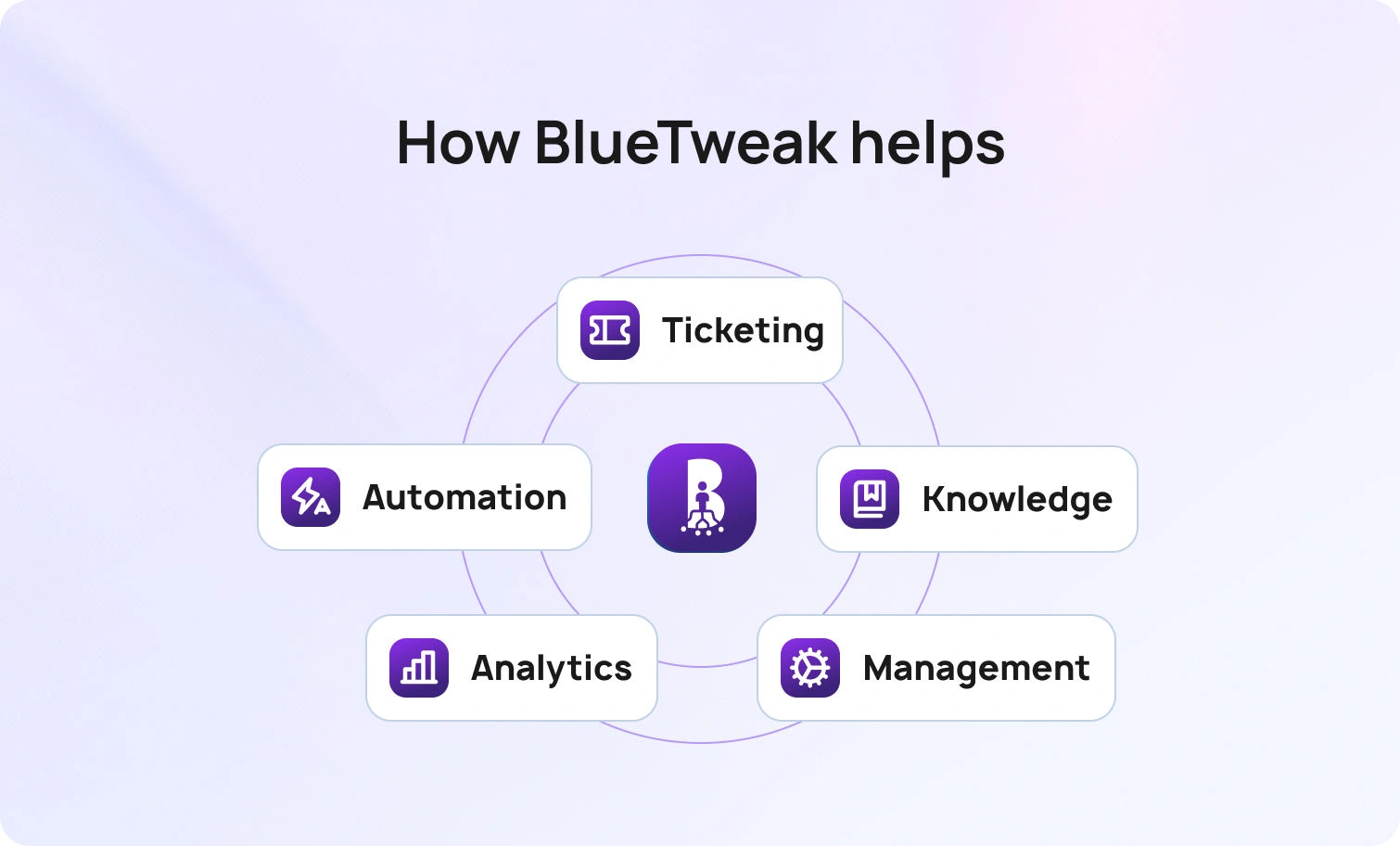
BlueTweak delivers omnichannel ticketing, AI-powered automation, native workforce management, and transparent pricing. It’s built for teams needing both Intercom and Zendesk capabilities without managing multiple vendors.
Below, we’ll break down everything you need to know about Intercom, Zendesk, and BlueTweak to find the right support platform for your team.
Help Desk Platforms for Customer Support Teams 2018 → 2026
Back in 2018, channel silos ruled. Email lived in one system, chat was a bolt-on widget, and voice required a separate call center platform. AI meant basic keyword matching. Reporting was an afterthought. If you wanted omnichannel support, you stitched together three disconnected tools and hoped agents could context-switch fast enough.
Now, in 2026, omnichannel is table stakes, not a premium feature. Both Zendesk and Intercom have evolved to cover email, chat, and messaging channels—though they approach integration differently. Knowledge bases now power both agent assistance and customer self-service. AI has moved from keyword matching to actual classification, summarization, and knowledge base-grounded suggested replies. Strong WFM and analytics are expected, not nice-to-haves. Open APIs connect everything.
Ultimately, you need to unify your channels, knowledge base, and analytics under one roof. Avoid stacking point tools that fragment customer data, inflate TCO, and force agents to context-switch between systems.
The platforms that survived the last seven years consolidated capabilities. The ones that didn't became integration projects.
What Matters in 2026: Everything Under the Same Umbrella
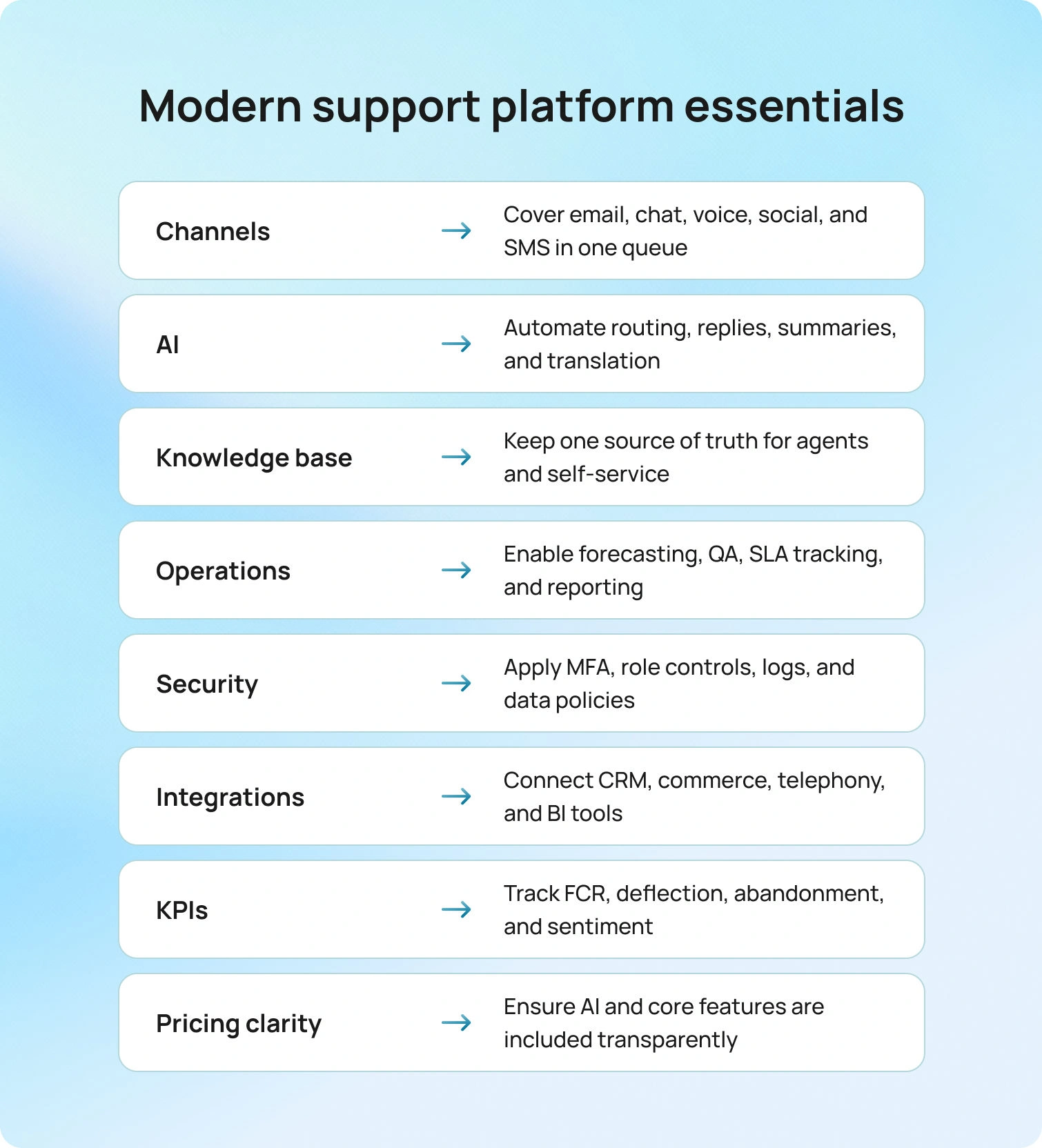
It’s easy to get overwhelmed by features, reviews, and marketing claims. And while some of those things are important, here are the elements you need to focus on the most:
- Channels
- AI
- Knowledge base
- Operations
- Security
- Integrations
- KPIs
- Pricing clarity
Channels
Email, chat, and voice are non-negotiable. Social and SMS are increasingly expected. Your ticketing system needs unified queuing so agents can see the full customer journey.
AI
Classification routes tickets. Summarization condenses threads. Suggested reply drafts knowledge base-grounded responses. Real-time translation supports multilingual teams. Spam detection keeps queues clean.
Knowledge Base
Must surface answers for agents, power self-service portals, feed your AI chatbot, and update everywhere simultaneously.
Operations
Teams need workforce management for forecasting and scheduling, QA for sampling interactions, SLA dashboards, and reporting tracking metrics that matter: FCR, containment, abandonment, and sentiment.
Security
MFA, audit logs, role-based permissions, and data retention are compliance requirements. Workspace segmentation by brand or client matters for multi-account teams.
Integrations
CRM sync, commerce integrations, telephony, and BI tools. Open APIs and webhooks tie everything together.
KPIs
FCR, containment rate, deflection, abandonment, concurrency, and sentiment shifts tell you whether help desk operations are improving.
Pricing Clarity
Core AI shouldn't require add-ons. Prefer plans where AI isn't locked behind separate SKUs.
Feature-by-Feature Comparison: Intercom vs Zendesk vs BlueTweak
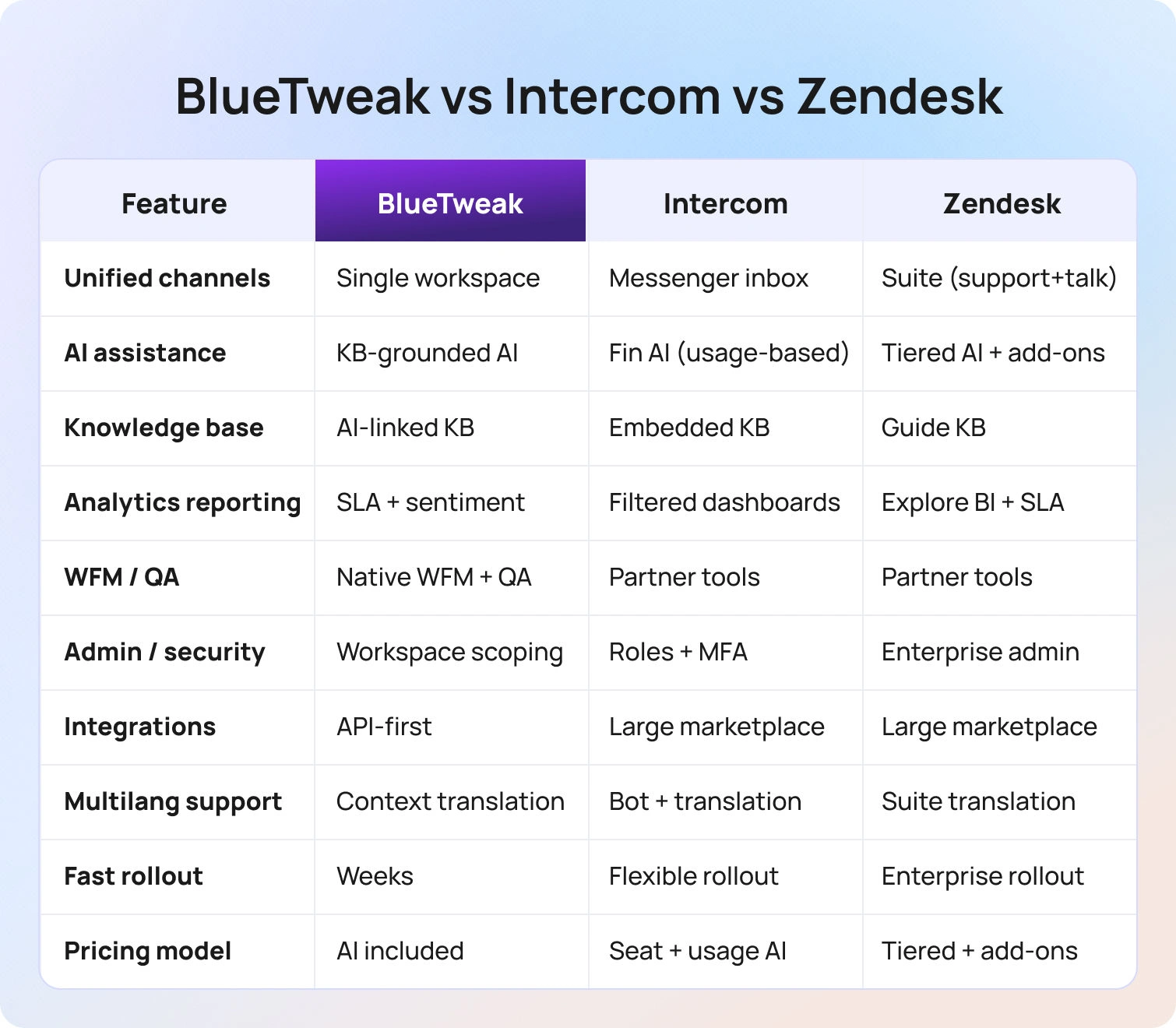
1. Omnichannel Coverage
Unified intake for email, chat, voice, social/SMS with single-queue routing.
- BlueTweak: Unified Inbox with multi-brand routing. AI voicebot handles routine calls with instant escalation. Single workspace; no separate instances for multiple brands. True omnichannel customer support.
- Intercom: Intercom Messenger with inbox functionality. Emphasizes continuity—chat continues via email or in-app without separate cases. Verify voice scope and partner integrations.
- Zendesk: Zendesk Suite bundles Support, Messaging, and Talk. Skills-based routing by expertise and language. Talk integrates voice seamlessly with ticketing functionality.
All three cover chat/email. Voice depth and single-queue execution are swing factors. BlueTweak: multi-brand routing. Zendesk: integrated Talk. Intercom: conversational continuity.
2. AI Assistance
Summaries, classification, proposed reply, spam filtering, live translation, and post-call notes.
- BlueTweak: AI Ticket Summary condenses threads. Suggested Reply drafts KB-grounded responses. Spam filtering. Real-time translation. Post-call notes.
- Intercom: Fin AI (GPT-4) handles 50% of common queries autonomously. Fin AI Copilot suggests replies. Fin resolutions billed at $0.99 each; adds up fast at volume.
- Zendesk: Zendesk AI agents deliver summaries, suggested responses, and intent classification. Talk transcription. Sentiment analysis. Advanced AI often requires monthly add-ons of $50 per agent.
Prioritize KB-grounded replies. BlueTweak emphasizes grounding. Intercom's Fin is sophisticated but usage-based. Zendesk is powerful but often requires add-ons.
3. Knowledge Base and Self-Service
Agent KB + public KB, search quality, widgets, bot source citation.
- BlueTweak: Knowledge base grounds AI replies and chatbot answers, reducing hallucinations. Canned responses for consistency.
- Intercom: Articles, power agent assist, and portals. Messenger-embedded help. Multi-language support.
- Zendesk: Guide with versioning and publishing workflows. Help Center widgets. Multilingual with translation management.
Choose a stack that grounds both agent assist and bots in the same KB. BlueTweak tightly couples KB with AI outputs.
4. Analytics and Reporting
Real-time dashboards, SLA tracking, KPI depth (FCR, Containment, Sentiment), outcome tagging.
- BlueTweak: Real-time SLA dashboards with built-in analytics. Sentiment analysis. Outcome tagging. Post customer interaction summaries.
- Intercom: Dashboards with channel/team/time filtering. Automation reports. Verify containment and sentiment depth by plan.
- Zendesk: Explore analytics with custom dashboards and BI features. SLA/CSAT standard. Data export and API access.
Look for sentiment and outcome tagging feeding back into routing. BlueTweak analytics inform actions. Intercom/Zendesk lean post-hoc.
5. WFM and QA
Forecasting, scheduling, adherence, and QA scorecards.
- BlueTweak: WFM (forecast/schedule) and QA (scorecards/calibration) native. Data flows automatically; no middleware.
- Intercom: WFM/QA via partners. Confirm native versus marketplace.
- Zendesk: WFM/QA through partners (Tymeshift, Playvox). Native analytics support planning.
Native improves time-to-value. BlueTweak includes both. Intercom/Zendesk use partners (effective, but add steps/costs).
6. Administration and Security
Roles, MFA, audit logs, data retention, AI/routing guardrails.
- BlueTweak: Central admin with workspace/brand scoping. AI/routing controls. MFA/audit.
- Intercom: Roles, MFA, audit logs. Verify AI guardrail configurability.
- Zendesk: Admin Center with centralized control. Audit logging scales on enterprise tiers.
All three handle competently. BlueTweak's workspace scoping is useful for multiple brands/clients.
7. Integrations and Extensibility
CRM, commerce, telephony, BI; APIs/webhooks.
- BlueTweak: CRM/commerce/telephony/BI connectors. Open APIs. Integration assistance in onboarding.
- Intercom: Large marketplace. App store. Proactive orchestration. Verify telephony path.
- Zendesk: Extensive marketplace. Sunshine platform for custom data models. Active developer community.
Breadth vs depth decides implementation speed. Intercom/Zendesk has larger ecosystems. BlueTweak prioritizes core integrations.
8. Multilingual Support
Real-time translation with KB grounding, bot languages, voice handoff with context.
- BlueTweak: Real-time translation maintains context. Multilingual voicebot. Context-preserving handoff.
- Intercom: Translation and bot language capabilities. Verify the scope by plan.
- Zendesk: Translation across Messaging/Guide/Talk. Voice handoff maintains context.
Double-check text, voice coverage, and context carryover. BlueTweak excels at maintaining context during language switches.
9. Implementation and Onboarding
Set up KB ingest, enabling suggested reply and change management.
- BlueTweak: Guided rollout. KB ingestion immediately enables AI Suggested Reply. Documented best practices. Fast implementation (weeks).
- Intercom: Migration center tools. Fin AI setup trains on historical data. Self-service and assisted options.
- Zendesk: Migration kits. Professional services for enterprise. Zendesk AI trains on historical data. Can span months for complex implementations.
Fast path: import KB, map intents, enable suggested replies. BlueTweak prioritizes speed. Intercom offers flexibility. Zendesk scales with complexity.
Pricing and TCO Framework
Use this to compare more than just list pricing. It factors in the real total cost: licenses, required add-ons like AI, telephony, and WFM, plus implementation, integrations, training, and ongoing admin work. This framework helps tie each cost line to ROI and time-to-value, so your budget reflects how the platform will actually operate in your world, not a sales-deck fantasy.
Seat vs Usage (at a Glance)
Customer service software pricing usually combines per-agent licenses with usage-based add-ons. Understanding that splitting early prevents budget blowups down the line.
- Included in seat (typical): Core ticketing, standard channels (email/chat UI), basic analytics, standard SLAs, standard storage.
- Usage/add-ons (typical): AI (summaries/suggested reply), WFM, telephony minutes, advanced analytics, bots/automation flows, extra storage/retention, SSO/premium security, sandboxes, HIPAA/industry packs.
BlueTweak: Simple plan with core AI features included. €65 per agent per month covers omnichannel ticketing, AI features (ticket summary, suggested reply, spam filtering, real-time translation), multilingual AI voicebot and chatbot, workforce management, QA scorecards, knowledge base, pre-built analytics dashboards, and call transcription. See pricing and ROI calculator.
Intercom: Intercom pricing for base plans runs roughly $29 to $132 per seat per month (billed annually) and covers core inbox and messaging. AI is priced separately: Fin AI Agent costs $0.99 per resolution, and Fin AI Copilot costs $29 per seat per month. Proactive Support Plus is another $99 flat per month. In practice, costs can climb quickly as AI usage and Intercom user base grow.
Zendesk: Zendesk starts at $55 per agent per month for Suite Team, with Suite Professional at $115 and Suite Enterprise at $169, adding more analytics, routing, and security. AI, voice, analytics, and workforce management often sit outside base tiers. Advanced AI (Copilot) is reported to cost around $50 per agent monthly, WFM runs about $25 per agent monthly, and Talk minutes and Explore analytics may trigger overages or tier upgrades.
What to Collect (Apples-to-Apples Checklist)
When modeling total cost, collect:
- Seats & contracts: Agent count by tier; monthly versus annual; overage terms.
- AI metering: Included versus add-on? Per-message, per-token, or per-seat pricing?
- Channels & volume: Monthly tickets; percentage email/chat/voice/social; peak versus average.
- Telephony: Minutes in/out, AHT, recording/transcription charges, numbers/DIDs.
- WFM: Included versus add-on? Forecast/schedule licensing?
- Automation/bots: Per-flow, per-session, or included? Containment assumptions?
- Storage/retention: Limits, archival fees, legal hold.
- Security/SSO: SSO/SCIM, audit logs, data residency, enterprise packs.
- Services/onboarding: Migration, implementation, premium support SLAs.
- Hidden costs: Marketplace apps, data export fees, API rate limits/overages.
Worked Model (The 50-Agent Scenario)
Let’s see how the pricing works with a real-world scenario.
Scenario: 50 agents, 3 brands, 4 languages, 40,000 tickets per month, 30% voice.
Inputs:
- Seat price per tier
- Included AI (Y/N)
- AI metering
- Minutes per month
- Recording
- Bot sessions and containment percentage
- WFM/QA add-ons
- Storage
- Services
Outputs:
- Monthly platform cost (seats + add-ons + usage)
- Telephony subtotal
- AI subtotal
- All-in monthly and 12-month TCO
- Optional: cost per resolved ticket and per agent
The biggest movers are usually AI metering, voice minutes, and bot containment. A 10% shift in bot containment can swing monthly costs by hundreds or thousands, depending on the pricing model.
BlueTweak makes this simple: One plan including core AI chat features. See pricing and try the ROI calculator for your inputs. €65 per agent per month, all-in, eliminates surprise add-on bills.
How We Evaluated
We only used public vendor sites for our research and evaluation: features, pricing pages, docs/help centers, trust pages, and marketplaces as of January 2026.
And as for use cases and ideal clients, we looked at public logos and case studies (if available on vendor sites).
Must-Have Capability Checklist
- Omnichannel intake (email, chat, voice; social optional)
- KB-grounded answers (agent assist + bots)
- AI: classification, summarization, suggested reply, translation
- Analytics with 2-3 KPIs (FCR, Containment, Abandon, Concurrency, Sentiment)
- WFM/QA native or first-party
- Security/admin: MFA, audit logs, roles
- Integrations + APIs
- Pricing that includes core AI (not only add-ons)
Scoring Rubric
- Fit for 20–100 agents
- Voice/omnichannel depth
- AI coverage (agent assist + KB grounding)
- WFM/QA
- Time-to-value
- Total cost to operate (TCO)
- Security & control (roles, audit, MFA, data residency)
Conclusion
Intercom excels at chat-first engagement, proactive customer relationship journeys, and conversational support that feels modern. It’s best for SaaS teams where in-app messaging is primary, and voice isn't mission-critical. The trade-off is that usage-based AI costs can spike, voice capabilities should be verified, and WFM/QA requires partners.
Zendesk delivers ticketing breadth, marketplace ecosystem depth, and integrated voice through Talk. It’s best for high-volume operations requiring strict SLA management, deep customization, and enterprise security. The trade-off is increased implementation complexity, longer timelines, and unpredictable costs with add-ons.
BlueTweak is positioned as a single-platform omnichannel with KB-grounded AI, built-in WFM/analytics, and simple pricing, making it strong for 20-100-agent teams and multi-brand operations that need comprehensive features without fragmented ticketing tools. It’s the best for a holistic ticketing system that handles customer inquiries and customer conversations at scale across channels.
When to shortlist BlueTweak: If you want omnichannel (voice, email, chat, social), KB-grounded AI, WFM/QA, and simple pricing in one platform. It’s built for teams managing 20-100 support agents who need both Intercom and Zendesk capabilities without juggling multiple vendors or decoding complex add-on structures.
Request a demo to see BlueTweak's omnichannel capabilities, AI assist features, and analytics in action. Or check pricing for transparent costs and an ROI calculator.
Looking for more alternatives? Check out Intercom alternatives and best Zendesk alternatives for broader comparisons.
10 Best AI Chatbots for Customer Support in 2026
Before You Choose: Why Multilingual + GDPR Is Non-Negotiable in 2026
Customer support volume has shifted from email-only to omnichannel messaging, with teams handling inquiries across WhatsApp, chat, voice, and social media in 15+ languages. Human agents alone can't scale this efficiently, which is why AI chatbots and voicebots are stepping in to automate routine inquiries.CFOs now focus on total cost of operation, data sovereignty, and whether your AI chatbot actually grounds answers in your knowledge base or hallucinates under pressure. Common pitfalls include:
- Add-on sprawl: Separate vendors for chat, voice, translation, WFM, and QA (each with its own contract, integration headaches, and siloed analytics).
- Unclear data flows: No DPA (Data Processing Agreement), vague sub-processor lists, or missing data residency options that put you at risk during GDPR audits.
- Text-only bots: Platforms that call themselves multilingual but only handle chat, forcing you to bolt on telephony and voicebot capabilities separately.
We evaluated 10 platforms against a consistent checklist and scoring rubric to help you find exactly what each customer service AI chatbot delivers, where it falls short, and when to shortlist BlueTweak for an all-in-one approach. Here are the top five:
| Platform | Best For... | Key AI Feature | GDPR / Residency | Pricing (2026) |
|---|---|---|---|---|
| BlueTweak | Omnichannel Teams | Native Multilingual Voicebot | EU-Native (Full) | €65/agent (All-in) |
| Intercom | SaaS / In-app Chat | Fin AI Agent | Standard DPA | $29/seat + fees |
| Zendesk | Enterprises | Answer Bot | Regional Options | $55/agent + AI |
| Ada | Chat-First Teams | No-Code Automation | Enterprise DPA | Custom Quote |
| Gorgias | Shopify Stores | Order Automation | Standard DPA | $10/mo + fees |
AI Technology Overview: From Translation Add-Ons to GDPR-Ready, Multilingual CX (2018→2026)
A typical 2018 setup might include Zendesk for ticketing, Twilio for voice, Google Translate API for chat, a standalone chatbot builder (such as Drift or Chatfuel), and manual quality assurance via call recording exports. Customer data flowed through five systems with no unified customer profile, no shared context between channels, and weak oversight of what information the AI chatbot could access.However, growth in messaging and voice volume, as well as the increasing complexity of multi-brand operations for BPOs, and stricter privacy expectations, drove the shift. Older stacks (one vendor for ticketing, another for chat, a third for telephony, separate translation APIs, spreadsheet-based WFM) created unclear data paths, siloed analytics, inconsistent terminology, and high agent handoff rates.To accommodate, teams moved from chat-only existing tools with menu-based IVR systems and translation plug-ins to unified omnichannel platforms
with multilingual AI chatbots and voicebots that ground answers in the knowledge base and provide transparent data governance.Now, it's important to prioritize:
- Native multilingual capability across voice and text channels
- Knowledge base grounding with embeddings + LLM to prevent hallucinations
- Clear GDPR posture (DPA/SCCs, sub-processors, data residency options, DSAR tooling, audit logs)
- Unified analytics over piecemeal add-ons
Double-check the platform handles customer interactions end-to-end—bot deflection, seamless agent escalation,suggested replies
, and post-interaction analysis—without requiring custom development or third-party middleware.These changes demonstrate the importance of using our must-have checklist and scoring rubric for every vendor evaluation.
10 Best AI Customer Service Chatbots With Multilingual Support & GDPR Compliance
These platforms pair knowledge-grounded chatbots with agent copilot tools to deflect routine work and speed resolution. Each was evaluated using the checklist and rubric above.
1. BlueTweak – Editor's Choice

BlueTweak is an AI-native customer service solution
that unifies ticketing, chatbot, agent assist, analytics, and workforce management. It handles email, chat, SMS, WhatsApp, Facebook Messenger, and voice in a unified inbox with shared customer profiles.The platform grounds AI in your internal knowledge base using embeddings + LLM, preventing hallucinations with natural language processing while enabling instant answers to complex queries across text and voice channels.Multilingual support
is available for both chatbots and voicebots, featuring real-time translation and native fluency in over 35 languages. GDPR compliance includes DPA with SCCs, EU data residency, a public sub-processor list, DSAR automation, and audit logs tracking every interaction.Who Uses It
: BPO providers and internal CX teams (20–100+ agents) across e-commerce, telecom, finance, and healthcare, managing multilingual support at scale.Key Features
- Customer support automation: Intelligent routing, auto-classification, sentiment analysis prioritizing urgent customer issues.
- AI voicebot & chatbot: Multilingual conversations (35+ languages) grounded in your KB; seamless agent handoff with full context.
- Copilot assist: Call transcription, AI ticket summary, and suggested replies in under 10 seconds using KB and past tickets.
- Omnichannel inbox: Email, chat, SMS, WhatsApp, Facebook Messenger, unified with shared customer profile history.
- WFM built-in; QA available via add-on: Forecasting, real-time adherence dashboards, shift planning, automated scoring, feedback loops, coaching workflows.
- Multilingual AI: Real-time translation across multiple channels; native fluency for consistent terminology.
- €65/agent/month all-in (ticketing, omnichannel, AI chatbot, AI voicebot, copilot tools, WFM, QA, analytics, integrations)
- AI usage priced separately per interaction (transparent, predictable)
- No feature gating; unlimited users and integrations included
- Bundles agentic AI (voicebot + chatbot), agent copilot tools, native WFM/QA, and full omnichannel in one subscription
- Multilingual across voice and text with KB-grounding to prevent hallucinations
- GDPR-ready: DPA, SCCs, EU data residency, DSAR automation, audit logs
- Transparent pricing; no voice or AI add-ons
- Fast time-to-value (weeks, not months); onboarding support from the BlueTweak team
- Built for BPOs: multi-tenant, multi-brand configuration in one instance
- Suggested replies reduce first response time to under 10 seconds
- Call transcription and ticket summaries free agents from note-taking
- Newer brand compared to Zendesk/Salesforce legacy (though proven with 15M+ customer interactions).
- AI usage scales with volume; per-interaction pricing AI model requires volume forecasting.
to see how BlueTweak's unified AI customer support platform handles voicebot deflection, agent copilot workflows, and real-time workforce analytics in one subscription—no feature gating, no surprise fees.
2. Zendesk
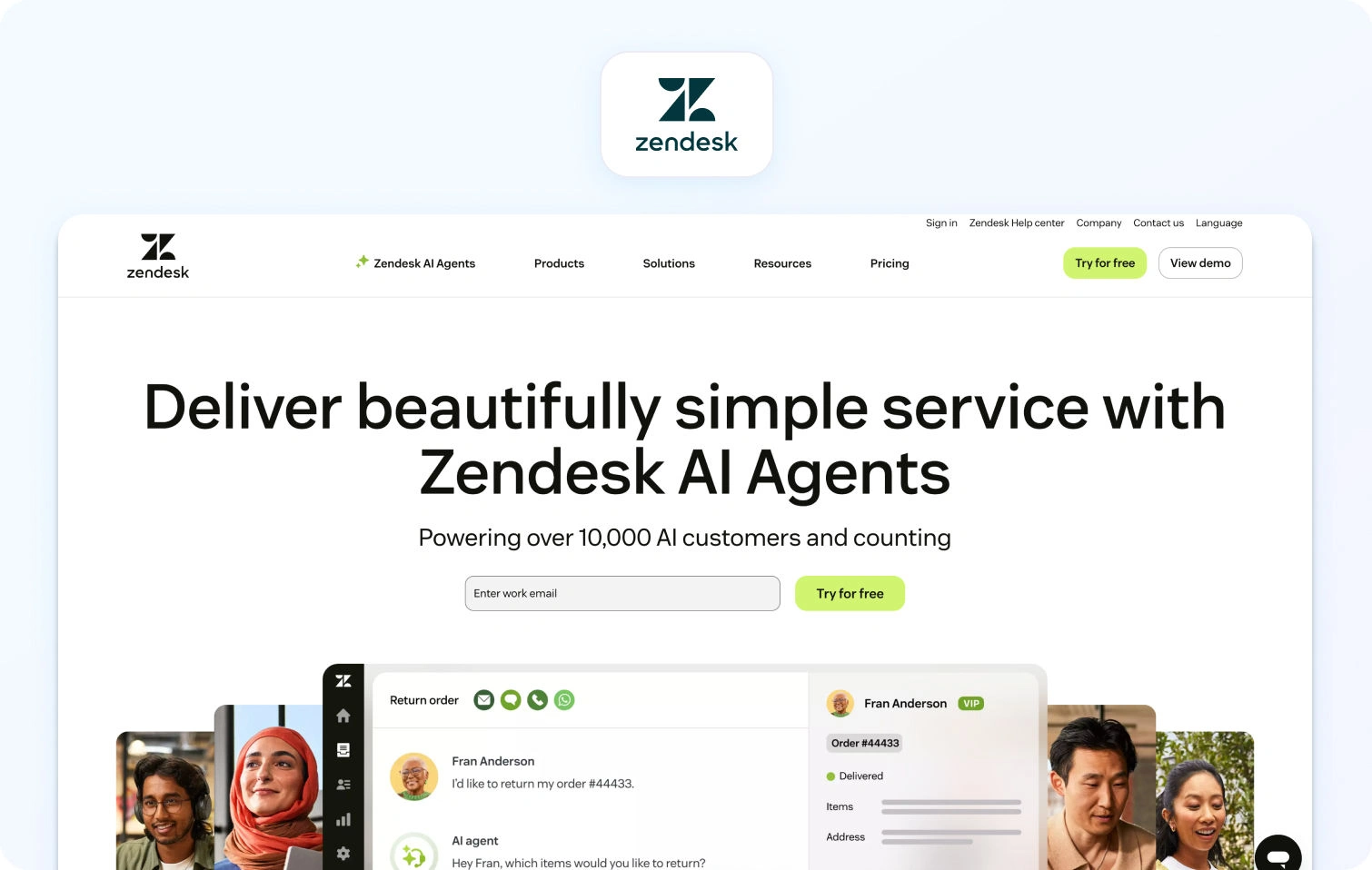
is a cloud-based helpdesk platform with AI add-ons for ticket summarization, customer intent detection, and chatbot automation. It covers email, chat, voice (via Twilio partnership), and messaging, but charges separately for advanced AI, WFM, and voice features.Who Uses It
: SMBs to enterprises across industries; strong in SaaS, e-commerce, and tech support.Key Features
- Omnichannel ticketing with macros and automation
- Answer Bot (knowledge-base chatbot, text-only)
- AI-powered workflow automation and intelligent routing
- Basic reporting dashboards
- Zendesk Talk (voice via Twilio third-party integration)
- Marketplace with 1,200+ app integrations
- Suite Team: $55/agent/month (billed annually)
- Suite Growth: $89/agent/month (billed annually)
- Suite Professional: $115/agent/month (billed annually)
- Suite Enterprise: $150+/agent/month (billed annually)
- Voice, WFM ($25/agent/month), QA ($35/agent/month), and premium AI features cost extra
- Mature ecosystem with an extensive app marketplace
- Familiar UI for many support teams
- Strong integration library for CRM and commerce platforms
- Public DPA with SCCs available
- Voice is partner-dependent (Twilio), not native
- WFM and advanced AI are gated behind enterprise tiers, inflating TCO
- No native voicebot, only text-based Answer Bot
- AI chatbots are limited compared to LLM-native platforms
3. Intercom
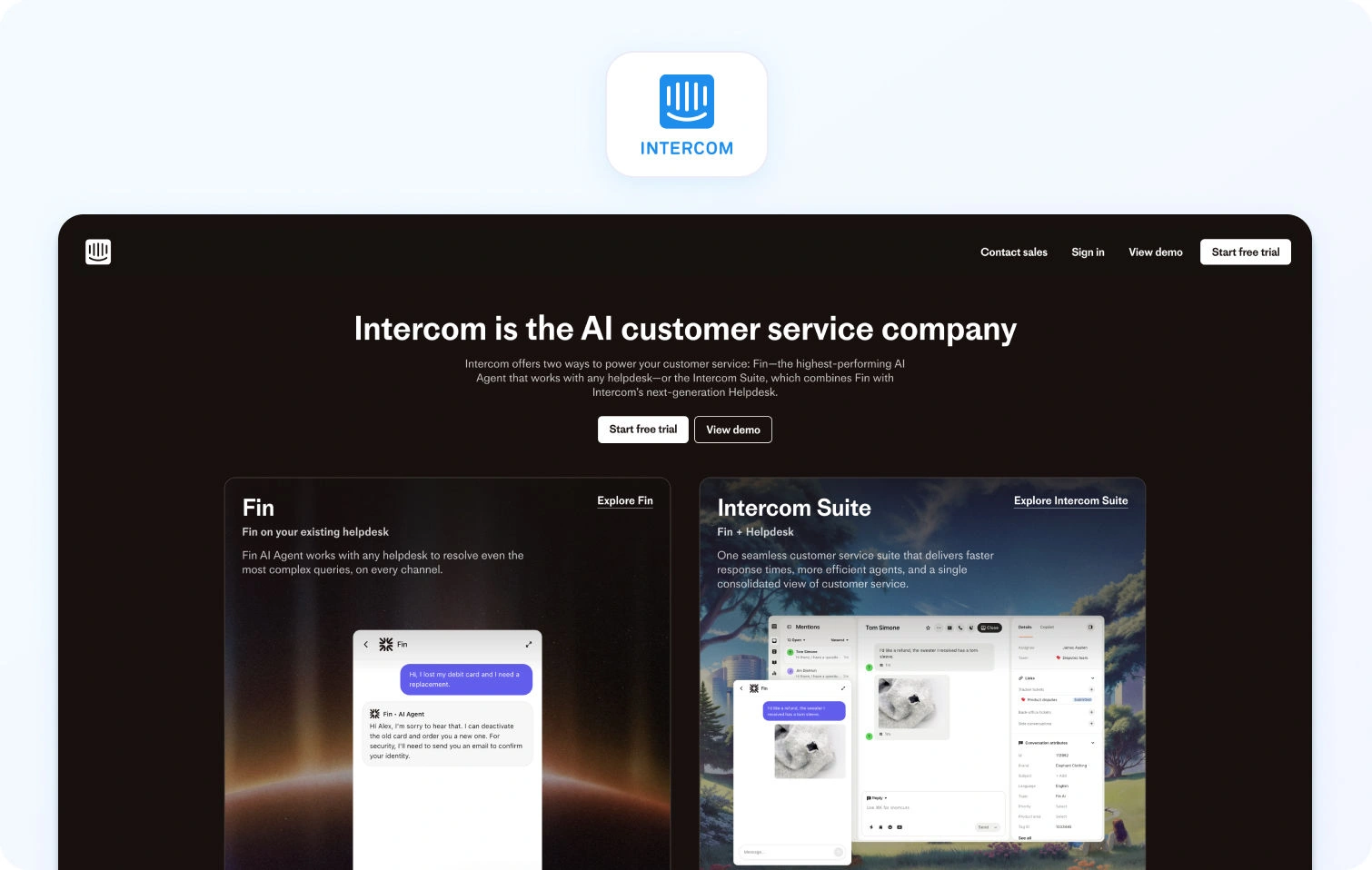
combines live chat, a custom AI chatbot (Fin AI), and helpdesk ticketing, with a focus on proactive engagement and sales conversations. It includes basic email/messaging but limited native voice support.Who Uses It
: SaaS companies, product-led growth teams, and digital-first businesses engaging customers via in-app chat.Key Features
- Fin AI chatbot (GPT-powered, KB-grounded, text-only)
- Live chat and messaging
- Product tours and proactive campaigns (Series)
- Basic ticketing system
- Reporting dashboards
- Multilingual support (45+ languages)
- Essential: $29/seat/month (billed annually)
- Advanced: $85/seat/month (billed annually)
- Expert: $132/seat/month (billed annually)
- Fin AI Agent: $0.99 per resolution (minimum 50 resolutions/month = $49.50 baseline)
- Fin AI Copilot: $35/seat/month for unlimited agent assist
- Proactive Support Plus: $99/month base
- No native voice; integrations required for telephony
- Strong chatbot UX with modern interface
- Proactive messaging capabilities
- Quick setup for digital preferred channels
- Multilingual chatbot
- Expensive at scale
- No native voice or voicebot
- Analytics is limited compared to contact-center platforms
- Unpredictable costs; AI resolution fees balloon during peak volumes
4. Freshdesk (Freshworks)
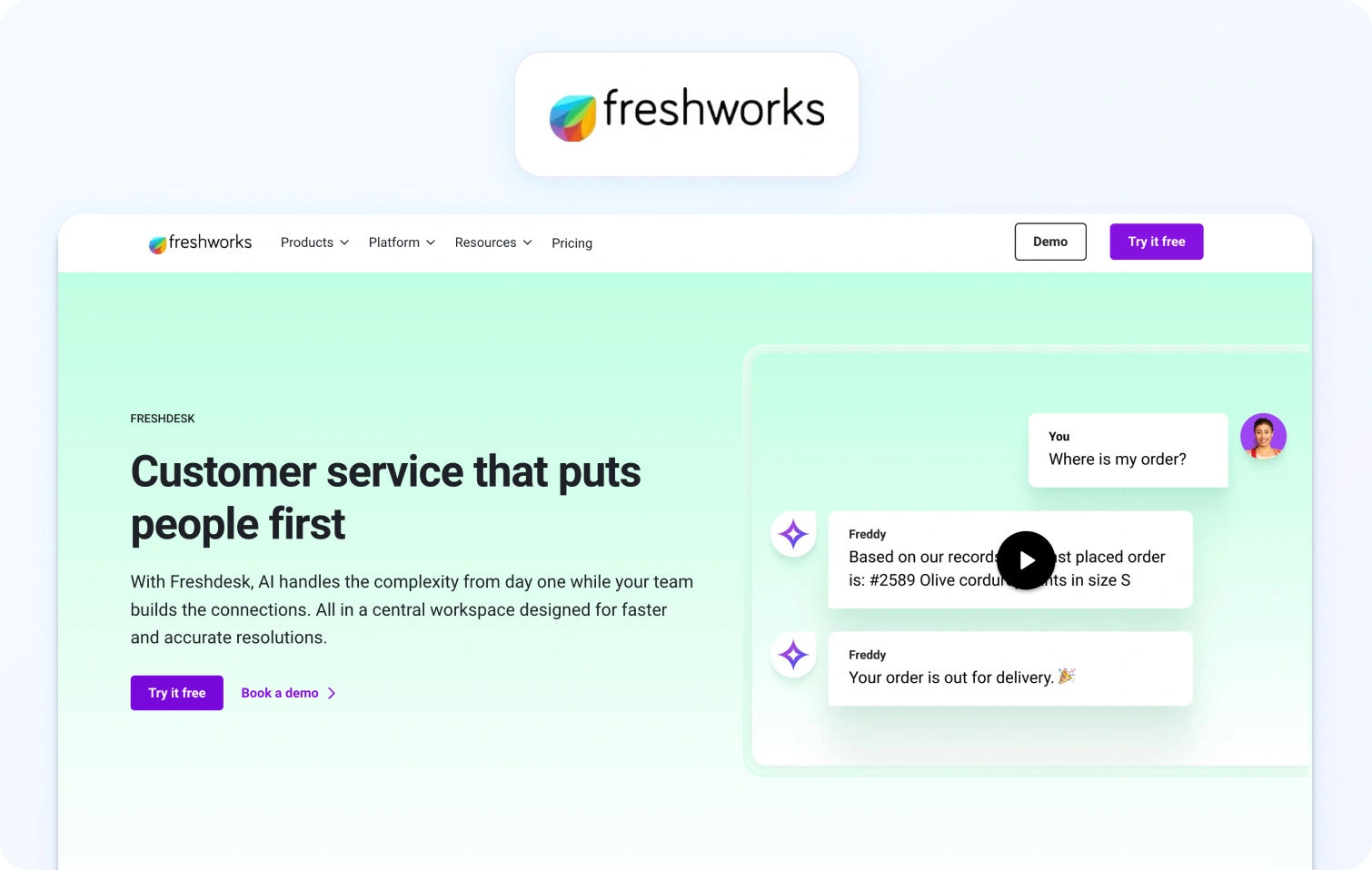
offers ticketing, email, chat, phone (Freshcaller), and Freddy AI for chatbot and real-time assistance. WFM and advanced analytics are available in higher tiers or separate Freshworks products.Who Uses It
: SMBs and mid-market teams; popular in retail, hospitality, and education.Key Features
- Omnichannel ticketing (email, chat, phone, social)
- Freddy AI chatbot (text-only)
- Ticket automation and workflow rules
- Freshcaller (cloud telephony add-on)
- Team collaboration tools
- Basic reporting
- Free: $0 for up to 2 agents (limited features)
- Growth: $15/agent/month (billed annually)
- Pro: $49/agent/month (billed annually)
- Enterprise: $79/agent/month (billed annually)
- Freddy AI Copilot: $29/agent/month (add-on)
- Freddy AI Agent: $100 per 1,000 bot sessions (usage-based)
- WFM via separate Freshworks suite
- Affordable entry point
- Easy onboarding with an intuitive interface
- Decent AI chatbot for text channels
- Voice and WFM bolt-ons inflate TCO
- Freddy AI is less advanced than LLM-native platforms
- Per-session AI pricing is unpredictable (deflecting more tickets = higher costs)
5. Salesforce Service Cloud (Einstein for Service)
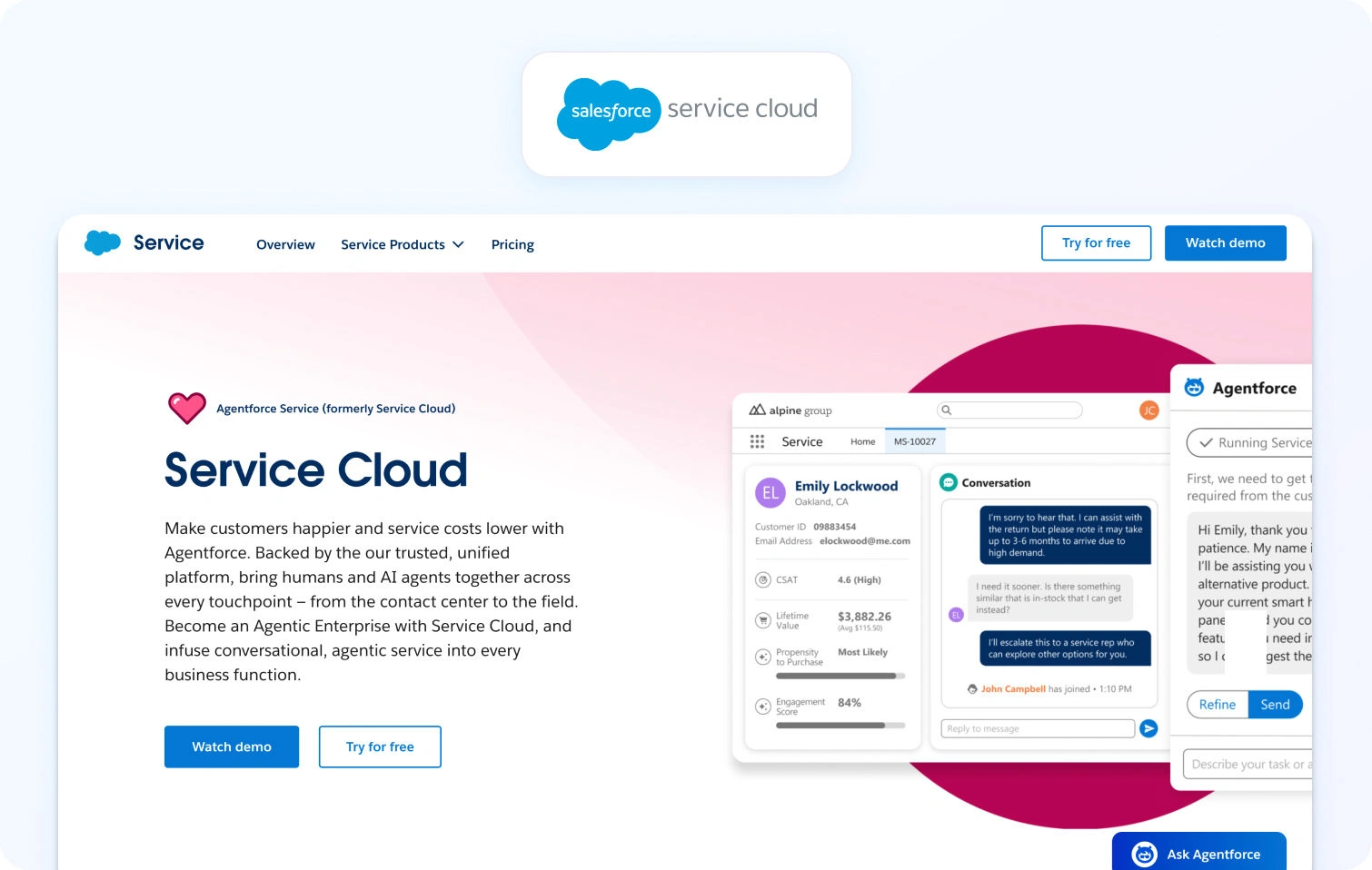
integrates CRM data with omnichannel case management and Einstein AI for predictive routing, chatbots, and sentiment analysis. Voice via third-party CTI or Amazon Connect integration.Who Uses It
: Enterprise companies already in the Salesforce ecosystem; finance, healthcare, and B2B services.Key Features
- Einstein Bots (text chatbot, no voicebot)
- Omnichannel case management
- Einstein AI for case classification and routing
- Field service management
- Einstein analytics and dashboards
- Workflow automation
- Secure CRM integration
- Service Cloud Essentials: ~$75/user/month
- Enterprise Edition: ~$165/user/month
- Unlimited Edition: ~$330/user/month
- Einstein AI add-on: $50/user/month (requires Enterprise or Unlimited Edition)
- Agentforce add-on (newer AI): $125/user/month
- Voice, WFM, and advanced features require higher tiers or additional products
- Deep CRM context for Salesforce-native organizations
- Enterprise-grade security and compliance
- Powerful for teams already invested in Salesforce
- Complex setup requiring months of implementation
- Voice not native; requires third-party integration
- Einstein Bots text-only (no voicebot)
- WFM via separate products
6. Genesys Cloud CX
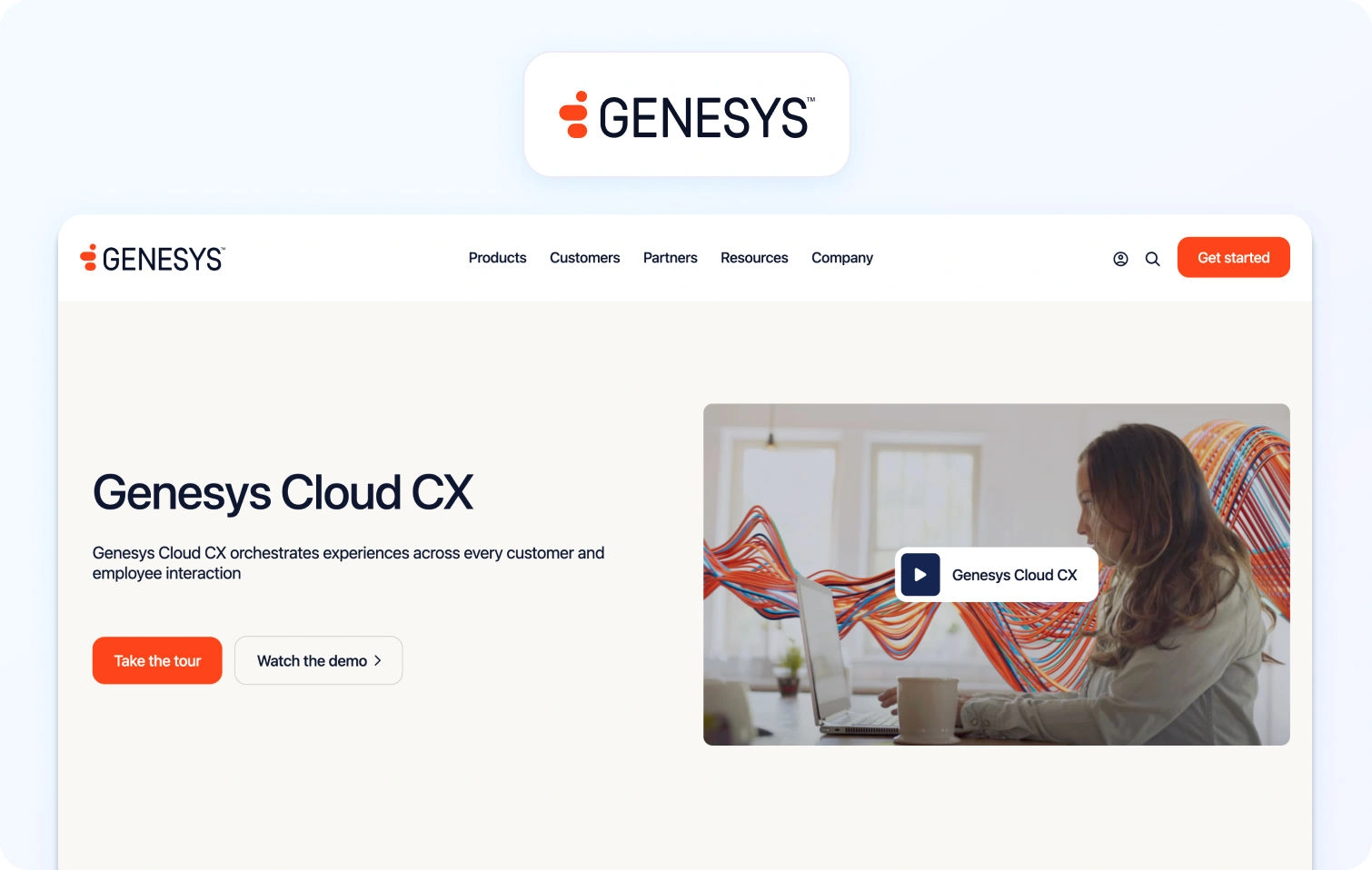
is a contact-center platform with native voice, digital channels, WFM, QA, and AI for predictive routing, sentiment analysis, and agent assist.Who Uses It
: Large contact centers (100+ agents) in telecom, financial services, healthcare, and utilities.Key Features
- Omnichannel (voice, chat, email, SMS, messaging)
- Genesys AI (routing, bots, transcription, analytics)
- Native WFM and QA tools
- Real-time analytics and chatbot performance monitoring
- Workforce engagement management
- Genesys Cloud CX 1: ~$75/user/month (voice-only)
- Genesys Cloud CX 2: ~$115/user/month (includes digital + AI features)
- Genesys Cloud CX 3: ~$155/user/month (adds WFM)
- Genesys Cloud CX 4: ~$240/user/month (adds AI Customer Experience Orchestration)
- Minimum monthly contract commitment: $2,000 (roughly 27 agents on CX 1)
- AI Experience tokens: 250 named or 350 concurrent tokens per org/month included; additional tokens cost extra
- Enterprise contracts often require custom quotes
- Full contact-center stack with robust voice
- Native WFM/QA included in higher tiers
- Strong compliance controls for regulated industries
- Gartner Magic Quadrant Leader (11+ consecutive years)
- Overkill for <100 agents
- Steep learning curve
- Slower time-to-value
- Complex AI token system adds cost unpredictability
7. Ada
is a no-code AI chatbot platform (text-only) that automatically handles customer inquiries via chat and messaging. No native ticketing, voice, or WFM. It integrates with external helpdesks.Who Uses It
: E-commerce, fintech, SaaS; companies seeking chatbot-first automation with low IT overhead.Key Features
- GPT-powered chatbot (text-only)
- Knowledge-base grounding
- Multilingual support (45+ languages)
- Analytics dashboard
- Integrations (Zendesk, Salesforce, Shopify)
- Custom pricing only; no public paid plans
- Per-resolution or per-conversation pricing model
- No free plan; contact sales for a quote
- Fast chatbot deployment
- Strong text automation
- Multilingual capabilities (45+ languages)
- Easy for non-technical teams
- No transparent pricing (requires sales contact)
- Text-only (no voice or voicebot)
- No native ticketing or WFM
- Must integrate with a separate helpdesk
- Limited visibility into agent workflows or quality assurance
8. LivePerson
is a conversational messaging platform that specializes in messaging-first customer engagement across web, mobile apps, SMS, and social channels, utilizing generative AI and LLM orchestration.Who Uses It
: Enterprise brands (retail, telecom, finance, hospitality) prioritizing digital-first, messaging-based engagement over voice.Key Features
- Conversational Cloud platform (messaging-first)
- Omnichannel messaging (SMS, WhatsApp, Apple Business Chat, Facebook, web, app)
- Generative AI and LLM orchestration (Bring Your Own AI)
- Intent Manager and Conversation Builder (no-code AI chatbot builder)
- Agent Assist and Conversation Copilot
- Analytics Studio (voice + text conversation analysis)
- Integration with Apple Pay for in-chat transactions
- Compliance (GDPR, HIPAA, PCI DSS, CCPA)
- Custom pricing only (no public plans)
- No free option; free trial available
- Messaging-first platform (ideal for digital-first brands)
- Handles 1 billion+ conversations monthly
- Strong LLM/generative AI capabilities
- BYOAI (Bring Your Own AI) flexibility
- Deep social and messaging integrations
- No transparent pricing (requires sales contact)
- Expensive for SMBs
- Messaging-focused; limited native voice
- Complex setup and navigation
- Not ideal for voice-heavy contact centers
9. HubSpot (Chatbot)
combines CRM, marketing automation, and customer service with a free chatbot builder and live chat. It's designed for inbound marketing teams that want unified customer data across sales, marketing, and support.Who Uses It
: SMBs and mid-market companies using HubSpot CRM; strong in SaaS, professional services, and B2B.Key Features
- Free chatbot builder with conversation flows
- Live chat widget with team inbox
- Ticketing system with automation
- Knowledge base and help center
- Email integration and team collaboration
- CRM integration (contact history, deal tracking)
- Basic AI features in paid tiers
- Reporting and analytics
- Free: $0 (includes basic chatbot, live chat, ticketing for up to 2 users)
- Service Hub Starter: $15/seat/month (2-seat minimum = $30/month)
- Service Hub Professional: $90/seat/month (5-seat minimum = $450/month)
- Service Hub Enterprise: $150/seat/month (10-seat minimum = $1,500/month)
- AI features are limited to Professional and Enterprise tiers
- No native voice or voicebot
- Free plan available with basic chatbot and ticketing
- Seamless CRM integration for HubSpot users
- Easy setup with no-code chatbot builder
- Unified platform for marketing, sales, and service
- Strong for inbound lead generation
- Limited AI capabilities compared to dedicated platforms
- No native voice or voicebot
- No native WFM or QA tools
- Chatbot flows are basic (rule-based vs conversational artificial intelligence and machine learning)
- Limited multilingual support
10. Gorgias
is an e-commerce-focused helpdesk with deep integrations for Shopify/BigCommerce/Magento, as well as AI Agent capabilities for order management, refunds, and product recommendations.Who Uses It
: E-commerce brands (especially Shopify stores) with moderate to high order volumes.Key Features
- Deep e-commerce integrations (Shopify, BigCommerce, Magento)
- AI Agent (text-only chatbot) for order tracking, cancellations, and refunds
- Omnichannel inbox (email, chat, SMS, social, voice)
- Automated workflows and macros
- Revenue-driving features (upsells, product recommendations)
- 100+ e-commerce app integrations
- Starter: $10/month (50 tickets included)
- Basic: $60/month (300 tickets included)
- Pro: $360/month (2,000 tickets included)
- Advanced: $900/month (5,000 tickets included)
- AI Agent resolutions: $0.90–$1.00 each (annual vs monthly billing)
- Overage fees apply beyond plan limits
- Best-in-class for Shopify/e-commerce stores
- Order management directly in Helpdesk
- Revenue-focused features (product recommendations, cart recovery)
- Affordable entry point for small e-commerce teams
- Primarily Shopify-focused; limited value for non-e-commerce
- AI Agent text-only (no voicebot)
- Complex pricing: pay for AI resolutions + they count toward ticket limits
- No native WFM or QA tools
What Counts as GDPR-Ready, Multilingual in 2026
Not all platforms that claim GDPR compliance actually deliver the controls teams need. Here's what to verify before signing:GDPR essentials
- DPA/SCCs: Data Processing Agreement with Standard Contractual Clauses for EU data transfers.
- Sub-processors: Public, updated list of all third-party AI providers (OpenAI, Anthropic, Google) the platform uses.
- Data residency: Options to store customer data in EU or other regional data centers, not just US-only cloud.
- DSAR tooling: Built-in features to handle data subject access requests (view, export, delete customer data).
- Audit logs: Granular records of who accessed what data, when, and why—critical during compliance reviews.
- Native vs translation: Does the AI chatbot support multiple languages natively (trained on multilingual datasets) or rely on real-time translation APIs that introduce latency and errors?
- KB grounding: Can the chatbot pull context from your internal knowledge base, CRM, or external APIs to answer queries accurately, or does it generate responses from a generic model?
: Confirm multilingual support for chat (not just translated UI labels), and evaluate any voice features separately if you plan to automate phone calls.
The Importance of GDPR Compliance
Choosing a customer service AI chatbot without verified GDPR compliance exposes your organization to regulatory penalties, reputational damage, and operational disruption. Here's what's at risk:
- Regulatory penalties: GDPR fines can reach €20 million or 4% of global annual revenue, whichever is higher. In 2023, the Irish Data Protection Commission fined Meta €1.2 billion for inadequate data transfer mechanisms—a direct result of unclear sub-processor agreements and missing SCCs.
- Reputational damage: A data breach or non-compliance disclosure triggers customer churn, especially in finance, healthcare, and insurance, where trust is the foundation. Support teams that can't demonstrate secure data handling lose enterprise contracts.
- Operational disruption: Without DSAR tooling and audit logs, responding to data subject requests becomes a manual, time-consuming process. Platforms that store customer data in non-EU data centers without SCCs force you to halt operations during compliance reviews.
- Third-party liability: If your AI chatbot relies on external LLMs (OpenAI, Google, Anthropic) without clear DPAs, you inherit their compliance gaps. Many platforms don't disclose sub-processor relationships until after the contract is signed, leaving you liable for their data handling.
- Loss of customer trust: Customers expect transparency about how AI handles their data. Platforms that can't explain where human conversations are stored, who accesses transcripts, or how long data is retained create friction during sales cycles and support interactions.
GDPR compliance isn't a checkbox. It's a competitive advantage. Sales teams that choose GDPR-ready platforms with transparent data governance win enterprise deals, pass audits faster, and sleep better knowing customer interactions are protected.
How We Evaluated Each AI-Powered Chatbot
Our ranking process ensures you can compare platforms objectively, without marketing spin or unverified claims. Here's how we assessed every AI customer service chatbot:
- Features: Checked against the must-have checklist below using public documentation, product demos, and vendor support articles. We prioritized platforms that bundle AI chatbot, voicebot, agent copilot tools, and customer support automation in base subscriptions rather than charging per feature.
- Who uses it: Drawn from public case studies, customer logos on vendor websites, and third-party review platforms (G2, Capterra). If user segments weren't clear, we noted and evaluated them based on the stated positioning (SMB vs. mid-market vs. enterprise).
- Pricing: From published pricing pages. If absent, we noted the stated model (per-agent, per-resolution, tiered) and flagged "contact sales."
- Pros/cons: Evidence-based strengths and gaps tied directly to checklist criteria and rubric scores. No superlatives ("best-in-class," "industry-leading") unless supported by third-party benchmarks. We focused on what teams at 20–100 agents will encounter: setup complexity, integration quality, support responsiveness, and whether AI chatbots actually reduce ticket volume or just shift work to agents.
Must-Have Capability Checklist
Every platform below was evaluated against these baseline requirements:
- Multilingual AI & Voice: Supports 10+ languages with native fluency and conversational IVR for 60–80% routine deflection.
- KB-Grounded Accuracy: Uses RAG (Embeddings + LLM) to pull context from your internal knowledge base, preventing AI hallucinations.
- True Omnichannel: A single inbox for email, WhatsApp, SMS, and voice with a unified customer profile.
- GDPR & Data Sovereignty: Mandatory DPA/SCCs, regional data residency (EU/US), and granular audit logs for compliance.
- Operational Alignment: Built-in Workforce Management (WFM) and Quality Assurance (QA) to avoid "tool sprawl."
- Pricing Integrity: Flat "all-in" per-agent rates; no hidden per-resolution fees that balloon during peak volume.
Scoring Rubric
After confirming baseline capabilities, we scored each platform on these dimensions:
| Dimension | What We Look For |
|---|---|
| Mid-Market Fit | Scaled for 20–100 agents; avoids SMB limitations or enterprise complexity. |
| AI Coverage | Balance of "Agentic AI" (autonomous) and "Copilots" (agent assistance). |
| Native WFM/QA | Ability to forecast, schedule, and score interactions without 3rd-party add-ons. |
| Time-to-Value | Deployment in weeks, not months of professional services. |
| Total Cost (TCO) | Full visibility into voice, AI, and integration costs for 50-agent scenarios. |
| Security Controls | MFA, role-based permissions, and DSAR automation for data requests. |
Choosing the Right GDPR-Ready, Multilingual Chatbot
The best AI chatbot for improving customer service delivers multilingual coverage, a knowledge base foundation to prevent hallucinations, a clear GDPR posture, and native WFM/QA capabilities. It does this without gating features behind enterprise SKUs or charging unpredictable per-resolution fees.If you're running a 20–100 agent team and need everything in one platform, BlueTweak delivers. It's the only solution that bundles agentic AI (voicebot + chatbot), agent copilot tools (call transcription, ticket summaries, suggested replies), native workforce management, quality assurance, and full omnichannel capabilities in one €65/agent/month subscription.No feature sprawl, no surprise fees, no voice or AI add-ons; just transparent pricing and fast deployment.Schedule a 30-minute demo
and learn how BlueTweak replaces five tools while delivering measurable gains in ticket deflection, first response time, and agent productivity.
FAQ
Want to see BlueTweak for yourself? Sign up to our free 14-day trial!
Free trial



