



TL;DR
GDPR compliance for customer support means understanding how a platform collects, stores, accesses, and processes personal customer data across voice, email, chat, and AI. The GDPR applies to organizations in the EU and, in certain circumstances, organizations outside the EU that offer goods or services to people in the EU or monitor their behaviour. Non-compliance can lead to fines of up to €20 million or 4% of annual worldwide turnover, whichever is higher. Before choosing a platform, teams need to know where customer data sits, who can access it, how it's protected, and what AI is permitted to do with it. BlueTweak is GDPR compliant and ISO 27001 certified, with data processing agreements available for enterprise customers on request.
Customer support platforms can put a lot of customer data in one place, particularly when organizations use omnichannel support to manage conversations across email, chat, voice, and social channels. Conversations may contain contact details, account information, order history, or sensitive information, then move through multiple channels, integrations, analytics tools, and AI features.
That makes GDPR compliance harder to assess than simply asking whether a platform is "GDPR compliant." You need to understand what happens to customer data throughout the support process, including where it's stored, who can access it, and how it's processed.
BlueTweak is GDPR compliant and ISO 27001 certified, with security controls designed to protect customer data and support for specific data residency requirements. But what should you actually look for when assessing a customer support platform?
Why Customer Support Creates Specific GDPR Considerations
Customer support creates a particularly complex environment for data processing because personal information can pass through several systems during a single interaction.
A customer might start with an email, move to live chat, and then speak to an agent by phone. The platform could then store the conversation, generate a transcript, summarize the interaction, classify the ticket, analyze sentiment, or use AI to help an agent draft a response.
Each of these activities can involve personal data. Under the General Data Protection Regulation (GDPR), processing personal data covers activities such as collecting, storing, accessing, using, sharing, and deleting information relating to an identifiable individual. For customer service teams, that can include far more than the name and email address attached to a ticket.
A support platform may process:
- Names and contact details
- Account and order information
- Email threads and support tickets
- Voice recordings and call transcripts
- Chat conversations
- Customer preferences and interaction history
- Information contained in attachments
- Customer service analytics
- Information processed by AI tools
The important point is that these different types of customer data don't necessarily have the same purpose, access requirements, or data flows. An agent may need access to an order number to resolve a request. An analytics tool may process interaction data to identify trends. An AI system may need the conversation and relevant knowledge-base content to suggest an appropriate response.
For organizations working to ensure GDPR compliance, understanding these different processing activities matters. The question isn't just whether a platform can protect customer data. It's whether you can understand and control how that data moves through the platform and what happens to it along the way.
That becomes particularly important as customer service teams introduce more automation and AI. The more systems involved in service delivery, the more important it is to have clear data flows, appropriate access controls, and a clear understanding of what each system is permitted to process.
What To Check For GDPR Compliance Before Choosing A Support Platform
When assessing GDPR compliance for customer support, buyers need to look beyond a vendor's compliance statement and understand how the platform handles personal data throughout its lifecycle.
A customer support platform can act as a data processor on behalf of your organization, while your organization may remain the data controller responsible for deciding why and how customer data is processed. Understanding that relationship is an important starting point for procurement and compliance teams.
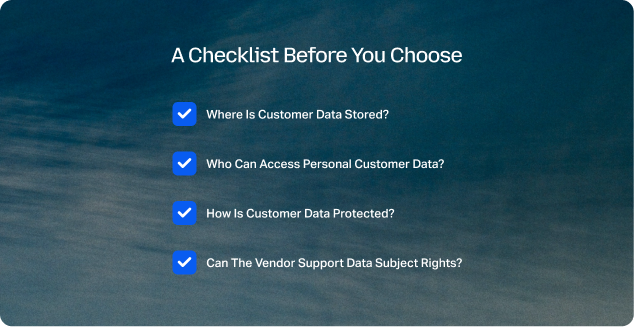
Before choosing a platform, ask:
Where Is Customer Data Stored?
Data residency matters when your organization has specific requirements around where personal customer data is stored and processed. Ask the vendor where customer data is hosted, whether data can move between regions, and which subprocessors may have access to it.
This is particularly important for organizations serving customers in the European Union (EU) or European Economic Area (EEA), where international data transfers may introduce additional requirements.
Who Can Access Personal Customer Data?
A GDPR-compliant platform should give organizations appropriate controls over who can access customer information. Look for role-based access controls, authentication measures, audit trails, and other technical measures that help prevent unauthorized data access.
Access should also reflect what people actually need to do their jobs. Customer service teams don't necessarily need access to every piece of customer information stored in a platform.
How Is Customer Data Protected?
Data security is a core part of protecting personal customer data. Ask vendors how they protect information in storage and transit, how they manage access, and what processes they have in place to detect and respond to data breaches. Customer service teams should also have processes for documenting personal data breaches and escalating them appropriately. Under GDPR, where a personal data breach is likely to result in a risk to individuals' rights and freedoms, the data controller must notify the relevant supervisory authority without undue delay and, where feasible, within 72 hours of becoming aware of the breach.
It's also worth asking how the vendor demonstrates ongoing compliance rather than relying on a one-time certification or statement.
BlueTweak is ISO 27001 certified, an internationally recognized standard for information security management systems (ISMS). The certification covers how information is stored, accessed, and protected across the organization, with the system independently audited and certified. Data processing agreements are also available for enterprise customers on request.
Can The Vendor Support Data Subject Rights?
Under GDPR, data subjects have rights relating to their personal data, including rights around access, correction, deletion, portability, and objection in certain circumstances.
Your support platform therefore needs to fit into the processes you use to respond to these requests. During procurement, ask how the platform supports data access requests, deletion requests, data portability, and other relevant data subject rights.
You should also understand how long customer information is retained and whether your organization can define or manage retention requirements.
What GDPR Compliance Means For AI-Powered Customer Support
AI adds another layer to GDPR compliance because customer conversations can be processed not only to provide support, but also to generate summaries, classify interactions, analyze sentiment, translate conversations, or suggest responses.
The key question isn't simply whether an AI feature is "GDPR compliant." It's what personal data the AI processes, why it processes it, where that processing takes place, and what controls your organization has over it.
This is where the distinction between different types of AI functionality becomes important.
An AI tool that summarizes a conversation for an agent is processing customer data differently from an autonomous system that makes decisions or communicates directly with a customer. Similarly, an AI feature that retrieves information from an approved knowledge base has a different data flow from a system that can freely generate responses from a wider set of sources.
For procurement teams, useful questions include:
- What customer data is sent to the AI system?
- What is that data used for?
- Is customer data used to train or improve models?
- Where does AI processing take place?
- Which third parties or subprocessors are involved?
- Can organizations control which AI features process customer data?
- Is there a human review step before AI-generated content reaches the customer?
- Can the organization document and review these processing activities?
These questions become particularly important when evaluating the best GDPR compliant conversation intelligence software or platforms that use AI to analyze large volumes of customer interactions. When comparing the best GDPR compliant conversation intelligence software for your organization, look beyond the feature set to understand how each platform handles personal data, AI processing, data residency, and access controls. The same considerations apply when assessing the best GDPR compliant conversation intelligence platforms: compliance should be evaluated alongside the specific data flows, AI capabilities, and governance controls your customer service operation requires.
Radu Dumitrescu, Head of Presale & Digital Transformation at BlueTweak, describes the importance of treating these elements as part of the same underlying system:
“Most teams have a fragmentation problem rather than a channel problem. They've already invested in email, chat, voice, and social, but the real value comes when those interactions, the AI supporting them, the knowledge behind every answer, and the data used to measure performance all work from the same foundation.” — Radu Dumitrescu, Head of Presale & Digital Transformation, BlueTweak
From a data protection perspective, that shared foundation matters. When conversations, AI processing, knowledge, and reporting sit across disconnected systems, it can be harder to understand the complete data flow and maintain consistent controls.
A unified platform doesn't automatically make an organization GDPR compliant, but it can make the underlying data processing activities, access controls, and AI workflows easier to understand and govern.
Why The Knowledge Base Matters For GDPR And AI Governance
A knowledge base can act as an important boundary for AI-powered customer support by defining the information the system should use when helping agents or responding to customers.
For organizations evaluating GDPR compliance for customer support, this matters for a reason that goes beyond accuracy. The more clearly you can define what information an AI system should draw from, the easier it is to establish what the system is permitted to use when generating an appropriate response.
BlueTweak's Smart Knowledge Base provides a single source of verified content for agents, suggested replies, chat, and voice. Suggested replies are grounded in approved knowledge-base content rather than generated freely.
That creates a useful distinction between customer data and the information used to answer a customer request.
For example, a support agent may need access to a customer's order details to resolve an issue. The AI may then need the relevant policy or product information from the knowledge base to help formulate a response. Those are different types of information serving different purposes.
A well-governed setup should make those boundaries clear; it should also give customer service teams control over what information is available to AI features, who can access it, and when a human needs to review an AI-generated response. This supports data minimization by helping organizations avoid making more customer information available to an AI system than is necessary for the task.
For businesses working to maintain GDPR compliance, this is an important part of the wider picture: protecting customer data isn't only about securing the database. It's also about understanding what data each part of the customer service platform can access, what it can do with that data, and what it is allowed to say to customers.
How To Demonstrate GDPR Compliance With A Customer Support Platform
GDPR compliance isn't something a customer support platform can demonstrate with a single checkbox. Organizations need to be able to show how personal data is processed, what controls are in place, and how those controls support their wider data protection responsibilities.
This is where documentation becomes particularly important during procurement.
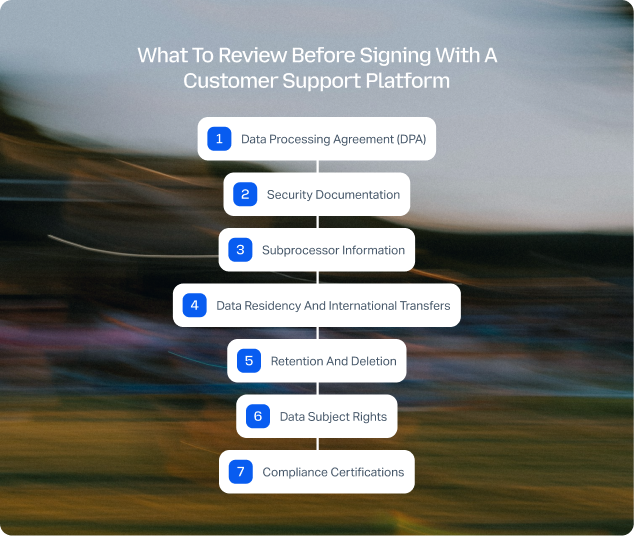
Before signing with a customer support platform provider, your compliance or data protection team may want to review:
- Data processing agreement (DPA): A DPA should set out how the service provider processes personal data on your behalf, including relevant responsibilities and obligations.
- Security documentation: Look for information about technical and organizational measures, access controls, encryption, authentication, monitoring, and incident response.
- Subprocessor information: Understand which third parties may process customer data as part of delivering the service.
- Data residency and international transfers: Establish where data is stored and processed, and whether standard contractual clauses or other safeguards are relevant to international data transfers.
- Retention and deletion: Check how long personal data is retained and what happens when it is no longer required.
- Data subject rights: Confirm that the platform can support processes for access, deletion, correction, portability, and other applicable data subject rights.
- Compliance certifications: Independent certifications can provide additional evidence of the technical and organizational controls supporting data protection.
A data protection impact assessment (DPIA) may also be appropriate where proposed processing is likely to result in a high risk to individuals. The assessment should consider the nature, scope, context, and purposes of the processing, as well as the potential risks to data subjects and the measures being used to address them.
For customer service teams introducing extensive analytics, automated processing, or AI processing, it's worth involving the organization's data protection officer (DPO) or relevant privacy team early in the procurement process. They can help determine the appropriate legal basis, assess data processing activities, and identify whether additional safeguards are needed.
BlueTweak supports this review with its security framework, GDPR compliance, and ISO 27001 certification. Enterprise customers can also request a data processing agreement as part of their assessment.
The aim isn't to collect compliance documents for their own sake. It's to give your organization enough information to understand the platform's data flows, assess potential risks, and demonstrate accountability for how customer information is processed.
Maintaining GDPR Compliance After Implementation
Choosing a GDPR-compliant customer support platform is only the beginning. Organizations also need to regularly review how customer data is processed as their customer service processes, technology, and AI capabilities change.
A platform may initially be approved for a specific set of processing activities. Over time, your support operation could add a new channel, integrate another service, introduce an AI feature, change retention periods, or expand into another market. Each change can affect the way customer information is collected, accessed, or processed.
That's why ongoing GDPR compliance should form part of normal platform governance. Customer service and compliance teams should regularly review:
Data Processing Activities
Keep an up-to-date view of what personal data the platform processes, why it is processed, where it goes, and which systems or subprocessors are involved.
This can also help identify opportunities for data minimization. If a feature or workflow doesn't need access to particular customer information, that information shouldn't automatically be made available to it.
Access Controls
Review user permissions regularly, particularly when people change roles or leave the organization. Access should remain appropriate to each person's responsibilities rather than accumulating over time.
AI Processing
As AI features change, review what data they can access, what they process, and whether the original assessment still reflects the way the technology is being used.
For example, introducing automated processing into a workflow that previously relied on human review may require a fresh assessment of the relevant risks, safeguards, and legal basis.
Data Retention
Regularly check whether customer information is being retained for longer than necessary. Retention should reflect the purpose for which data was collected and any applicable legal or business requirements.
New Integrations And Subprocessors
Adding an analytics tool, CRM integration, communication channel, or other service can create a new data flow. Your compliance process should account for these changes rather than treating the original platform assessment as permanent.
Maintaining GDPR compliance therefore requires more than choosing a GDPR-compliant customer service platform. It requires ongoing visibility into the data processing activities that support customer service and the controls surrounding them.
Organizations should also reassess their data flows when changing systems, adding integrations, or undertaking a contact center migration. Changes to your technology stack can alter where customer data is stored, which systems can access it, and which subprocessors are involved, so these changes should be included in your ongoing GDPR compliance review.
For organizations using AI, that governance becomes even more important. Regular reviews can help ensure that customer data remains protected as support workflows evolve, new features are introduced, and customer-facing teams rely on more automated processing.
GDPR Compliance Checklist For Customer Support Platforms
A GDPR compliance checklist can help procurement and customer service teams assess whether a support platform has the controls needed to process customer data responsibly.
Before choosing a customer support platform, work through these areas with your compliance, security, and customer service teams:
This checklist shouldn't replace a formal legal or security review. Instead, it gives procurement and customer service teams a practical starting point for understanding the platform's data flows and identifying questions that need further investigation.
For organizations processing EU customer data, GDPR compliance is an ongoing responsibility. A vendor's compliance status matters, but so does your own understanding of how the platform fits into your customer service processes.
How BlueTweak Supports GDPR Compliance
BlueTweak is GDPR compliant and designed to give organizations greater visibility and control over how customer data is handled across their support operation.
BlueTweak is ISO 27001 certified, an internationally recognized standard for information security management systems (ISMS). The certification covers the processes and controls used to store, access, and protect information, with the system independently audited and certified.
For enterprise customers, BlueTweak also provides data processing agreements on request, giving organizations documentation they can use as part of their data protection and procurement review.
Security controls include measures such as role management, multi-factor authentication, audit trails, and data residency controls, helping organizations manage who can access customer information and how that access is governed.
The platform also brings customer conversations from channels such as email, voice, chat, WhatsApp, and Facebook Messenger into a single interaction timeline. That can give customer service teams a clearer view of where customer data is being processed rather than requiring them to manage disconnected systems for each channel.
AI governance is another part of that picture. BlueTweak's Smart Knowledge Base provides a verified source of information for agents and AI-supported features, while suggested replies are grounded in approved knowledge-base content rather than generated freely.
That distinction matters for GDPR compliance and wider data governance. Protecting customer data isn't only about securing where information is stored. It's also about understanding what systems can access that information, what they can do with it, and what information they're permitted to use when supporting customers.
For organizations reviewing customer support platforms, the key questions are therefore practical: where does customer data go, who can access it, how is it protected, and what happens when AI processes it?
If you want to explore how BlueTweak can support your customer service and data protection requirements, try BlueTweak free for 14 days , no credit card required.
GDPR Compliance In Customer Support
GDPR compliance for customer support isn't just about choosing a platform that says it's GDPR compliant. Organizations need to understand how customer data is collected, stored, accessed, processed, and transferred throughout the customer service operation.
The right questions start with the fundamentals: where does customer data sit? Who can access it? Which third parties process it? How long is it retained? And what happens when AI features process customer conversations?
A support platform should give your procurement, security, and compliance teams enough visibility to answer those questions and demonstrate that appropriate technical and organizational measures are in place.
BlueTweak is GDPR compliant and ISO 27001 certified, with data processing agreements available for enterprise customers on request. Its security controls, data residency options, unified customer interaction data, and knowledge-base-driven AI features are designed to give organizations greater control over their customer service data and how it's used.
GDPR compliance doesn't end when you sign a contract, though. Regularly reviewing data processing activities, access controls, retention, integrations, subprocessors, and AI processing helps organizations maintain compliance as their customer service operation changes.
If you're evaluating a new platform, use the questions in this guide as a starting point for your procurement and compliance review. To see how BlueTweak can support your customer service and compliance requirements, book a demo with our team.

As Head of Digital Transformation, Radu looks over multiple departments across the company, providing visibility over what happens in product, and what are the needs of customers. With more than 8 years in the Technology era, and part of BlueTweak since the beginning, Radu shifted from a developer (addressing end-customer needs) to a more business oriented role, to have an influence and touch base with people who use the actual technology.



