



TL;DR
AI governance in customer support gives teams a practical way to decide what AI can handle, where human oversight is required, and when a conversation must be escalated. A strong AI governance framework sets those boundaries before launch, supports an AI risk management framework, and continuously checks that AI outputs meet your standards for data integrity, compliance, and customer experience management. BlueTweak builds these controls into its tiered approach, helping support leaders put responsible AI practices into their AI strategy while maintaining control over AI outcomes.
AI can answer customer questions, summarize conversations, translate messages, and help agents respond faster. But once AI starts interacting directly with customers, the question changes from what can it do? To, what should we let it do?
That's where many support teams hit a problem. They want to automate more without losing control over accuracy, brand voice, customer experience, or sensitive decisions. And when something goes wrong, "the AI made a mistake" isn't much of a governance strategy.
AI governance in customer support refers to the way an organization defines, manages, and monitors how AI is used across customer interactions. That makes it more than a set of policies. It's a practical framework for deciding which AI governance initiatives are appropriate, what level of AI oversight is needed, and how AI compliance fits alongside existing risk and data governance.
BlueTweak takes a more controlled approach. Instead of treating AI as an all-or-nothing decision, its tiered model lets support teams define which requests AI can handle, where it should assist a human, and when a human must take over. Guardrails, brand voice, and approved knowledge are validated before AI goes live, so the level of automation matches the level of trust you've established.
The result is a more practical way to introduce AI: decide what AI is allowed to do, put controls around it, and make human intervention part of the system from the start.
Define What AI Can Handle in Customer Support
A useful AI governance framework starts with scope. Before choosing how much automation to introduce, support leaders need to decide which customer interactions AI can handle independently, which require human oversight, and which should always go straight to an agent.
That decision shouldn't be based solely on whether AI can complete a task. A better question is whether the business is comfortable with AI completing it without human intervention.
For example, a support team might decide that AI can independently handle:
- Frequently asked questions with clear, approved answers
- Order or account questions where the required information is available and the outcome is straightforward
- Translation and summarization
- Basic troubleshooting covered by the knowledge base
Other requests might sit in a second tier, where AI can prepare or suggest a response but a human makes the final decision. This could include more complex troubleshooting, unusual requests, or conversations where the customer's situation requires some judgment.
Then there are interactions that shouldn't be left to AI alone. Complaints involving significant customer impact, sensitive cases, exceptions to company policy, or situations where the available information is unclear may need immediate human involvement.
This tiered approach matters because not every customer interaction carries the same level of risk. Giving AI full control over a simple FAQ is very different from allowing it to make a judgment that could affect a customer's account, money, or relationship with the business.
The boundaries also don't have to stay fixed. As the team reviews AI performance, it can expand automation where the results are consistently reliable or tighten controls where problems emerge.
That makes scope the first governance decision: AI should have a defined area of responsibility, rather than unrestricted access to every customer conversation.
Set Human Oversight Based on AI Risk
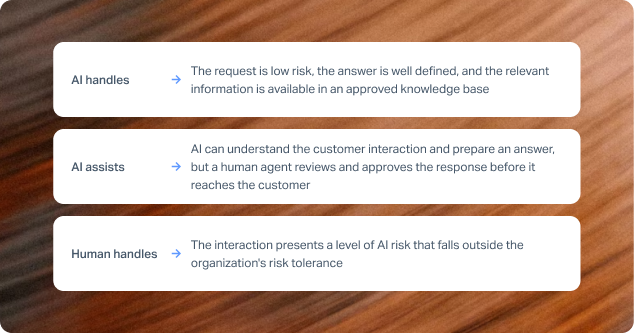
Human oversight should increase with the potential risk of an AI interaction. A practical AI governance framework gives support teams clear rules for when AI can act independently, when a human needs to approve its output, and when an interaction must be transferred to a human agent.
Not every AI use carries the same level of risk. A customer asking for your business hours is very different from someone disputing a charge, sharing sensitive data, or making a complaint that could have regulatory implications. Your AI governance practices should reflect that difference.
One way to structure this is with three levels of AI involvement:
AI handles: The request is low risk, the answer is well defined, and the relevant information is available in an approved knowledge base. AI can resolve the interaction without human intervention.
AI assists: AI can understand the customer interaction and prepare an answer, but a human agent reviews and approves the response before it reaches the customer. This is particularly useful for more complex requests where AI can improve operational efficiency without making the final decision.
Human handles: The interaction presents a level of AI risk that falls outside the organization's risk tolerance. It should be routed to a human agent, with AI potentially continuing to support the agent through summarization, translation, knowledge retrieval, or proposed replies.
This approach creates a clear governance control around AI decisions. Rather than asking whether an AI system is "safe" in general, support leaders can define what responsible AI use looks like for each type of customer interaction.
It also gives teams a way to scale AI adoption without treating every use case as equally suitable for automation. As AI outputs become more reliable and the business gains confidence in a particular use case, its level of automation can be reviewed. Where AI-related risks increase, the level of human oversight can increase with them.
The result is a governance model that supports responsible AI adoption while keeping accountability with the people who own the customer experience.
Use Your Knowledge Base as an AI Governance Control
The information an AI system can access directly affects the quality and risk of its outputs. For customer support teams, an effective AI governance framework should therefore include clear controls over the knowledge AI uses to answer customer interactions.
AI models can generate plausible answers even when they don't have the right information. That makes data quality and knowledge governance particularly important in customer support. If policies are outdated, product information is incomplete, or different sources contain conflicting answers, an AI-powered support system can reproduce those problems at scale.
A governed knowledge base gives AI a defined source of truth. Support leaders can decide which information AI is allowed to use, keep that content current, and establish processes for reviewing changes before they become part of the AI's available knowledge.
This is also where data governance and data protection become part of AI risk management. Teams should understand what customer data an AI system can access, how that data is used, and which information should be subject to strict access controls. Sensitive data shouldn't become available simply because an AI tool can technically retrieve it.
BlueTweak's customer service knowledge base gives teams a central place to manage the information that supports customer interactions. This helps create a more controlled environment for AI deployment, where responses can be grounded in approved business knowledge rather than relying on an AI model to fill gaps itself.
Knowledge governance also needs to continue throughout the AI lifecycle. When products, policies, pricing, or regulatory requirements change, the information available to AI needs to change with them.
That makes the knowledge base more than a content repository. It's one of the governance controls that determines what an AI system can say, which information it can rely on, and how confidently a support team can deploy it.
Monitor AI Outputs and Build Escalation into the AI Lifecycle
AI governance doesn't end when an AI system goes live. Ongoing monitoring is needed to understand whether AI outputs remain accurate, whether customer interactions are producing the intended outcomes, and whether the system is operating within the organization's risk tolerance.
This is particularly important because AI systems operate in changing environments. Customer questions evolve, products change, knowledge bases are updated, and AI models and technologies themselves can change. A response that was appropriate when an AI initiative launched may not remain appropriate months later.
Support teams should therefore establish a review process that looks at more than resolution rates. Useful governance measures can include:
- Accuracy and relevance of AI outputs
- Escalation and handoff rates
- Customer sentiment and customer experience outcomes
- AI interactions that require agent correction
- Recurring knowledge gaps or unsupported questions
- Cases involving sensitive data or potential compliance risks
- Differences in performance across channels, languages, or customer groups
These checks give support leaders evidence for deciding whether to expand, restrict, or redesign a particular AI use case. They also create a feedback loop between day-to-day support operations and the wider AI governance program.
Human handoff is an important part of that loop. When AI can't confidently resolve an interaction, the system should be able to transfer it to a human agent without forcing the customer to start again. A well-designed AI-to-human handoff preserves relevant context so the agent can understand what happened and take over efficiently.
For teams using AI to assist rather than independently resolve conversations, BlueTweak's AI Proposed Reply provides another level of human oversight. AI can prepare a response while the human agent remains responsible for reviewing and sending it.
This creates a continuous governance cycle: define the boundaries, deploy AI with appropriate controls, monitor the outcomes, and adjust those controls as the evidence changes.
That's what makes AI governance practical. It's not a one-time approval before deployment; it's an ongoing process for managing AI risk while ensuring AI initiatives continue to align with business objectives, customer expectations, and responsible AI principles.
Document Your AI Governance Framework and Risk Controls
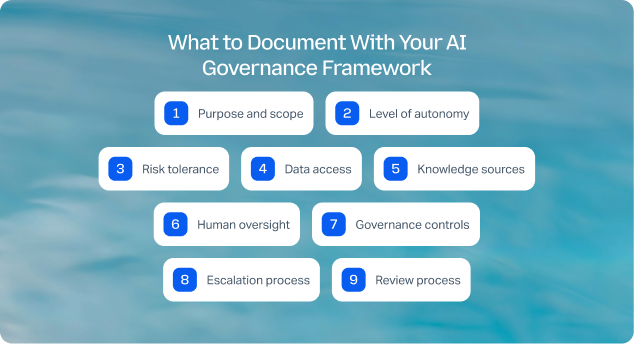
An effective AI governance framework needs to be documented so everyone involved in an AI initiative understands what the system is allowed to do, who is accountable for it, and how AI-related risks are managed.
It doesn't need to be a huge policy document. For customer support teams, the most useful governance framework is one that turns broad AI principles into practical rules for each use case.
For every AI system or AI-powered feature, document:
- Purpose and scope: What is the AI being used for, and which customer interactions does it cover?
- Level of autonomy: Can AI act independently, assist a human agent, or only provide recommendations?
- Risk tolerance: What could go wrong, and how much risk is the organization willing to accept?
- Data access: What customer data can the AI access, and what sensitive data should be restricted?
- Knowledge sources: Which information is the AI permitted to use when generating responses?
- Human oversight: Who reviews AI outputs, handles escalations, and makes decisions when AI can't be trusted to act alone?
- Governance controls: What testing, approval, monitoring, and access controls need to be in place?
- Escalation process: What happens when AI encounters an interaction outside its defined scope?
- Review process: When will the AI use case be reassessed, and who owns that review?
This documentation also helps prevent shadow AI from becoming a governance blind spot. If employees are already using consumer AI tools to summarize customer messages, draft responses, or analyze customer data, those AI systems can introduce risks that sit outside the organization's formal AI governance program.
A documented framework gives business leaders, support leaders, data scientists, and other stakeholders a shared reference point. It also creates a record of how decisions were made throughout the AI lifecycle, from initial evaluation and testing through deployment and ongoing monitoring.
For teams scaling AI adoption, that's important. Governance shouldn't live in one person's head or depend on informal agreements. If you can't clearly explain what an AI system is allowed to do and who is responsible for its outputs, the system isn't fully governed.
Align AI Governance with Compliance and Business Objectives
AI governance and regulatory compliance are closely connected, but compliance shouldn't be the only reason to put governance controls in place. A strong governance approach also helps ensure AI initiatives align with business objectives, customer expectations, and the organization's values.
The regulatory requirements that apply to an AI system will depend on factors such as where the organization operates, what data it processes, and how the AI is used. The EU AI Act, for example, introduces a risk-based approach to regulating AI systems and includes requirements that vary according to the level and type of risk involved.
For customer support teams, this means AI governance should sit alongside existing data protection, security, and compliance processes rather than operating as a completely separate program. Teams should understand which regulatory obligations apply to their AI use, what documentation needs to be maintained, and how changes to AI systems could affect ongoing compliance.
But regulatory compliance is only one part of the picture.
An AI governance program should also ask whether a particular use of AI is actually helping the business achieve its intended outcomes. If an AI agent reduces handling time but produces inaccurate answers, increases escalations, or damages customer sentiment, the initiative isn't delivering a successful outcome simply because the technology works as designed. Transparency, data privacy, and maintaining the right balance between AI and human support are also important parts of the customer experience.
That means support leaders should connect governance decisions to measurable outcomes such as:
- Customer satisfaction and sentiment
- Resolution rates and escalation rates
- Response and handling times
- Accuracy and quality of AI outputs
- Agent productivity and operational efficiency
- Data protection and compliance performance
- Customer and employee trust
This connection makes governance a business discipline rather than a blocker to AI adoption. It gives leaders a way to assess whether AI technologies are delivering value within an acceptable level of risk.
It also creates a stronger foundation for responsible AI adoption. When AI use is evaluated against both regulatory requirements and business objectives, teams can make more informed decisions about where to scale AI, where to introduce additional oversight, and where a human should remain responsible.
Make AI Governance an Ongoing Process, Not a One-Time Approval
AI governance needs to continue throughout the AI lifecycle. Approving an AI system before deployment isn't enough when its data, knowledge, use cases, customer interactions, and underlying AI models can all change over time. That's one reason AI implementation needs to be treated as an ongoing process rather than a one-off technology project.
Ongoing monitoring gives support teams a way to identify emerging AI risk before it becomes a larger customer or compliance problem. It also helps organizations understand whether their governance practices are producing the intended AI outcomes.
A practical review cycle might include:
Before deployment: Test the AI against approved use cases, knowledge sources, brand voice, edge cases, and escalation rules. Confirm that the appropriate governance controls are in place before customers interact with it.
After deployment: Monitor AI outputs, customer sentiment, escalation patterns, agent corrections, and other relevant performance measures. Look for recurring errors or interactions that consistently fall outside the AI's capabilities.
When something changes: Reassess the governance framework when you introduce a new AI tool, change the knowledge base, expand the AI's scope, alter data access, or make significant changes to the underlying technology.
At regular intervals: Review whether the AI system is still operating within the organization's risk tolerance and whether its use continues to support business objectives and regulatory obligations.
This is especially important as organizations scale AI. An approach that works for one AI use case may not be enough when an organization introduces multiple AI platforms, AI agents, or AI initiatives across different customer-facing teams.
Effective AI governance therefore needs clear ownership. Someone should be responsible for reviewing performance, managing risk, maintaining technical documentation, coordinating compliance requirements, and deciding when governance controls need to change.
That doesn't mean creating a new layer of bureaucracy around every AI tool. It means establishing enough oversight to understand how AI is being used, what it's producing, and whether those outcomes remain acceptable.
For support leaders, this creates a sustainable approach to AI adoption. Rather than approving AI once and hoping it continues to behave as expected, teams can use ongoing monitoring and human oversight to keep AI aligned with their standards as customer interactions, business requirements, and AI technologies evolve.
How BlueTweak Supports AI Governance in Customer Support
BlueTweak gives support teams control over how AI is used across customer interactions, so they can increase automation without giving up oversight. Its tiered approach allows organizations to decide where AI can act independently, where it should assist human agents, and where human intervention is required.
This makes the platform's AI capabilities part of the governance model itself.
Teams can establish the appropriate level of AI use for different request types, then apply the controls needed for each level. AI can handle straightforward interactions where the knowledge and outcome are well defined, while more complex requests can be routed through human oversight.
The approach also supports several of the core governance controls discussed throughout this guide:
Controlled knowledge: AI responses can be grounded in the organization's approved customer service knowledge, helping ensure AI outputs are based on information the business has chosen to make available.
Human oversight: Teams can keep human agents responsible for interactions that require judgment, review, or a higher level of risk management. BlueTweak's Proposed Reply capability, for example, allows AI to assist with responses while the agent retains control over the final message.
Quality assurance: AI interactions can be reviewed alongside broader customer service performance, helping teams identify errors, recurring issues, and opportunities to improve their governance controls. BlueTweak's customer service quality assurance capabilities support this ongoing review.
Human handoff: When an interaction falls outside AI's defined scope, customers can be transferred to a human agent rather than being forced through an automated process. This makes escalation part of the system rather than an afterthought.
Ongoing visibility: Support leaders can use performance data to understand how AI is affecting customer interactions and outcomes, giving them evidence to adjust AI use as requirements change.
The important point is that responsible AI isn't achieved by adding a governance policy around an otherwise unrestricted AI system. The controls need to be reflected in how the AI is configured, what information it can access, when it can act, and what happens when it reaches its limits. That's the role BlueTweak's tiered approach is designed to support.
Ready to put responsible AI governance into practice? Try BlueTweak free for 14 days , no credit card required.
Build AI Governance into Every Stage of AI Adoption
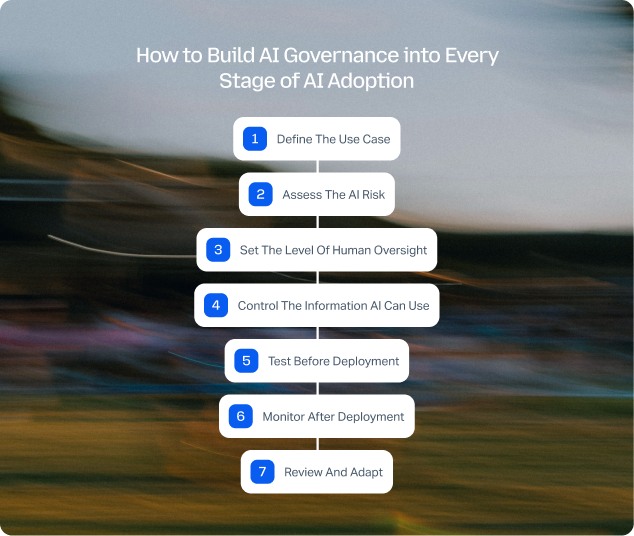
AI governance works best when it's treated as part of the AI lifecycle rather than a final approval step. Support teams can use the following framework to keep governance connected to each stage of an AI initiative.
1. Define the Use Case
Start with the customer problem you're trying to solve. Define the intended AI use, the customer interactions involved, and the business objectives you're trying to achieve.
2. Assess the AI Risk
Consider the potential impact if the AI produces an inaccurate, inappropriate, or incomplete response. Identify sensitive data, regulatory requirements, and customer interactions that may require additional controls.
3. Set the Level of Human Oversight
Decide whether AI can handle the interaction independently, assist a human agent, or hand the interaction directly to a person. Match the level of oversight to your risk tolerance.
4. Control the Information AI Can Use
Make sure the AI has access to accurate, relevant, and approved knowledge. Review data access and establish appropriate data protection and access controls.
5. Test Before Deployment
Validate AI outputs against real-world scenarios, including edge cases. Check accuracy, brand voice, escalation behavior, and compliance requirements before exposing customers to the system.
6. Monitor After Deployment
Track AI outputs, customer sentiment, resolution rates, escalations, agent corrections, and other relevant outcomes. Use these insights to identify AI-related risks and opportunities to improve.
7. Review and Adapt
AI governance isn't static. Reassess the use case when the AI system, underlying technology, knowledge, data access, regulations, or business requirements change.
This approach helps support leaders move from simply experimenting with AI tools to deploying AI responsibly at scale. It also gives business leaders a clearer way to decide which AI initiatives are ready to expand and which need stronger governance controls first.
AI Governance Makes Customer Support AI More Scalable
AI governance in customer support isn't about putting unnecessary restrictions around AI. It's about creating enough structure to know where AI adds value, where it introduces risk, and where human judgment still matters.
The most effective AI governance frameworks combine clear boundaries, approved knowledge, human oversight, risk management, ongoing monitoring, and defined accountability. These AI governance best practices give support leaders a way to scale AI adoption while protecting customer experience, meeting AI compliance requirements, and maintaining control over AI outcomes.
BlueTweak's tiered approach puts those principles into practice. By deciding what AI can handle, what requires human involvement, and how AI performance is monitored, support teams can make automation a controlled part of their customer experience strategy. That can help organizations move beyond experimentation and build AI capabilities that support long-term business objectives and create competitive advantage without taking unnecessary risks.
The more AI you introduce into customer support, the more important it becomes to know exactly where its responsibility ends.
If you're exploring how to introduce AI into customer support responsibly, book a demo with BlueTweak to see how its tiered approach can help your team scale automation with the right level of control.

As Head of Digital Transformation, Radu looks over multiple departments across the company, providing visibility over what happens in product, and what are the needs of customers. With more than 8 years in the Technology era, and part of BlueTweak since the beginning, Radu shifted from a developer (addressing end-customer needs) to a more business oriented role, to have an influence and touch base with people who use the actual technology.



